The Lobster That Conquered China: How OpenClaw Became the Biggest AI Story of 2026
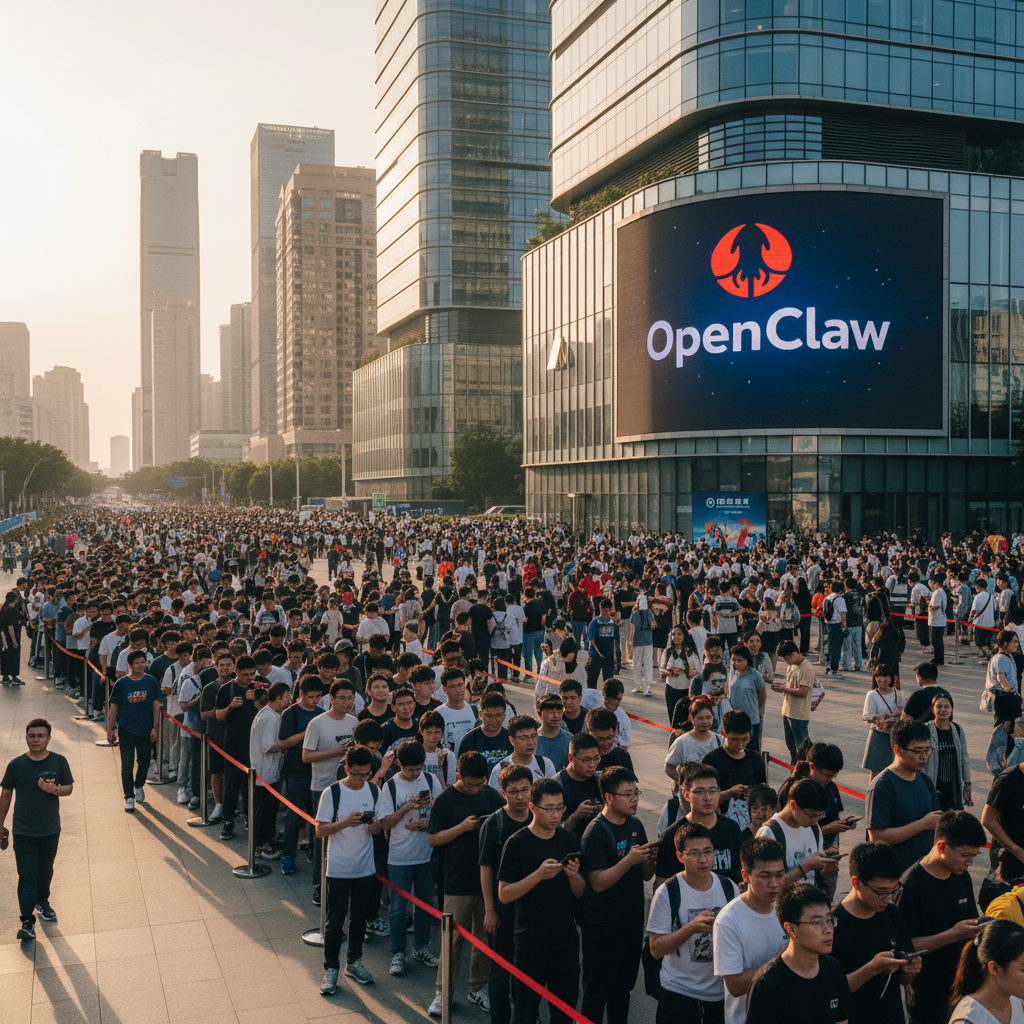
On March 6, nearly a thousand people lined up outside Tencent’s headquarters in Shenzhen. Some carried NAS drives. Others brought MacBooks. A few showed up with mini PCs under their arms. They were waiting for Tencent Cloud engineers to install a piece of free software onto their devices.
The software is called OpenClaw. Within 100 days of its release, it became the most-starred repository in GitHub history — surpassing even Linux. China-based usage has already surpassed the United States. And on Monday, Nvidia CEO Jensen Huang called it „the most important release of software, probably ever.“
This is the story of how an open-source AI agent built by an Austrian programmer became the catalyst for the biggest shift in China’s AI ecosystem since DeepSeek.
What OpenClaw Actually Is
OpenClaw is not a chatbot. It’s not a language model. It’s an AI agent framework — an infrastructure layer that connects any large language model to your computer and your apps, then executes tasks autonomously.
Where ChatGPT answers your questions, OpenClaw does your work. It can send emails, manage files, browse the web, book reservations, write and execute code, control smart home devices — all running locally on your machine, 24 hours a day, without human oversight.
The project was created by Peter Steinberger, an Austrian software developer and former founder of PSPDFKit. He built the first prototype in under an hour in November 2025 using what he describes as „vibe coding“ with Claude AI. The tool operates through familiar messaging apps — WhatsApp, Telegram, Slack, WeChat — so interacting with your AI agent feels like texting a colleague.
It’s completely open-source under the MIT license. Bring your own API key for any model — Claude, GPT, DeepSeek, Qwen, or local models via Ollama — and OpenClaw handles the rest.
By February 2026, the project had surpassed 200,000 GitHub stars. Steinberger was hired by OpenAI. And then China happened.
Why China Went Wild for the Lobster
OpenClaw’s red lobster mascot earned it the Chinese nickname „raising a lobster“ (养龙虾). But the mania goes far beyond cute branding. China adopted OpenClaw faster and more intensely than any other country for structural reasons.
The super-app culture is a perfect fit. Chinese users are already accustomed to doing everything inside one interface — WeChat handles messaging, payments, shopping, government services. An AI agent that connects to everything and works through chat apps isn’t alien in China. It’s the logical next step.
Chinese open-source models are cheaper. Every running OpenClaw instance generates hundreds of API calls per day. The cost advantage of Chinese models — DeepSeek, Qwen, Kimi, MiniMax — makes them natural fits for this consumption pattern. On OpenRouter, the top three tools used by OpenClaw users in the past month were all from Chinese companies, with combined usage double that of Google and Anthropic models.
The government sees strategic value. Local governments are actively subsidizing OpenClaw adoption. Shenzhen’s Longgang district has proposed up to 10 million yuan ($1.4 million) in equity financing for „one-person companies“ — startups where a single founder uses AI agents to automate all operational functions. Hefei’s high-tech zone offers similar incentives.
Tech giants smell opportunity. Every installed OpenClaw instance is a revenue stream for cloud and model providers. That’s why Tencent engineers were setting up folding tables outside headquarters to help strangers install free software.
The Corporate Land Grab
Within weeks, every major Chinese tech company launched its own OpenClaw integration:
Tencent became an official OpenClaw sponsor on March 16, providing free deployment servers across 17 Chinese cities. Tencent integrated OpenClaw into WeChat Work and QQ, and launched its own „lobster special forces“ suite. This came after a public dispute — Tencent’s SkillHub platform had scraped over 13,000 skills from OpenClaw’s ClawHub marketplace without permission, pushing Steinberger’s server costs into five digits. The conflict was resolved when Tencent formalized its sponsorship.
Baidu unveiled a full family of „lobsters“ on March 17: DuMate (desktop assistant), RedClaw (mobile platform), and DuClaw (cloud deployment service). Baidu’s smart-device unit Xiaodu announced that its speakers will integrate OpenClaw capabilities. At a public installation event at Baidu’s Beijing headquarters on March 11, hundreds queued for hours.
ByteDance’s cloud unit Volcano Engine launched ArkClaw, a browser-based OpenClaw variant that eliminates the need for local installation.
Alibaba Cloud offers one-click OpenClaw deployment on its infrastructure.
MiniMax launched MaxClaw. Moonshot AI released Kimi Claw. SenseTime integrated its „Office Raccoon“ assistant with OpenClaw.
Even JD.com got involved, offering a 399 yuan ($58) service where Lenovo technicians remotely install OpenClaw on users‘ devices.
The stock market reacted accordingly. MiniMax shares rose 27.4% in a single weekend after its OpenClaw integration. Its market cap briefly exceeded Baidu’s — despite Baidu generating 230 times more revenue. Zhipu AI surged 14%.
The „One-Person Company“ Phenomenon
OpenClaw is spawning a new business model in China: the „one-person company“ (一人公司). The concept: a single founder uses AI agents to automate marketing, finance, customer support, and administration — functions that previously required a team.
„Human employees need rest, but OpenClaw can run 24/7,“ explains Wang Xiaoyan, who is using the tool to launch her own business.
The Chinese government is actively encouraging this. Shenzhen and Hefei both offer financing for OPC founders building on OpenClaw. As one consultant put it: „China is turning an open-source tool into national productivity infrastructure at a speed no other country is matching.“
This aligns perfectly with the 15th Five-Year Plan (2026–2030), passed on March 14, which mentions AI over 50 times and includes an „AI+ action plan“ aimed at integrating AI agents across all industries. For the first time, „embodied intelligence“ — AI-powered robotics — appears as a distinct strategic priority.
The Security Problem No One Wants to Talk About
There’s a dark side to the lobster craze. OpenClaw has full operating-system-level access: it can read files, execute commands, access email, SSH keys, and OAuth tokens. This makes it extraordinarily useful — and extraordinarily dangerous.
Supply chain attacks. On February 13, researchers discovered 341 compromised „skills“ (plugins) in ClawHub, OpenClaw’s marketplace. Malicious skills disguised themselves as legitimate tools — one posed as a research assistant while secretly downloading malware. Subsequent analysis identified over 800 infected skills, roughly 20% of the entire registry.
Prompt injection. OpenClaw doesn’t sanitize web content before passing it to the language model. A webpage containing hidden instructions can cause the agent to execute them as if they were user commands. Security researcher Simon Willison described OpenClaw’s architecture as a „lethal trifecta“: access to private data, exposure to untrusted content, and ability to take real-world actions.
Government pushback. Chinese authorities have begun issuing warnings about security and data risks. State media has published cautionary articles. Government agencies and companies in sensitive sectors like banking have been instructed to restrict OpenClaw usage.
Nvidia’s response. At GTC on March 16, Nvidia announced NemoClaw — essentially OpenClaw with enterprise-grade security. The platform uses „OpenShell“ to isolate agents in secure sandboxes, preventing them from accessing restricted data. Jensen Huang framed it as essential infrastructure: „For the CEOs, the question is: what’s your OpenClaw strategy?“
What This Means for Europe
For European observers, the OpenClaw phenomenon reveals several important dynamics:
1. China’s adoption speed is unmatched. From zero to national infrastructure in 100 days. Government subsidies, corporate integration events, consumer adoption — all happening simultaneously. Europe’s deliberative approach to AI adoption looks glacial by comparison.
2. Open source is the engine. OpenClaw is MIT-licensed. The Chinese models powering it are Apache 2.0 or MIT. The entire AI agent revolution is built on open-source foundations. Europe benefits from this — any European developer can deploy OpenClaw with Chinese models today.
3. The agentic shift changes everything. The move from „AI that talks“ to „AI that acts“ is the most significant transition in AI since ChatGPT. China is the first country to adopt it at scale. European companies that wait too long to understand agentic AI will find themselves playing catch-up.
4. Security is the unsolved problem. OpenClaw’s security issues aren’t China-specific — they’re architectural. Any European company deploying AI agents needs to grapple with the same prompt injection, supply chain, and data access risks. Learning from China’s rapid deployment (and its mistakes) is valuable.
5. The „one-person company“ model is coming to Europe too. The idea of AI-augmented solopreneurship isn’t uniquely Chinese. European founders, freelancers, and small businesses should be watching how this model evolves in China — it’s a preview of what’s possible when AI agents handle operational overhead.
The Bigger Picture
OpenClaw represents the convergence of several trends we’ve been tracking at Inside China AI:
The open-source dominance of Chinese models finds its ultimate expression in OpenClaw — cheaper models mean more API calls, which means OpenClaw runs better and cheaper on Chinese AI infrastructure.
The super-app culture that made Alibaba’s Qwen-as-shopping-interface possible is the same culture that makes AI agents feel natural to Chinese users.
The government-industry coordination visible in the AI Plus Initiative shows up here too — state subsidies for OpenClaw adoption are industrial policy in real time.
And the security vs. speed tension that defines Chinese AI regulation is playing out in miniature: the same government that’s subsidizing OpenClaw deployment is also warning about its risks.
This is China’s AI ecosystem in 2026: fast, open, government-supported, occasionally chaotic, and undeniably consequential. OpenClaw is the story that ties it all together.
—
*This is the first article from Inside China AI. We publish neutral, analytical coverage of China’s AI ecosystem from a European perspective — three times a week, plus a Sunday newsletter.*
*Subscribe: insidechinaai.com/newsletter*
*Follow: @InsideChinaAI on X and LinkedIn*
*Sources: CNBC, Fortune, Bloomberg, Caixin Global, TechNode, Pandaily, KDnuggets, DigitalOcean, Neurohive, TechCrunch, SecurityScorecard, Malay Mail, WinBuzzer. All figures based on published reports as of March 18, 2026.*
No responses yet