
Illustration: AI-generated · Inside China AI
China’s AI Just Raised Prices — and It’s Still Winning the Price War
Bloomberg asked this week how long America’s AI giants can fend off Chinese platforms that are “cheaper and almost as capable.” The question is well-timed — but it misses the most revealing data point of the month. On August 16, DeepSeek raised its API prices, in some configurations by up to twelve times, introducing peak and off-peak billing. And after that increase, its frontier model still costs five to twenty-five times less than comparable US APIs. China’s AI price war is ending. China’s AI cost advantage is not. Those are two different things, and the difference is what European decision-makers need to understand.

The actual numbers
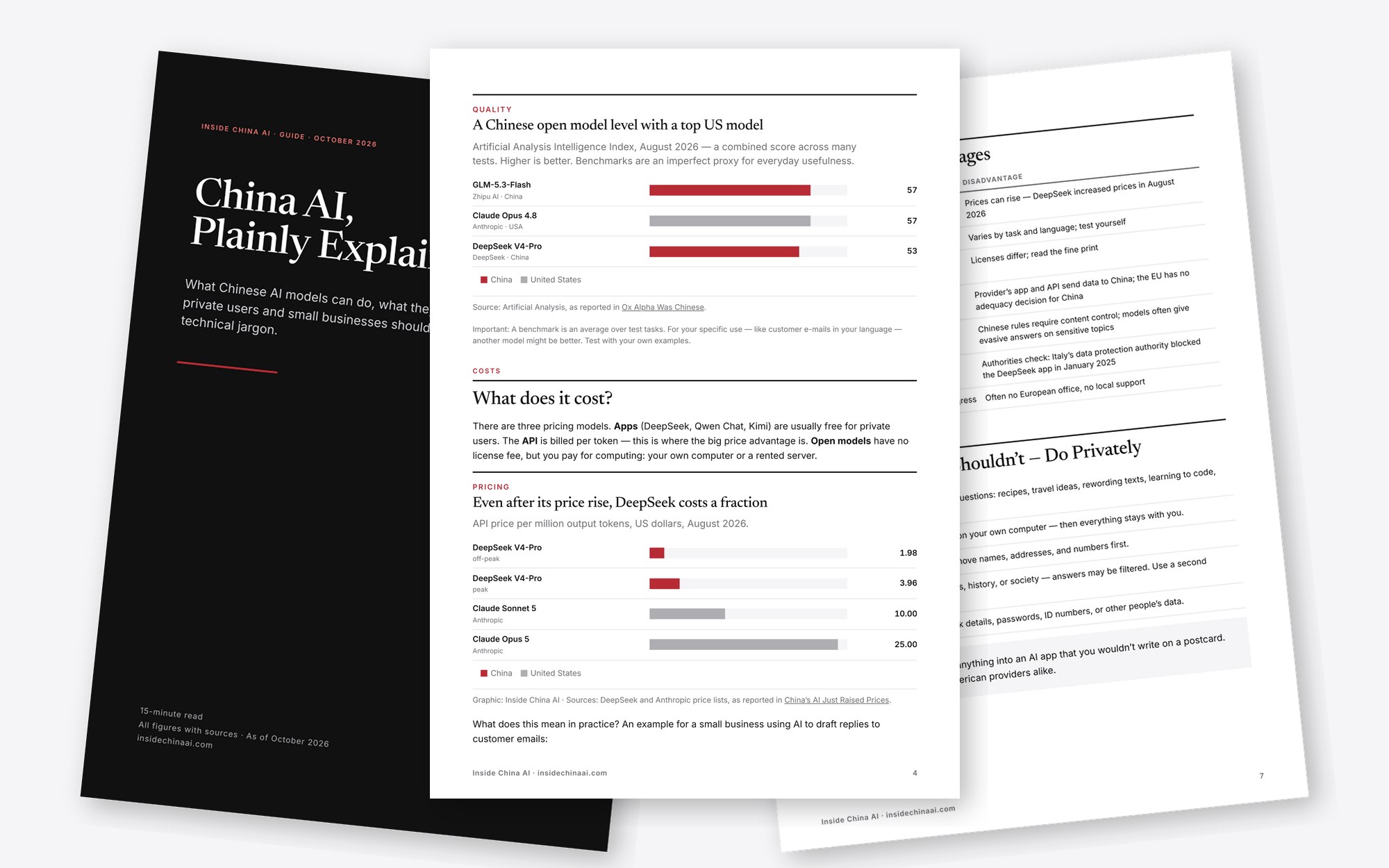
DeepSeek’s V4-Pro now charges $0.66 per million input tokens and $1.98 per million output tokens off-peak ($1.32 and $3.96 at peak) — up from a flat $0.87 output price before the change. Compare the US frontier: Anthropic’s Claude Sonnet 5 costs $2 and $10, Opus 5 runs $5 and $25, and the top-tier models sit higher still. At launch, DeepSeek marketed V4-Pro as roughly 46 times cheaper than Claude with a single-digit performance gap; even after the increase, the output-token gap to a comparable US tier remains five-fold to twelve-fold, depending on tier and time of day. Meanwhile, benchmark tests increasingly put Alibaba’s Qwen 3.8 and DeepSeek V4 in the same conversation as GPT-5.6 — and Qwen now claims parity with Claude on unsupervised agentic work.
Why a price hike is a show of strength
Companies in price wars do not raise prices. DeepSeek’s move signals the opposite of retreat: demand exceeding capacity — much of it running on domestic silicon, as we detailed in our analysis of China’s chip decoupling — and enough confidence in the performance gap to stop subsidising every token. The structural cost advantage stays: mixture-of-experts architectures pioneered at scale by Chinese labs, cheaper domestic accelerators, and an ecosystem that treats efficiency as the core discipline rather than an afterthought. Capital markets have noticed — JPMorgan raised its targets for the listed AI labs Zhipu and MiniMax this week, a sign that “cheap” no longer means “unprofitable.”
The flank Bloomberg’s question ignores
The API price comparison actually understates the pressure, because China’s second weapon costs nothing at all. Qwen’s open-weight models have passed three billion cumulative downloads, released under Apache 2.0; Xiaomi open-sourced MiMo-Embodied; DeepSeek publishes its weights. Even if Chinese API prices converged with American ones tomorrow, any enterprise can download the weights and run them on its own infrastructure — which is precisely what companies from Shenzhen to Stuttgart are quietly doing. Apple now lets Mac users in China connect to Qwen. The US giants’ moat assumes the toll bridge is the only way across the river. Open weights are the ford.
Why it matters for Europe
For European CIOs, the emerging picture is neither “buy American” nor “buy Chinese” — it is that AI inference is becoming a commodity with a structural low-cost producer, and procurement should be built accordingly. Three practical consequences: first, multi-model architectures beat single-vendor loyalty, because the price-performance frontier now moves monthly. Second, the open-weight route (Qwen, DeepSeek, MiMo on European infrastructure) deserves a serious total-cost calculation — it can address both the cost question and the data-sovereignty concerns that keep European legal teams up at night, though AI Act compliance duties apply either way. Third, the assumption baked into many European AI budgets — that frontier capability costs frontier prices — is now a choice, not a law of nature. The companies that notice first will out-iterate the ones that do not.

No responses yet