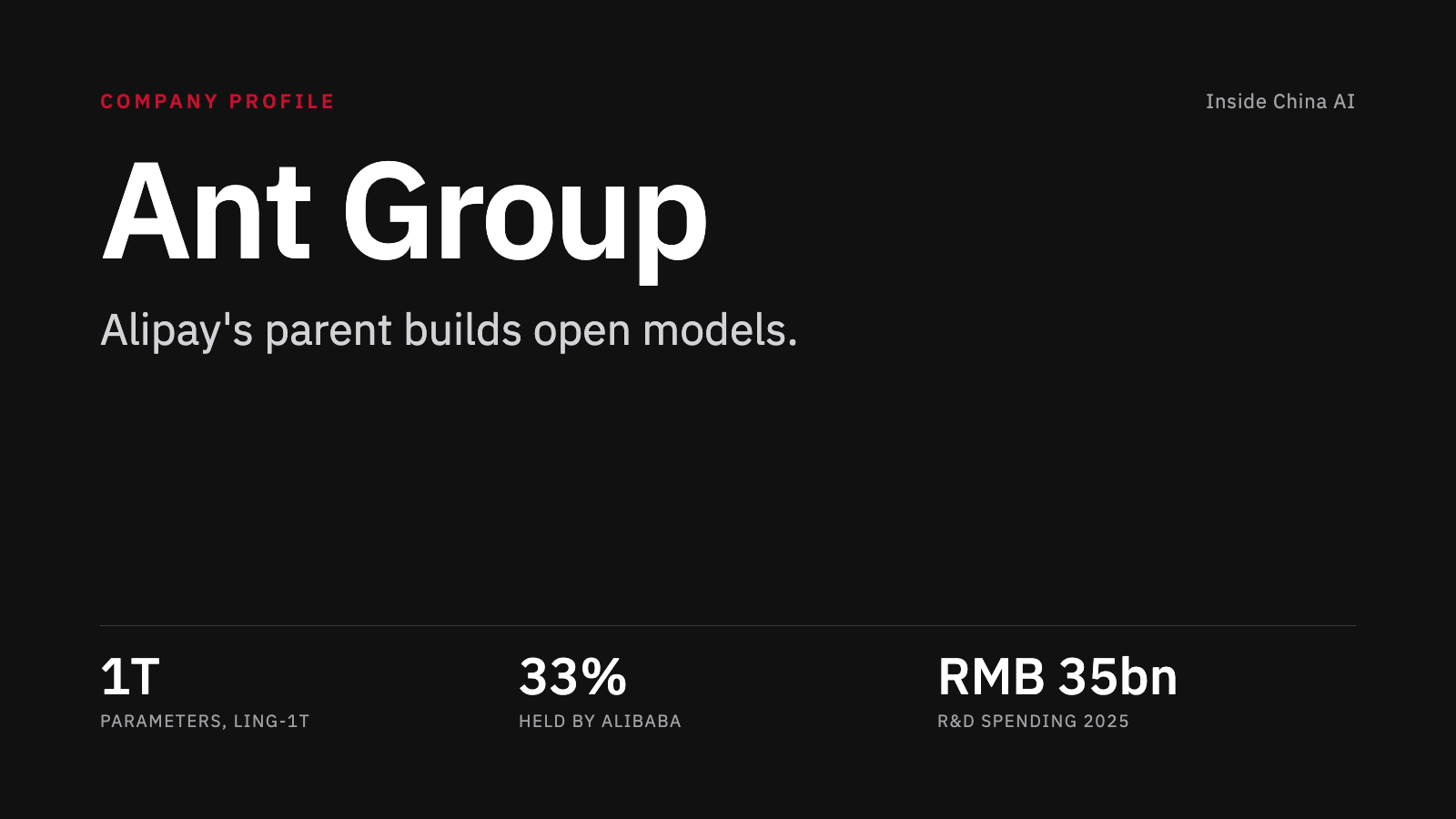
Graphic: Inside China AI
Ant Group: Alipay’s Parent Builds Open AI Models — and Documents Them for the EU AI Act
Company profile · 20 November 2026.
Ant Group, the Hangzhou company behind Alipay, also builds large open-weight AI models: its Ling and Ring families include several trillion-parameter models released under the MIT licence. For its main models it publishes training-data summaries on the EU AI Act’s template. Europe meets Ant in two ways. Developers can download its models, and European merchants deal with the international payments business. Since 2024 that business has been run by Ant International, a separate company whose subsidiaries hold e-money licences in Luxembourg, the United Kingdom and the Netherlands.
Origins and backing
Ant traces its roots to Alipay, the escrow service that Alibaba’s Taobao introduced in 2003 and that was formally established in December 2004. Ant Financial was set up in October 2014 and renamed Ant Group Co., Ltd. in July 2020 (Ant Group). Eric Jing is chairman; Cyril Han, previously president and chief financial officer, became chief executive on 1 March 2025 (Yicai). Both still held these roles on 11 November 2026 (Ant Group).
Ant is not listed. Its planned dual listing in Shanghai and Hong Kong was halted on 3 November 2020, two days before trading was to begin. Regulators had summoned Ant’s “ultimate controller”, its chairman and its chief executive, and the Shanghai Stock Exchange ruled that the company “may no longer meet the conditions for offering and listing” (Shanghai Stock Exchange). An overhaul ordered by the regulators followed. In January 2023 founder Jack Ma gave up control; by Reuters’ calculation his voting rights fell to about 6.2 per cent (CNBC). In July 2023 regulators led by the central bank fined Ant 7.12 billion yuan, about $984 million (Reuters via Insurance Journal). Days later Ant offered to buy back up to 7.6 per cent of its shares at a valuation of about 567.1 billion yuan, roughly $78.5 billion (Alibaba filing).
Alibaba is a major shareholder. It states: “As of March 31, 2026, our equity interest in Ant Group on a fully diluted basis was 33%.” Ant does not publish its own results. Alibaba’s share of Ant’s profit fell from 12.6 billion yuan in the year to March 2025 to 5.0 billion yuan in the year to March 2026. Alibaba attributes the fall to Ant’s spending on “new growth initiatives, including user growth, and technologies” (Alibaba annual report 2026). Ant itself says it spent 35.03 billion yuan on research and development in 2025 (Ant Group).
What they build
Alipay remains the core in China, alongside the wealth platform Ant Fortune and the consumer-credit services Huabei and Jiebei. Ant also builds infrastructure software such as the OceanBase database and AntChain (Ant Group). Its AI work is grouped under the “Ant Ling AI Model Family”, which the company says targets “healthcare, financial services, and everyday services” (Ant Group).
Ant releases its open models under the Hugging Face name inclusionAI, in three lines: Ling for general language tasks, Ring for reasoning and Ming for speech, images and other modalities. Ling-1T, released in October 2025, has one trillion parameters, of which about 50 billion are active per token, and was pre-trained on more than 20 trillion tokens (model card). Trillion-parameter versions followed in 2026: Ling-2.5 and Ring-2.5 in February, Ling-2.6 and Ring-2.6 in April and May (inclusionAI on Hugging Face). The latest open flagship, Ling-3.1-flash, has 560 billion parameters (25 billion active) and a one-million-token context. Its weights went public on Hugging Face in mid-October 2026 under the MIT licence (model card).
Ant has also worked on training with cheaper hardware. In a March 2025 technical report, its Ling team wrote that a 300-billion-parameter model “can be effectively trained on lower-performance devices”, cutting computing costs by “approximately 20%” (arXiv). The paper does not name the chips; it lists the accelerators it used only by the letters A to E. Bloomberg, citing anonymous people familiar with the matter, reported that they included Chinese chips from Alibaba and Huawei (Bloomberg). Ant has not confirmed this, and we found no statement on which chips were used for the newer Ling models.
The consumer products are Chinese. LingGuang, a multimodal assistant launched in November 2025, builds small apps from a prompt. Version 2.0, released on 27 October 2026, keeps working on tasks after the chat ends: with the user’s permission it can check Alipay bills for forgotten subscriptions or track flight prices. It is “rolling out in China” (Ant Group). AQ, a health app launched in June 2025 and called Ant A-Fu (阿福) in Chinese, had 15 million monthly users in December 2025, the company said (FF News). In September 2026 the company reported 150 million cumulative app users, a different measure (36Kr). Inside Alipay, the agent Ah Bao, launched in June 2026, orders coffee, pays bills and books services. The company says it is integrated with five smartphone brands and 16 carmakers (Ant Group). A robotics unit, Robbyant, released the weights of a touch model for robot hands on 10 November 2026 (TechNode).
Key numbers
- Founded Alipay December 2004; Ant Financial October 2014; Ant Group since July 2020. Headquarters Hangzhou
- Leadership Eric Jing (chairman), Cyril Han (CEO since 1 March 2025)
- Ownership Not listed; Alibaba holds 33 per cent (fully diluted, 31 March 2026). IPO halted November 2020
- Valuation About 567.1 billion yuan (~$78.5 billion) in the July 2023 share buyback; no newer official figure
- Profit Not published; Alibaba’s share of Ant’s profit 5.0 billion yuan in the year to March 2026, down from 12.6 billion
- R&D 35.03 billion yuan in 2025, the company says
- Models Ling, Ring, Ming (open weights, MIT); Ling-1T (1 trillion parameters), Ling-3.1-flash (560 billion)
- AI products LingGuang, AQ (Ant A-Fu), Alipay agent Ah Bao, agent platform Tbox
The European angle
- Offices Ant Group’s own list names six European offices: London, Luxembourg, Amsterdam, Milan, Paris and Munich (Ant Group). It does not say which company sits at each address. The London, Luxembourg and Amsterdam addresses are the registered addresses of Ant International’s licensed companies listed below.
- Payments, run by Ant International The international payments business (Alipay+, Antom, WorldFirst) was spun out as Ant International, based in Singapore, which “began independent operation in 2024”, the company says. In July 2026 it raised about $1.2 billion; “existing investors including Ant Group and Alibaba Group” took part (Ant International via The Asian Banker). How much of it Ant Group owns is not published. Its licensed companies in Europe include Alipay (Europe) Limited S.A., an e-money institution supervised by Luxembourg’s CSSF, whose annual accounts for 2024 name “Ant International (Cayman) Holding Limited” as ultimate parent (annual accounts, via the German Bundestag lobby register); World First UK Ltd, authorised by the FCA (WorldFirst); and World First Netherlands B.V., licensed by De Nederlandsche Bank (WorldFirst). On 16 September 2025 Alipay (Europe) also received a licence to issue e-money tokens under the EU’s MiCA rules, which could allow a regulated euro stablecoin (Paperjam). We found no such token on the market.
- Supervisory record On 19 May 2025 the CSSF fined Alipay (Europe) 214,000 euros for anti-money-laundering failings found in an inspection in 2023 and 2024. In six cases involving counterfeit goods, suspicious transactions had not been reported. The regulator noted that the company cooperated fully and took corrective measures (CSSF).
- Partners The European payment provider Viva.com switched on Alipay+ in all 24 European markets it serves in September 2024, letting merchants accept payments from 15 e-wallets used mainly by visitors from Asia (The Fintech Times). On 11 November 2026 Ant Group renewed its UEFA partnership for UEFA EURO 2028 and extended it to Ant International (Ant Group).
- AI and the AI Act Ant publishes training-content summaries for its main Ling, Ring and Ming models, organised on the public template for Article 53(1)(d) of the EU AI Act; it adds that the documents are not a certification (inclusionAI). For Ling-3.1-flash, the summary names Ant Intelligence (Hang Zhou) Technology Co., Ltd as the provider and gives 14 October 2026 as the date the model was placed on the EU market. It declares more than 10 trillion tokens of text and a crawler called “Ant Spider”; the company says its collection is checked against robots.txt. It also states that data from users of the model or of the provider’s other services was not used for training. The entry for an EU authorised representative reads “Not Applicable” (summary). The AI Act waives the representative requirement for models released under a free and open-source licence, unless they present systemic risks (Article 54(6)); we have not assessed how the Ling models are classified. Ant has not signed the EU’s Code of Practice for general-purpose AI. As of the list’s update on 7 October 2026, no Chinese lab had (European Commission).
- How Europeans reach the models The Ling weights can be downloaded and run anywhere. On OpenRouter, Ling-3.1-flash is served by Novita, and a newer Ling 3.2 Flash, listed since 13 November 2026 without published weights, is served by a provider listed as “Ant Digital” (OpenRouter). LingGuang, AQ and Ah Bao are not offered in Europe.
- Lists Ant Group is not on the US Entity List or the Pentagon’s 1260H list of Chinese military companies, nor on the EU’s financial sanctions list, according to our check of the published lists in November 2026. Its 33 per cent shareholder Alibaba was added to the 1260H list on 8 June 2026 (Fortune). The list is not a sanction, but it restricts Pentagon contracts with listed companies; Alibaba is challenging its listing in court (Reuters via The Standard).
- What a European buyer would actually encounter Open models under the MIT licence, with published EU training-data summaries. On the payments side, licensed and supervised European companies that belong to Ant International, not to Ant Group.
What we could not verify
- Ant Group’s own revenue and profit. Only Alibaba’s share is published.
- How much of Ant International Ant Group still owns, and which company runs the Milan, Paris and Munich offices.
- Which chips trained the current Ling models.
- Whether a euro stablecoin from Luxembourg will launch, after Beijing reportedly told Ant in October 2025 to pause its Hong Kong stablecoin plans (Reuters via Yahoo Finance, citing the FT).
- Ling 3.2 Flash: listed on OpenRouter, but no weights or licence found.
The open question for Europe: will Ant’s open models, already documented under the AI Act, find European enterprise users? And will its AI assistants follow Alipay into Europe?
No responses yet