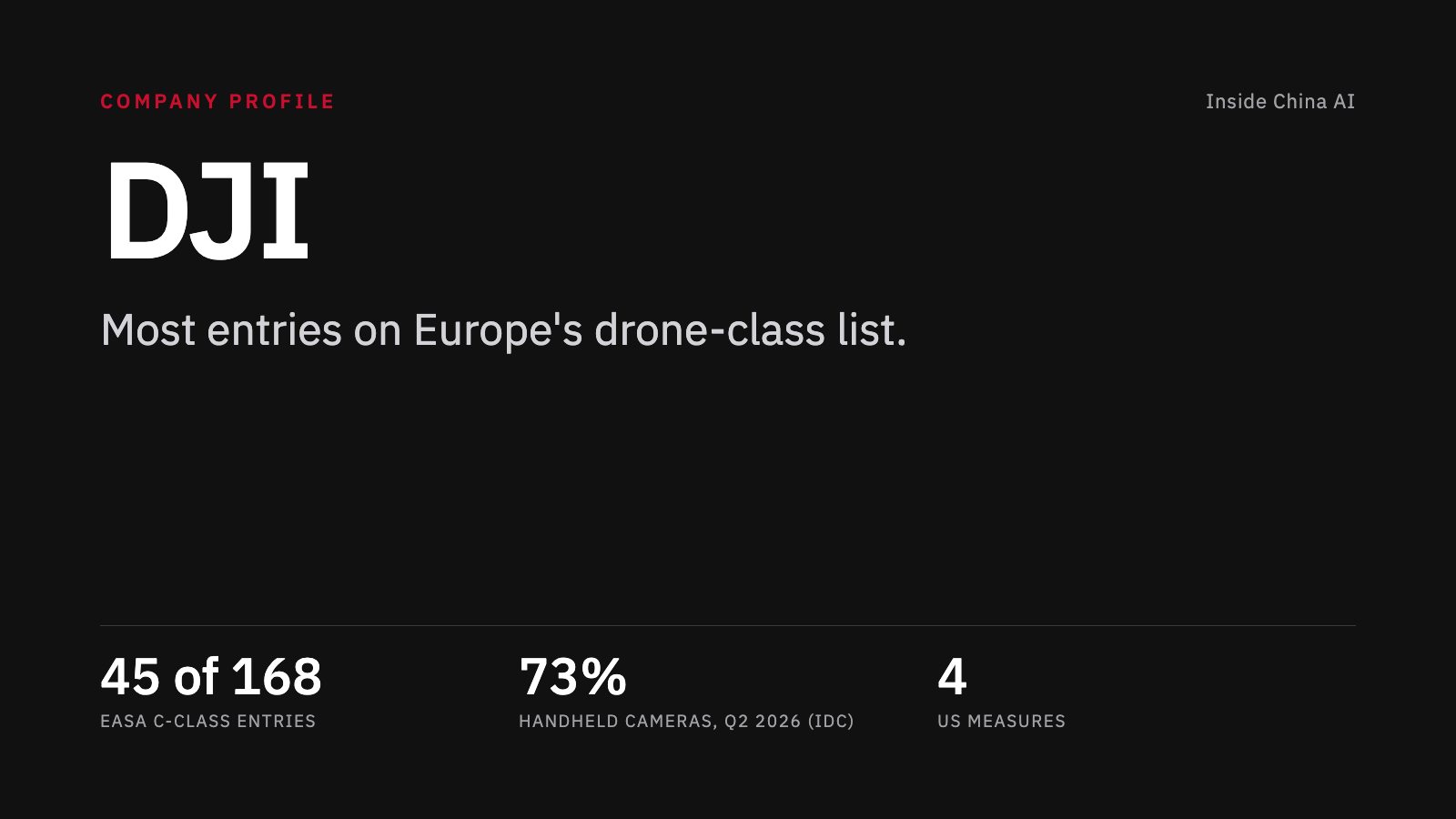
Graphic: Inside China AI
DJI: Most Entries on Europe’s Drone-Class List, Four Measures in Washington
Company profile · 20 November 2026.
DJI is the Shenzhen company whose camera drones, gimbals and action cameras use on-board AI to sense obstacles and follow their subjects. In Europe it is the manufacturer with by far the most entries on the aviation safety agency’s list of drones with an EU class mark. In the United States it is on the Commerce Department’s Entity List, the Treasury’s investment-ban list and the Pentagon’s list of “Chinese military companies”, and since December 2025 the FCC has barred new authorisations for foreign-made drones, DJI’s included. For European buyers, police forces and inspection firms, the question is not whether DJI products work here – they are certified – but how long the US measures stay an American matter.
Origins and backing
DJI says it has grown “from a single small office in 2006 to a global workforce” and is headquartered in Shenzhen (DJI). The operating company is SZ DJI Technology Co., Ltd. (DJI privacy policy); a US appeals court describes it, together with its subsidiary SZ DJI Baiwang Technology, as a maker of “consumer and commercial drones” whose customers “range from governments to businesses to hobbyists” (D.C. Circuit, 14 August 2026). Its founder is Frank Wang, whom the Hong Kong University of Science and Technology described as “the Founder and CEO of DJI” when it gave him its Distinguished Engineering Alumni Award in January 2026 (HKUST).
DJI is not listed on any stock exchange and calls itself “a privately owned and operated company” (DJI). It publishes no revenue, profit or headcount, and we found no confirmed valuation. The state’s role is contested: the US Defense Department argues that DJI benefits from “tax breaks, free cash subsidies, and financial support from state-owned capital funds” through its 2021 recognition as a National Enterprise Technology Center, a claim the appeals court quotes from the department’s report of 6 December 2024 (D.C. Circuit).
DJI’s car-technology unit became a separate company, Zhuoyu Technology (卓驭科技), in 2023. In September 2025 the state-owned carmaker FAW moved to take 35.8 per cent and become its largest shareholder, with the DJI-linked holder dropping to 34.9 per cent (Caixin). Zhuoyu has its own entry in our directory.
Entity List (export control). The Commerce Department added DJI with effect from 18 December 2020. Its reason covers four companies jointly – AGCU Scientech, China National Scientific Instruments and Materials, DJI and Kuang-Chi Group – which it said “have enabled wide-scale human rights abuses within China through abusive genetic collection and analysis or high-technology surveillance, and/or facilitated the export of items by China that aid repressive regimes around the world”. Exports to DJI of items subject to US export rules require a licence, with a presumption of denial except for items needed to detect and treat infectious disease (Federal Register).
NS-CMIC list (investment ban). The Treasury identified SZ DJI Technology on 16 December 2021 as one of eight Chinese technology firms in the “Chinese military-industrial complex”, stating that DJI “has provided drones to the Xinjiang Public Security Bureau, which are used to surveil Uyghurs in Xinjiang”. US persons may not buy or sell publicly traded securities linked to listed firms (US Treasury); the listing took effect on 14 February 2022 (OFAC).
Section 1260H list (Pentagon, not a sanction). The Defense Department has listed DJI as a “Chinese military company” since October 2022, most recently in a list published on 10 June 2026 that says DJI is “directly affiliated with” China’s industry ministry and the People’s Armed Police; the court noted that it was “unclear whether” the new reasons in that list “are factually supported” (D.C. Circuit). DJI sued in October 2024. On 14 August 2026 the Court of Appeals for the D.C. Circuit rejected three of DJI’s four arguments but reversed the lower court on one finding – that DJI “contributes” to China’s defence industrial base – because the Pentagon’s explanation had been fully redacted. It sent that question back to the district court, which may now examine the classified record. DJI remains on the list (D.C. Circuit).
FCC Covered List. The defence law for fiscal 2025 named equipment “produced by Shenzhen Da-Jiang Innovations Sciences and Technologies Company Limited” and required the FCC to add it to its Covered List if no security agency ruled on it within a year (Public Law 118-159, section 1709). On 22 December 2025 the FCC added all foreign-produced drones and drone components, plus the equipment named in that section, citing a national security determination by an interagency body convened by the White House; covered equipment can no longer receive new US equipment authorisations (FCC). DJI challenged the listing in the Ninth Circuit on 20 February 2026, arguing that the FCC “exceeded its statutory authority” (DroneLife). That case has been paused since 28 May 2026 while the FCC considers DJI’s petition for reconsideration; on 2 November DJI asked the court to order the FCC to rule, and on 9 November the FCC and the Justice Department asked for the February case to be dismissed (DroneXL).
What they build
DJI makes camera drones for consumers and professionals, handheld gimbals and cameras, and enterprise and agricultural drones. It does not publish AI models; its AI sits inside the hardware, in perception and tracking. The Mini 5 Pro has “nightscape omnidirectional obstacle sensing” and “upgraded ActiveTrack 360°”, the company says (DJI); the Mavic 4 Pro pairs a 100-megapixel Hasselblad camera with “0.1-Lux Nightscape Omnidirectional Obstacle Sensing” (DJI). The Osmo Pocket 3 camera uses “ActiveTrack 6.0” (DJI), and the tracking module of the RS 5 camera gimbal follows a person at up to 10 metres and can reacquire them if they leave the frame, according to the company (DJI).
For industrial users DJI sells Manifold 3, an on-board computer for its Matrice 400 and Matrice 4 drones with up to 100 TOPS of computing power that “accelerate[s] algorithm models” on a GPU and a deep-learning accelerator, the company says (DJI Enterprise). Its agricultural Agras T100 carries up to 100 kg (DJI Agriculture). Away from drones, DJI won an IFA Innovation Award for its ROMO 2 series of robot vacuums at the Berlin trade fair in September 2026 (DJI).
In handheld smart cameras, DJI accounted for 73 per cent of global shipments in the second quarter of 2026, according to the market researcher IDC as reported by TechNode (TechNode). For drones we found no market-share figure from DJI or a market researcher.
Key numbers
- Founded 2006, Shenzhen (DJI)
- Ownership Private, not listed; revenue not disclosed
- Handheld cameras 73% of global shipments, Q2 2026 (IDC via TechNode)
- EU class marks 45 of 168 entries on EASA’s list of drones with a C-class mark name DJI GmbH as design organisation, as of 20 November 2026 (EASA)
- US measures Entity List since 18 December 2020; Treasury NS-CMIC list since 16 December 2021; Pentagon 1260H list since October 2022, most recently June 2026; FCC Covered List since 22 December 2025
The European angle
- Physical presence Yes. DJI GmbH, Industriestr. 12, 97618 Niederlauer (Bavaria), is the data controller for users in the European Economic Area (DJI privacy policy) and DJI’s contact address for requests under the EU Data Act (DJI terms). DJI also lists an office in the Netherlands (DJI); we could not confirm a Dutch company.
- Certification Under the EU drone regulation 2019/945, drones carry class marks C0 to C6. On 18 August 2022 DJI announced that it had received the world’s first C1 EU-type examination certificate, for the Mavic 3 series, from the notified body TÜV Rheinland (DJI). On 20 November 2026, DJI GmbH was the design organisation for 45 of the 168 entries on EASA’s list, from the Mini 5 Pro and Neo 2 (C0, the Mini 5 Pro also C1) to Matrice enterprise drones with C5 and C6 marks for standard scenarios. The next-largest entry holder had 14. EASA notes that the list relies on manufacturers’ voluntary information and may be incomplete (EASA).
- Customers DJI names European users itself: ski patrol teams at Val Thorens in France use a DJI Dock 3 for rescue work (DJI Europe, 3 June 2026), and Spain’s Guardia Civil “used DJI Dock 3 and the Matrice 4D Series for motorsport event security”, the company says (DJI Enterprise).
- Data For EEA users, DJI says it “may transfer your personal data outside of EEA for storage and processing” (DJI privacy policy, updated 1 March 2025).
- Russia and Ukraine On 27 April 2022 DJI temporarily suspended all business in Russia and Ukraine, saying it was “internally reassessing compliance requirements in various jurisdictions” (Al Jazeera).
- EU measures We found no EU sanction or EU-level restriction naming DJI. DJI does not appear on the EU’s consolidated financial sanctions list (version of 23 October 2026).
- What a European buyer would actually encounter Certified drones sold across Europe, a German company as the data controller – and a supplier that US law has largely closed to new products, which matters for anyone working with American partners or US-origin components.
What we could not verify
- Revenue, profit, headcount and valuation – DJI publishes none, and the figures circulating in the press are unconfirmed.
- Shareholders and the size of any state-linked stakes, from a primary document.
- A Dutch DJI company behind the office DJI lists in the Netherlands.
- European customers confirmed by the customers themselves rather than by DJI.
- The district court’s review of the classified record after the D.C. Circuit ruling of 14 August 2026, and the Ninth Circuit’s decision on the FCC’s motion to dismiss.
The open question for Europe: if Washington’s view of DJI hardens further, will European regulators and public buyers follow – or keep treating certification as the test that counts?
No responses yet