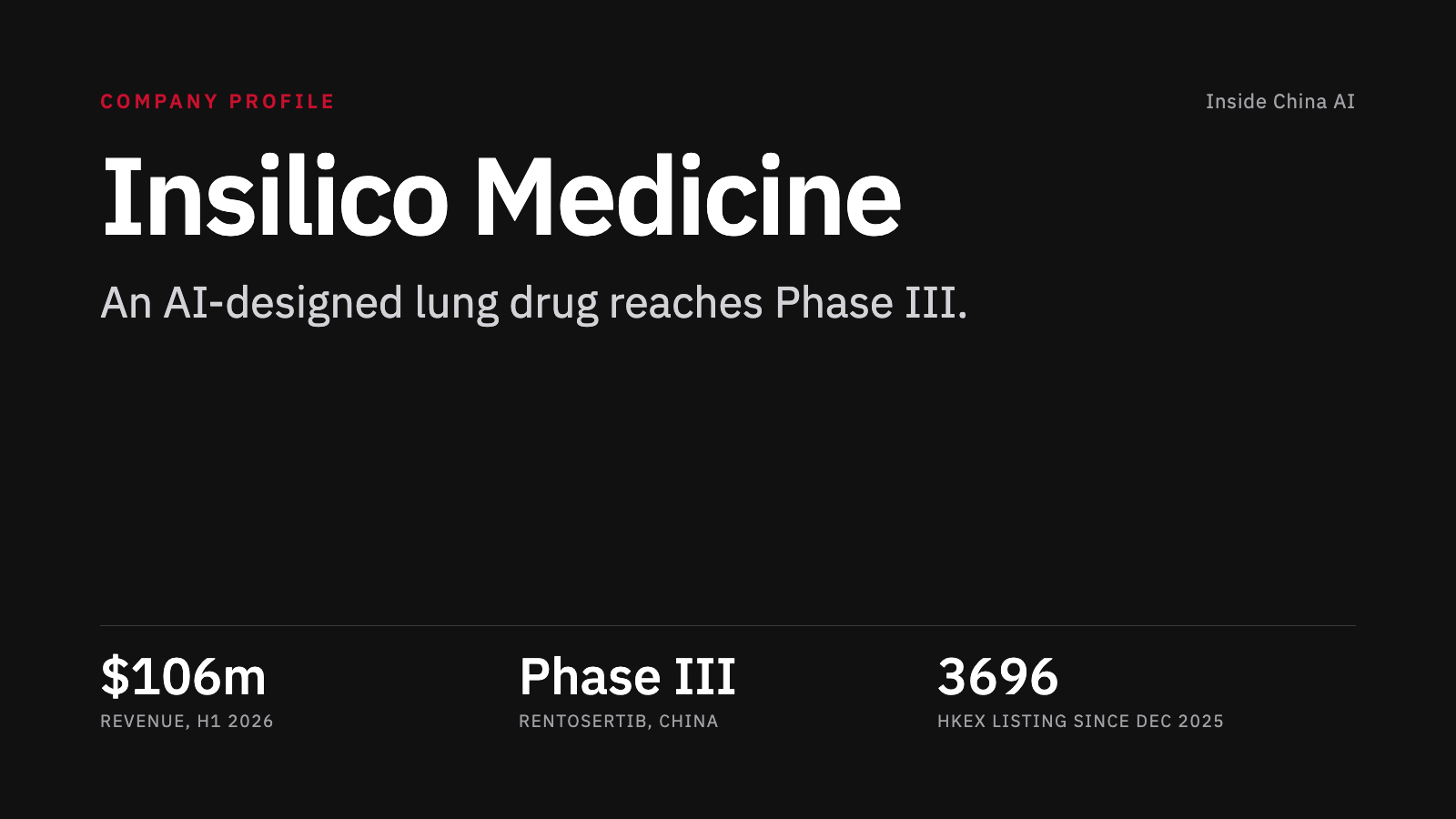
Graphic: Inside China AI
Insilico Medicine: An AI-Designed Lung Drug Reaches Phase III, With Europe’s Drugmakers Among Its Clients
Company profile · 20 November 2026.
Insilico Medicine uses generative AI to find disease targets and design drug molecules, then licenses many of them to large pharmaceutical companies. Its lead drug, rentosertib for the lung disease idiopathic pulmonary fibrosis, entered a Phase III trial in China in 2026, and the company says it was found and designed with AI. For Europe, Insilico is already a supplier: France’s Servier and Italy’s Menarini have signed deals with it, and two molecules it designed are in early trials at Spanish hospitals. Europeans should also understand what kind of company Insilico is. Its holding company is in the Cayman Islands, it is listed in Hong Kong, its press releases come from Cambridge, Massachusetts, and most of its fixed assets are in mainland China.
Origins and backing
Insilico (英矽智能) was founded in 2014 by Alex Zhavoronkov, according to the company (Insilico media kit). It started out as an American company: according to its listing prospectus, the group began operating through Insilico Inc., incorporated in Delaware on 10 February 2014, and the current holding company was set up in the Cayman Islands in November 2018 (HKEX prospectus). The listed parent, InSilico Medicine Cayman TopCo, has its registered office in the Cayman Islands. The address it gives as its principal place of business in Hong Kong is in the Hong Kong Science Park (HKEX interim report 2026). The company itself names Boston and Hong Kong as its headquarters, with offices and labs in Montreal, Shanghai, Yixing and Abu Dhabi and an automated robotics lab in Suzhou (Insilico media kit).
Insilico calls itself a global company. Its filings show a centre of gravity in mainland China: on 30 June 2026, $16.9 million of its $18.6 million in non-current assets were located there, and its bank borrowings were in renminbi (HKEX interim report 2026). Its research centre in Shanghai’s Pudong district dates from June 2019, and Shanghai’s Pudong Venture Capital and the Wuxi municipal government were among the investors in its Series E round in January 2025 (Yicai Global). Zhavoronkov told the SCMP in December 2025: “If you are not in China, you are not relevant” (SCMP via Yahoo Finance). Its paying customers, though, are mostly American. In the first half of 2026, $95.9 million of its $106.3 million in revenue came from clients in the United States (HKEX interim report 2026).
The company is run by two chief executives. Zhavoronkov, registered as Aleksandrs Zavoronkovs, is founder, chairman, CEO and chief business officer. Feng Ren (任峰) is CEO and chief scientific officer (HKEX interim report 2026). Insilico listed on the Hong Kong Stock Exchange’s Main Board on 30 December 2025. It qualified under the exchange’s market-value and revenue test (Rule 8.05(3)), not under Chapter 18A for pre-revenue biotech companies (HKEX prospectus). It sold 94,690,500 shares at HK$24.05, for gross proceeds of HK$2.28 billion before the over-allotment option (HKEX allotment results). After the option was exercised in full, net proceeds came to HK$2.35 billion (HKEX interim report 2026). The Hong Kong retail tranche was 1,427 times subscribed. Cornerstone investors included Eli Lilly, Tencent, Oaktree and Schroders (HKEX allotment results). On 30 June 2026 the largest disclosed shareholders were funds managed by Warburg Pincus, with 8.05 per cent, and Temasek, with 5.19 per cent (HKEX interim report 2026).
What they build
Insilico’s software platform, Pharma.AI, has four parts. Biology42 includes PandaOmics, which finds targets. Chemistry42 generates molecules. Medicine42 includes inClinico, which predicts how clinical trials will turn out. Science42 is the fourth part (HKEX interim report 2026). The company says it has produced 33 preclinical candidates with the platform and that it takes 12 to 18 months to get from a target to a candidate, against an industry average of 4.5 years. Selling software is a small business for Insilico: subscriptions brought in $2.7 million in the first half of 2026. Most of its money comes from licensing out drug programmes and from research collaborations (HKEX interim report 2026).
The test case is rentosertib, formerly ISM001-055 or INS018_055. It is an oral drug for idiopathic pulmonary fibrosis that blocks an enzyme called TNIK. The company says PandaOmics picked TNIK as the target and Chemistry42 designed the molecule (Insilico). Insilico described the route from discovery to the clinic in Nature Biotechnology in March 2024. A Phase IIa trial in China, sponsored by Insilico, tested the drug in 71 patients at 22 sites for 12 weeks, with 17 or 18 patients per group (NCT05938920). The results, written up by the trial doctors and Insilico staff, appeared in Nature Medicine on 3 June 2025. The trial’s primary goal was to show the drug is safe and tolerable. Side effects were about as common in the drug groups as on placebo; the most common reasons for stopping treatment were liver toxicity and diarrhoea. In the highest-dose group, lung capacity (forced vital capacity) rose by an average of 98.4 mL, while it fell by 20.3 mL in the placebo group (Nature Medicine). That is an early signal from a small safety trial run by the company, not proof that the drug works.
Insilico announced the Phase III trial on 7 July 2026. It is randomised, double-blind and placebo-controlled, and is meant to enrol 320 patients for 52 weeks. All 47 sites are in China. The leading principal investigator is from Peking Union Medical College Hospital in Beijing; the co-leads include the president of Shanghai Pulmonary Hospital (Insilico). According to the US trial registry, the study started on 9 September 2026 and its primary completion is estimated for October 2029 (NCT07687459). We found no approval of rentosertib anywhere. A smaller Phase IIa in the United States (NCT05975983) is still listed as recruiting, but its record was last updated in November 2025, and Insilico says it has put its US application to test oral rentosertib (IND) on inactive status because of changes in its research strategy (HKEX interim report 2026). Insilico also sponsors early trials of other molecules in China, the US, Australia and the United Arab Emirates (ClinicalTrials.gov).
The licensing deals are where the money comes from. In March 2026 Eli Lilly took an exclusive worldwide licence to preclinical oral programmes, with $115 million upfront and a potential total of about $2.75 billion (Insilico). Earlier, Exelixis licensed a USP1 inhibitor for $80 million upfront in 2023 (Insilico media kit). In July 2026 Insilico signed a collaboration with Takeda that brought about $60 million in project initiation fees, near-term payments and milestones (HKEX interim report 2026). The company puts the total contract value of its significant deals since 2021 at about $11 billion. Those headline values include milestone payments that are only due if the programmes succeed.
Key numbers
- Listing HKEX Main Board (3696) since 30 December 2025; offer price HK$24.05; net proceeds HK$2.35 billion (interim report)
- Revenue $106.3 million in H1 2026, up from $27.5 million, “mainly driven by upfront payments”; 97 per cent from drug discovery and pipeline deals (interim report)
- Profit $35.5 million in H1 2026, after a $19.2 million loss a year earlier; accumulated losses of about $997 million on 30 June 2026 (interim report)
- Cash $357.6 million in bank balances and cash, plus $109.0 million in term deposits and $118.3 million in short-term financial assets on 30 June 2026 (interim report); on 3 September 2026 it added US$305 million in zero-coupon convertible bonds due 2027, net proceeds about US$301.6 million (HKEX announcement)
- People 333 employees and consultants on 30 June 2026 (interim report)
- Lead drug Rentosertib, Phase III in China since September 2026, 320 patients planned (NCT07687459)
The European angle
- Customers French drugmaker Servier signed a multi-year oncology collaboration in January 2026, valued at up to $888 million, with up to $32 million in upfront and near-term payments. Servier shares the research costs and leads clinical development and commercialisation (Insilico via BioSpace; Caixin). On 20 October 2026 Insilico reported reaching the first research milestone, which triggers a payment from Servier of an undisclosed amount (HKEX announcement). Separately, the interim report shows $2.6 million of revenue from clients located in France in the first half of 2026, without naming them. Small amounts came from Denmark, Sweden, the UK and other European countries (interim report).
- Licensed drugs Italy’s Menarini Group (Menarini) licensed a KAT6 inhibitor, now MEN2312, in January 2024. In January 2025 its US subsidiary Stemline Therapeutics licensed a KIF18A inhibitor, now MEN2501. Insilico says the combined value of the agreements exceeds $550 million and that it has received milestone payments of $3 million (July 2025) and $5 million (February 2026) (Insilico).
- Trial sites Both Menarini molecules are in Phase I trials run by Stemline with sites in Spain, including hospitals in Madrid, Barcelona, Pamplona, Valencia and Santiago de Compostela (NCT06638307; NCT07226427). We found no European site in the trials Insilico sponsors itself, including those for rentosertib.
- Physical presence We found no European office or subsidiary. Insilico’s own list of locations covers North America, Hong Kong, mainland China and Abu Dhabi (Insilico media kit). The subsidiaries named in its prospectus are in the US, Canada, Hong Kong, mainland China, Taiwan, the UAE and the Cayman Islands (HKEX prospectus).
- Lists We found no entry for Insilico on the US Consolidated Screening List, which includes the Entity List, or on the Pentagon’s Section 1260H list (checked 20 November 2026), and no name match on the EU’s consolidated sanctions list (checked 15 November 2026).
- What a European partner would actually encounter An AI drug-discovery supplier listed in Hong Kong, whose fixed assets are mostly in mainland China and whose customers are mostly American. In Europe it does business through licensing deals with established drugmakers, not through offices of its own.
What we could not verify
- Which French client accounts for Insilico’s revenue in France. The filing does not name it.
- Whether the Sanofi collaboration from 2022 is still active. The prospectus of December 2025 still describes it and lists $0.5 million of revenue from it in the first half of 2025; the 2026 interim report does not mention it.
- Results or formal end of the US Phase IIa trial of rentosertib. Its registry entry has not been updated since November 2025, although Insilico has put the US application on inactive status.
- How Insilico’s staff are split between countries. The interim report gives only a total.
The open question for Europe: will the Phase III trial in China be enough for regulators elsewhere, or will rentosertib need trials in Europe before it can reach patients here?
No responses yet