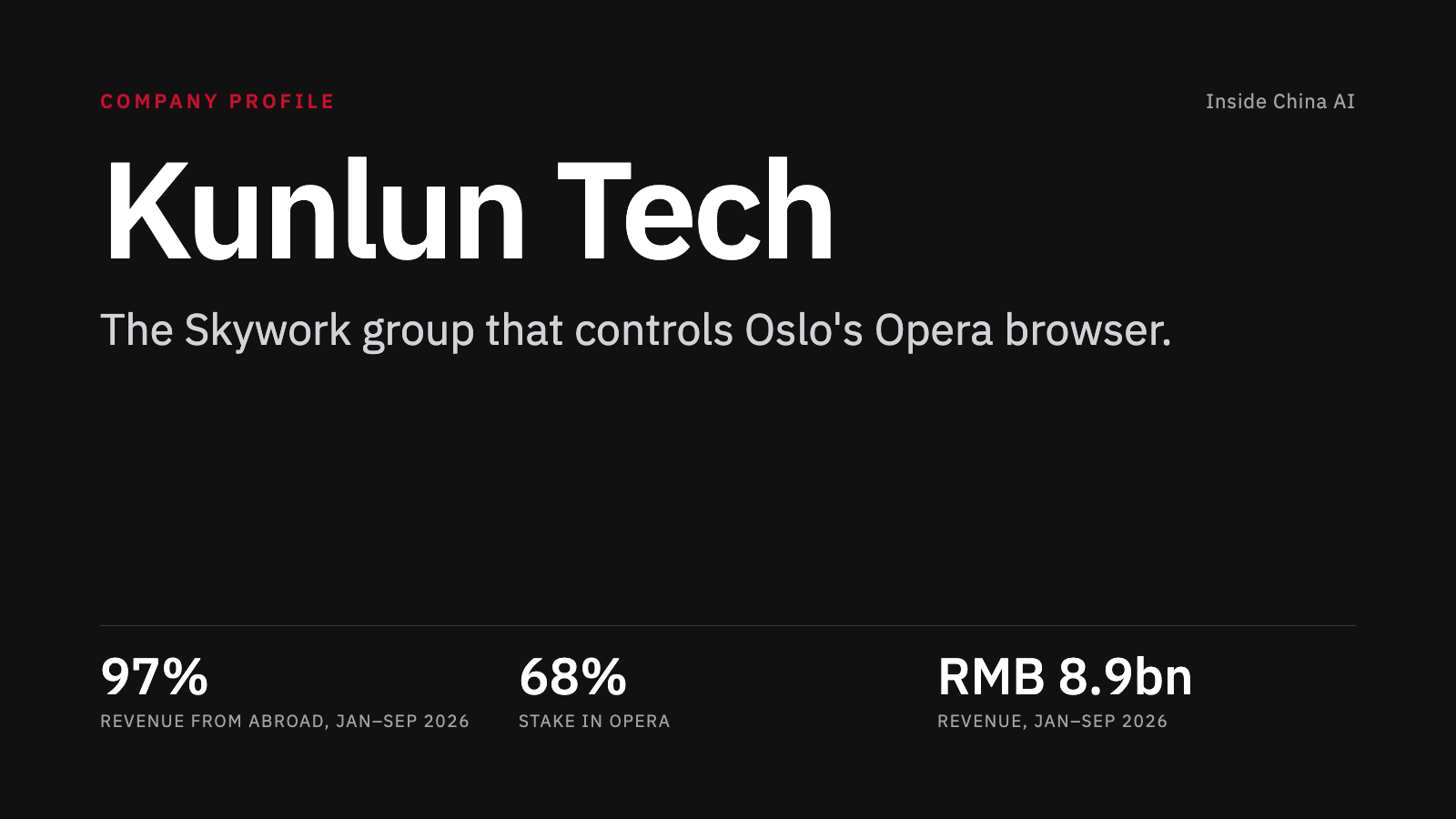
Graphic: Inside China AI
Kunlun Tech: The Skywork Group That Controls Oslo’s Opera Browser
Company profile · 20 November 2026.
Kunlun Tech is a Beijing company listed in Shenzhen that builds the Skywork AI models and agents, the Mureka music generator and AI short-drama apps, and earns almost all of its revenue outside China. It also owns about 68 per cent of Opera, the browser company headquartered in Oslo, and consolidates it in its accounts. For Europe, that makes Kunlun unusual among Chinese AI groups: through Opera, it already runs companies, development teams and data centres in Europe, including a GPU cluster in Iceland that Opera calls the basis of its AI services. Skywork itself, by contrast, has no European entity we could find.
Origins and backing
Kunlun (昆仑万维) was founded in 2008 as a games publisher and listed on Shenzhen’s ChiNext board on 21 January 2015, stock code 300418 (Kunlun). Its founder, Zhou Yahui, remains the actual controller (H1 2026 report): on 30 September 2026 he held 11.29 per cent directly and his concerted party, Beijing Yingrui Shiji Software R&D Centre, held 14.77 per cent (Q3 2026 report). Zhou left Kunlun’s board when a new board was elected on 10 July 2026; his shares are locked until 9 January 2027 (Q3 2026 report). The same day the new board elected Fang Han chairman and appointed him general manager (Kunlun, Kunlun).
The AI business sits in Skywork AI Inc., a Cayman Islands holding company that Kunlun owned 70.58 per cent of on 30 June 2026; its Singapore company Skywork AI Pte. Ltd. runs music, games, short-drama and AI businesses (H1 2026 report). Kunlun has also moved two AI ventures partly out of the group in 2026. Its AI-chip company Aijie Kexin (艾捷科芯) took in new investors, including China’s National AI Industry Investment Fund, at a post-money valuation above RMB 4 billion; Kunlun lost control, keeps 48.65 per cent and booked investment income of about RMB 1.48 billion. Its robotics unit Riemann Dynamics is now 50 per cent owned (H1 2026 report).
Opera came in stages. In 2016 a Chinese consortium led by Golden Brick Silk Road, which included Kunlun and Qihoo 360, bought Opera’s browser business for $600 million (AFP via VnExpress); Opera listed on Nasdaq in 2018 (Opera). On 23 October 2020 Kunlun’s Hong Kong unit agreed to buy a further 8.47 per cent of Opera from Keeneyes Future Holding Inc. for $80.1 million (SEC filing). Kunlun has owned foreign consumer apps before: in March 2020, after the US Committee on Foreign Investment set a June 2020 deadline, it agreed to sell its stake in the dating app Grindr for about $608.5 million (CNBC).
What they build
Kunlun calls its plan a “4+3 strategy”: four model lines — video, music and audio, game world models, and base text and multimodal models — feeding three platforms for AI short dramas, music and games (Q3 2026 report). The money comes from the platforms. DramaWave (paid) and FreeReels (free) stream short dramas abroad; in September 2026, the company says, they billed nearly $100 million in a month, and more than 95 per cent of new DramaWave episodes were AI-generated (Q3 2026 report). Mureka generates songs; Skywork Super Agents produces documents, slides, spreadsheets and videos, and since July 2026 works inside Slack, Lark, DingTalk, Discord and Telegram (H1 2026 report).
The models are a mix of open and closed. Open weights, on Hugging Face, include the Skywork-R1V3-38B reasoning model (MIT licence, built on OpenGVLab’s InternVL), the MindLink and Skywork-SWE models, and the Matrix-Game world models; Matrix-Game 4.0, released in October 2026 under Apache 2.0, has 5 billion parameters per scene and is built on Alibaba’s Wan2.2 video model (model card). Kunlun says it runs at 60 frames a second on a single consumer graphics card (Q3 2026 report); the model card itself guarantees no frame rate. The SkyReels video models come under a Skywork Community License that allows commercial use and asks users not to deploy them “for internet services without appropriate security reviews and records” (licence). The newest flagships — the SkyReels-V4 video model, the SkyClaw agent model with a one-million-token context, and Mureka V9.5 and O3 — are offered as products or via API; we found no published weights for them.
Opera is the other half of the group. Inside Kunlun’s reports it is now the “AI Agent browser platform” (Q3 2026 report). Its agentic browser Neon gives users models from other providers — the FAQ lists Gemini, GPT, Claude, Grok, DeepSeek, GLM-5 and Qwen3, not Skywork (Opera). We found no Skywork model in an Opera product.
Key numbers
- Listing Shenzhen ChiNext, 300418, since January 2015; controlling shareholder Zhou Yahui with his concerted party (26.06 per cent combined on 30 September 2026; Q3 2026 report)
- Revenue RMB 8.94 billion in January–September 2026, up 54 per cent; RMB 3.58 billion in the third quarter (Q3 2026 report)
- Profit Third-quarter net loss attributable to shareholders of RMB 1.09 billion. For January–September Kunlun reports a net profit of RMB 2.6 million, which includes RMB 1.55 billion in non-recurring gains; excluding these, the nine months show a loss of RMB 1.55 billion (Q3 2026 report). The largest such gain, RMB 1.48 billion, came from losing control of the chip unit (H1 2026 report)
- Where the money comes from Overseas revenue RMB 8.71 billion, about 97 per cent of the total; “Tiangong AI” (Skywork) revenue RMB 4.32 billion, up 168 per cent; selling expenses RMB 5.82 billion, up 101 per cent on the same period of 2025, which Kunlun attributes to marketing and channel fees (Q3 2026 report)
- Opera About 68 per cent owned; third-quarter 2026 revenue $182.8 million, up 20 per cent, net income $27.6 million, 279 million average monthly users (Opera)
- Open models R1V3, MindLink, Skywork-SWE, Reward-V2, UniPic, Matrix-Game (MIT, Apache 2.0 or base-model licences); SkyReels under Skywork’s own licence (Hugging Face)
The European angle
- Control of Opera Opera’s annual report says Kunlun “indirectly owns approximately 68.0% of our outstanding ordinary shares” and that Opera is “therefore a consolidated subsidiary of Kunlun”; it qualifies as a “controlled company” under Nasdaq rules (Opera 20-F). Kunlun’s own filing puts the stake at 67.90 per cent on 30 June 2026 (H1 2026 report). Zhou Yahui has been Opera’s executive chairman since he handed the chief executive role to Lin Song on 10 October 2025 (RTTNews); the annual report names him as executive chairman and “a controlling shareholder of Kunlun”. Under an agreement of 24 March 2026, Kunlun sells Opera shares to Opera each quarter in proportion to Opera’s buybacks of its shares on the market (SEC filing).
- Companies in Europe Kunlun’s half-year report lists Opera companies in Oslo (Opera Norway AS and two further entities), Linköping, Wrocław (two), Dublin (two), Amsterdam, Barcelona, Scotland (YoYo Games) and Reykjavík (Opera Hosting Iceland), each held at 67.90 per cent. Opera Norway reported revenue of RMB 1.18 billion in the first half of 2026, Opera Software Ireland RMB 1.08 billion (H1 2026 report). Opera says Oslo is “still our home base”, Wrocław its desktop development hub and Linköping and Gothenburg its mobile hubs (Opera). Kunlun also owns a UK games company, Kunlun Europe Limited, which its report places in London; its registered office is an accountancy in Manchester (Companies House).
- Data centres At the end of 2025 Opera owned 5,388 servers in seven data centres, two of them in the Netherlands and one in Iceland; according to Opera, the Icelandic site has “an NVIDIA DGX SuperPOD with 248 H100 GPUs”, which it describes as “the basis for our expanding AI services” (Opera 20-F).
- Users Kunlun reports that Opera’s mobile browsers grew their monthly users in the UK by 66 per cent year on year in the second quarter of 2026 (H1 2026 report).
- Skywork and Mureka No European entity, office, partner or customer found; they are run from Singapore, the US and China. Whom a European user of skywork.ai or mureka.ai contracts with, and where the data is stored, we could not read: both sites load their legal pages by script only.
- Regulatory exposure Opera’s annual report warns that actions by Chinese authorities could affect Kunlun’s “ability to exercise control over us”. Opera Norway lost its case against the European Commission over Microsoft Edge on 2 September 2026: the General Court upheld the decision not to designate Edge as a gatekeeper under the Digital Markets Act (General Court). Kunlun is not among the signatories of the EU’s Code of Practice for general-purpose AI models listed by the Commission on 20 November 2026 (European Commission). Kunlun, Skywork and Opera are not on the US Entity List, the Pentagon’s 1260H list or the EU’s consolidated sanctions list, according to our check of the lists as published on 14 November 2026.
- Copyright On 17 December 2025 independent musicians from Illinois filed a proposed class action against Kunlun Tech and Skywork AI Pte. Ltd. in the US District Court for the Northern District of Illinois (case 1:25-cv-15354), alleging that Mureka was built by copying their recordings without permission (complaint, plaintiffs’ lawyers). These are allegations. On 14 July 2026 Kunlun asked the court to dismiss the case against it for lack of jurisdiction and stated that it “has never downloaded recordings from YouTube to populate its training datasets”; Skywork filed its own motion to dismiss (N.D. Ill., case 1:25-cv-15354). We found no ruling. Kunlun’s half-year report lists no major litigation.
- What a European buyer would actually encounter A browser built in Norway, Sweden and Poland and controlled from Beijing — and, separately, Chinese AI apps for music, video and office work that reach European users from Singapore.
What we could not verify
- Skywork’s and Mureka’s terms for European users: the contracting entity, data location and any EU representative.
- Kunlun’s exact Opera stake on 30 September 2026; the latest figures are from March and June.
- Whether the newest Skywork models will get open weights.
- The current status of the Mureka lawsuit: the court docket was not accessible to us; the latest filings we could read are the motions to dismiss of July 2026.
The open question for Europe: will Kunlun ever bring Skywork’s models into Opera’s browsers and Icelandic GPU cluster — and if so, under which company and which data rules?
No responses yet