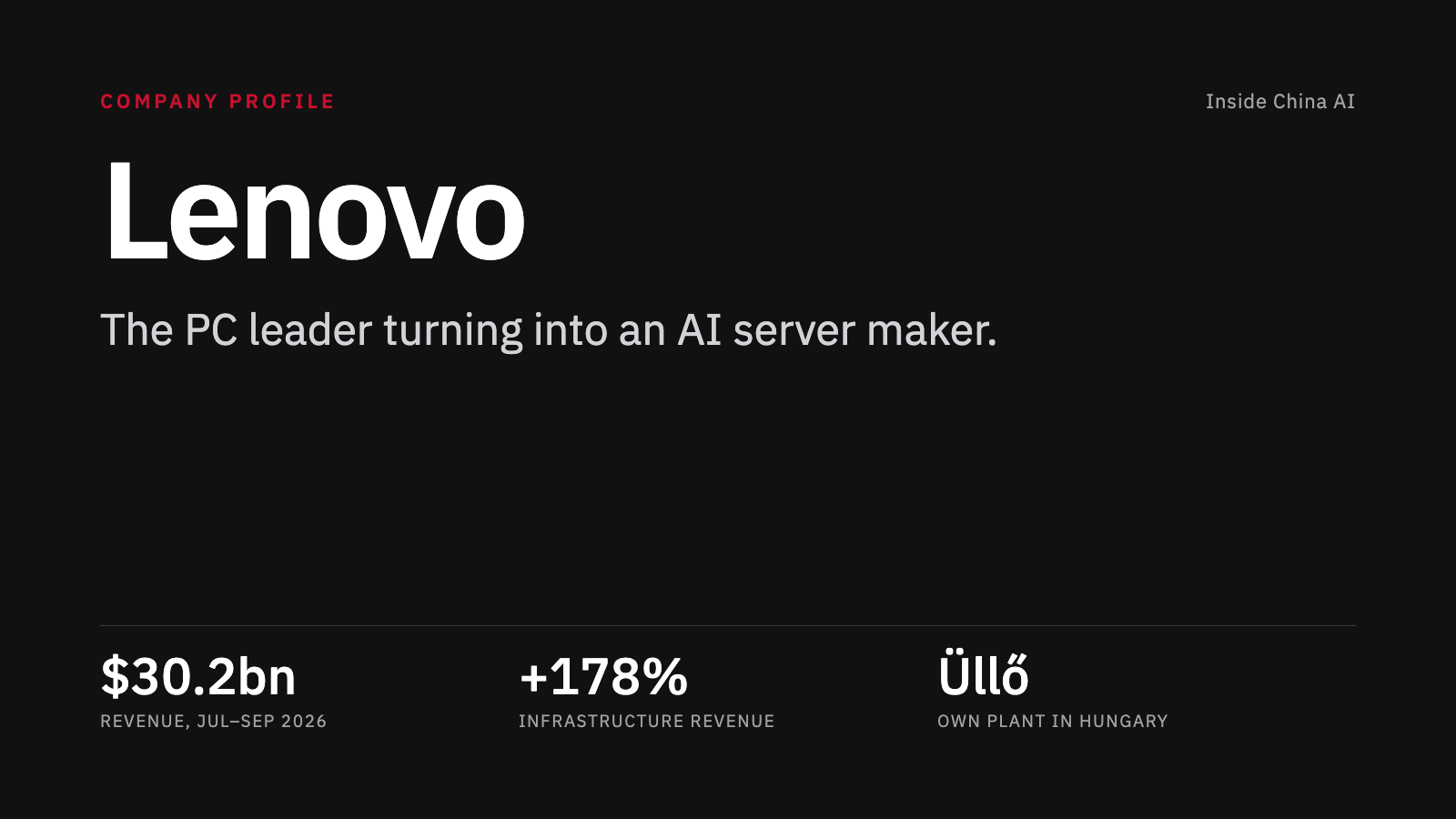
Graphic: Inside China AI
Lenovo: The World’s Largest PC Maker Is Becoming an AI Server Company — and Builds Servers in Hungary
Company profile · 20 November 2026.
Lenovo is the Chinese technology group that most Europeans already use: it is the largest PC vendor in Europe, the Middle East and Africa, the company says, it owns the German brand Medion, and it builds servers and workstations in its own factory in Üllő, next to Budapest airport. What is changing is the business underneath. In the quarter to September 2026, AI-related sales passed US$10 billion for the first time and revenue from servers and storage nearly tripled, according to Lenovo’s results of 19 November 2026. For Europe, Lenovo is less a model company than a supplier of the hardware that European AI runs on — including in universities and research centres that describe their systems as “sovereign” AI infrastructure.
Origins and backing
Lenovo was founded in 1984 and listed in Hong Kong in 1994 (Lenovo investor relations). Its story “begins in a dusty room in Beijing”, the company says (Lenovo). Three acquisitions made it global: IBM’s PC business with the ThinkPad brand in 2005, and IBM’s x86 server business and Motorola’s smartphone business in 2014.
Lenovo Group Limited is incorporated in Hong Kong, with its registered office at Cyberport. It names two “key operations centers”: Beijing’s Haidian district and Morrisville, North Carolina (corporate information). The shares trade in Hong Kong under the code 992, with an RMB counter (80992) and American depositary receipts (LNVGY). Yang Yuanqing is Chairman and CEO, and Winston Cheng is CFO (results release, 19 November 2026).
The largest shareholder is Legend Holdings, a joint-stock company incorporated in mainland China and itself listed in Hong Kong. It held 32.04 per cent of Lenovo’s issued shares on 31 March 2026, and Yang Yuanqing held 6.15 per cent (shareholding structure). Legend treats Lenovo as a subsidiary and reported a direct and indirect stake of 32.95 per cent on 30 June 2026 (Legend Holdings interim results).
In January 2025 Alat, a company of Saudi Arabia’s Public Investment Fund, completed a US$2 billion investment in Lenovo through three-year zero-coupon convertible bonds. In return Lenovo is setting up a Middle East and Africa headquarters and a factory in Riyadh (Lenovo). At the same time, Lenovo issued 1.15 billion warrants, 43 per cent of them subscribed by Lenovo leadership. Those warrants now dominate the reported profit, as the numbers below show.
What they build
Lenovo calls its strategy “Hybrid AI”: “Personal AI” on PCs, phones and tablets, and “Enterprise AI” on servers, storage and services (Lenovo). It has three business groups. The Intelligent Devices Group makes PCs such as ThinkPad and Yoga, and Motorola phones. The Infrastructure Solutions Group makes servers, storage and its “Neptune” liquid cooling for AI and supercomputing (Lenovo UK). The Solutions and Services Group sells IT and AI services. In April 2026 Lenovo completed the purchase of the storage company Infinidat for about US$410 million (interim results announcement).
Lenovo does not build its own large language model. “We’re not doing our own LLM. We’re really doing a partnership because there are regulations around the world,” CFO Winston Cheng told Reuters in Davos on 23 January 2026. According to Reuters, Cheng said Lenovo was looking to strike deals with many model developers and named Alibaba and DeepSeek in China among the potential partners (Reuters via Yahoo Finance). In February 2025 Lenovo said it had integrated technology from DeepSeek into its devices, including PCs and tablets (Reuters via Yahoo Finance).
On devices, the AI layer is Qira, a cross-device assistant for Lenovo PCs and Motorola phones launched at CES on 6 January 2026. Lenovo names Microsoft (Windows Foundry and Azure) and Stability AI, for on-device image generation, as partners (Lenovo). At IFA in Berlin on 3 September 2026, Lenovo said Qira was “expanding across more devices, apps, and markets” (Lenovo). For data centres, Lenovo offers an “AI Cloud Gigafactory” programme with NVIDIA (Lenovo). In China, Lenovo technicians have installed the OpenClaw agent on users’ devices in a paid JD.com service (our report).
Key numbers
- Revenue US$30.2 billion in the quarter to 30 September 2026, up 48 per cent; US$57.2 billion in the half-year, up 46 per cent. Lenovo calls it a “record Q2 performance” (results release; interim announcement)
- Profit A reported net loss of US$640 million in the quarter under Hong Kong accounting rules (HKFRS), mainly due to a non-cash loss of US$1.9 billion on the revaluation of the 2025 warrants. Excluding this and other items, adjusted net income was US$1.36 billion, up 166 per cent (investor presentation)
- AI share AI-related revenue up 79 per cent to more than US$10 billion, or 36 per cent of the total. Lenovo’s definition counts every PC and phone with an AI chip (NPU), GPU servers and AI services (results release)
- Servers Infrastructure revenue US$11.3 billion, up 178 per cent; GPU server revenue up more than 300 per cent; a pipeline of US$80 billion, the company says (results release)
- PCs Device revenue US$17.4 billion, up 15 per cent. Lenovo says its device operating margin held at 7.1 per cent thanks to premium products, “an improved mix and higher selling prices to offset volume pressure” (interim announcement). According to preliminary IDC data, Lenovo’s PC shipments fell 22.6 per cent to 14.9 million units in July–September 2026, for a world market share of 23.8 per cent (IDC)
- R&D US$794 million in the quarter, up 37 per cent (results release)
- Owner Legend Holdings about one third (shareholding structure); listed in Hong Kong (992)
The European angle
- Manufacturing Lenovo opened its first European in-house factory on 14 June 2022 in Üllő, next to Budapest. It builds mainly servers, storage systems and high-end workstations for Europe, the Middle East and Africa, with a stated capacity of “more than 1,000 servers and 4,000 workstations a day” (Lenovo). One year later the site had shipped one million units, the company says (Lenovo). Lenovo’s list of manufacturing sites as of February 2026 still includes Üllő as an in-house site, with about 777 employees (Lenovo). Notebookcheck visited the plant in February 2025 and reported that it makes ThinkCentre desktops, ThinkStation workstations and ThinkSystem servers, but no laptops (Notebookcheck).
- Companies Medion, the consumer electronics brand in Essen, describes itself as part of the Lenovo Group and now trades as medion GmbH (Medion). Lenovo (Deutschland) GmbH is based in Stuttgart (Lenovo).
- Sales Revenue in Europe, the Middle East and Africa rose 41 per cent to US$12.7 billion in the six months to September 2026. Lenovo says it has been the number one PC vendor in that region for 18 consecutive quarters (interim announcement). The figure is not broken down for Europe alone.
- AI infrastructure customers The UK’s STFC Hartree Centre signed with Lenovo in March 2024 for a 44.7-petaflop, water-cooled supercomputer to support AI research for industry (UKRI). Lenovo also says it is “powering” sovereign AI research at the HPC centre of the University of Erlangen-Nuremberg (NHR@FAU) “under strict GDPR requirements”, and its article cites the “Kraken” supercomputer of the University of Grenoble Alpes as a European example (Lenovo, 23 June 2026). Both are the company’s own description: the Grenoble computing centre’s announcement of the Kraken inauguration on 27 January 2026 names no supplier (GRICAD), and we could not open a confirmation from Erlangen.
- Data Lenovo’s German privacy statement says personal data may be transferred to countries where Lenovo operates, “darunter die USA und die Volksrepublik China” (including the USA and the People’s Republic of China), and that it uses standard contractual clauses for transfers out of the EU (Lenovo). In the United States, a proposed class action filed in February 2026 alleges that trackers on Lenovo’s website give its parent company, Lenovo Group, access to bulk data on American users. Lenovo responded: “Any suggestion that Lenovo improperly shares customer data is false” (The Register). We found no ruling as of 20 November 2026.
- Lists We found Lenovo neither on the Pentagon’s Section 1260H list of “Chinese military companies” nor on the US Consolidated Screening List, which includes the Entity List (checked 20 November 2026 via OpenSanctions mirrors). There was no hit on the EU’s consolidated financial sanctions list (checked 15 November 2026).
- What a European buyer would actually encounter A familiar laptop or server, often built for this region in Hungary, sold by Lenovo’s European companies and resellers — with AI features that run on models from partners Lenovo chooses market by market.
What we could not verify
- Current output of the Üllő plant. The last published figure is one million units in the first year; Lenovo gives no annual output for 2024–2026.
- Signed model partnerships in Europe. Lenovo names no European language-model partner for its devices or servers.
- Which language models Qira uses in Europe, and whether the DeepSeek integration announced in February 2025 applies outside China.
- The Erlangen and Grenoble systems, which rest on Lenovo’s own description; neither university confirms a Lenovo system on the pages we could open.
The open question for Europe: when Qira and Lenovo’s AI servers reach European customers at scale, whose models will run on them — and will Lenovo say so market by market?
No responses yet