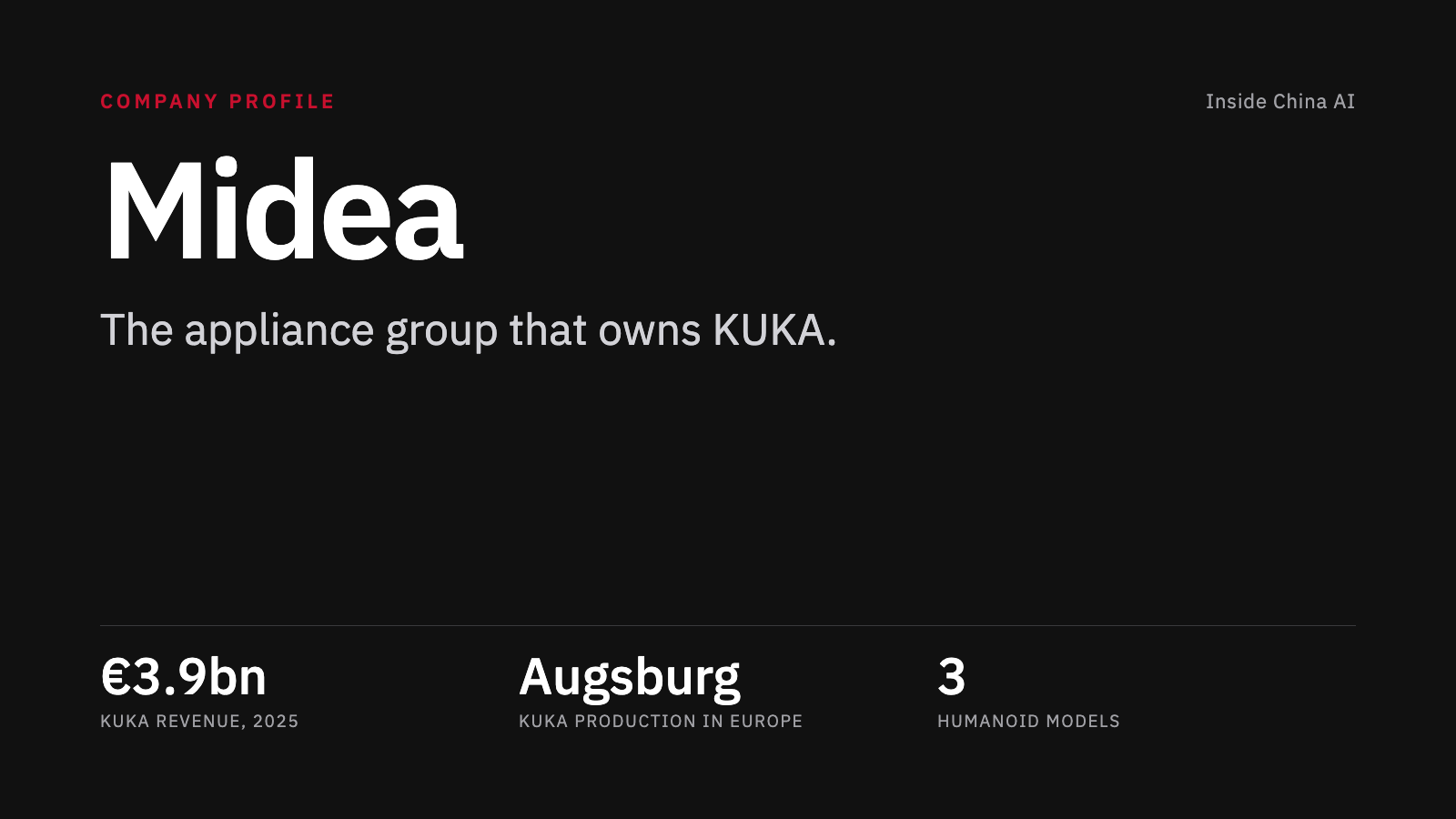
Graphic: Inside China AI
Midea: The Appliance Group That Owns KUKA — and Is Teaching Humanoids to Work in Its Factories
Company profile · 20 November 2026.
Midea is best known for air conditioners and washing machines, but it also owns KUKA, the Augsburg robot maker it took over from 2016 and took off the stock exchange in 2022. Around KUKA it is building an industrial AI business: factory agents, its own embodied AI models and humanoid robots, one of which already works on a Chinese production line, the company says. For Europe, Midea matters twice: as the owner of one of the continent’s best-known robotics companies, whose Augsburg plant remains its central European production site, and as a test case for how a Chinese group brings AI into European factories through a German subsidiary.
Origins and backing
Midea (美的集团) was founded in 1968 in Guangdong and describes itself as a technology group with seven business segments, from smart home to robotics and automation (Midea). Its headquarters are in Shunde, Foshan (Midea). Founder He Xiangjian left the board in 2012, when Fang Hongbo became chairman (Midea timeline); Fang signed the third-quarter report of 29 October 2026 as chairman and chief executive (HKEX filing). He Xiangjian remains the ultimate controlling person through Midea Holding (Interim Report 2026), which held 28.43 per cent of the shares on 30 September 2026 (HKEX filing).
Midea is listed in Shenzhen (000333) and, since 17 September 2024, in Hong Kong (0300) (Interim Report 2026). It says it has more than 190,000 employees, 68 major manufacturing bases and 41 R&D centres, 45 and 29 of them outside China (Interim Report 2026).
The KUKA takeover. On 28 June 2016 KUKA signed an investor agreement with Midea, which had offered €115 a share. Midea committed, until the end of 2023, to retain locations and jobs, to respect the management board’s independence, to ring-fence business partners’ data, and “not to pursue a domination agreement or delisting” (KUKA). Midea’s own timeline records a 94.55 per cent stake in 2017 (Midea timeline). In November 2021 the two sides announced that Midea planned to delist KUKA through a squeeze-out and said the 2016 agreements “are respected and honored” (KUKA). The squeeze-out took effect on 8 November 2022, with remaining shareholders paid €80.77 a share by a Midea holding company (KUKA).
What they build
Most of Midea’s revenue still comes from household appliances: smart home solutions made up 65.4 per cent of its 2025 revenue (Annual results 2025). Robotics and automation, which includes KUKA and the KUKA brands Swisslog and Swisslog Healthcare (Midea), contributed RMB 31.0 billion, or 6.8 per cent, in 2025 (Annual results 2025).
KUKA builds industrial robots, autonomous mobile robots, production systems and warehouse automation. In March 2026 it presented KUKA AMP, a software platform for what it calls “intent-based” automation, at Nvidia’s GTC conference, and said it had set up a software and AI centre in Silicon Valley (KUKA). KUKA AMP is software, not an AI model. KUKA’s own business is shifting east: its China revenue exceeded €1 billion for the first time in 2025 (KUKA), and KUKA China contributed more than 30 per cent of group revenue in the first half of 2026, Midea says (Interim Report 2026).
Humanoids are developed by Midea itself, not by KUKA. The company names two: “Miro” for factories and “Meila” for homes and shops. A six-armed, wheeled version, “Miro U”, unveiled in December 2025 (eWeek), has fastened more than 100,000 screws in over two months of operation at Midea’s washing-machine park in China, the company says. The bipedal “Meila X2” weighs under 40 kilograms; Midea names its own embodied AI models, the “cerebrum-cerebellum” model EAGLES-X, the vision-language-action model EAGLES-EA and the behavioural foundation model EAGLES-BF, which the company says give the robot autonomous mobile manipulation (Interim Report 2026). Midea also makes robot components: it shipped 26,000 precision reducers in the first half of 2026 and is developing joint modules for humanoids (Interim Report 2026).
AI in its own factories is where Midea puts most of its AI story. It reports eight factories designated “lighthouse factories” by the World Economic Forum, a “Factory Agent” programme, its own vertical large model Meiyan, which it combines with industry-specific models, and a density of more than 750 robots per 10,000 employees in June 2026 (Interim Report 2026). In appliances, Midea says its home AI agent, built on Meiyan and third-party models, serves more than 20 million users (Annual results 2025).
Key numbers
- Listing Shenzhen 000333, Hong Kong 0300; largest shareholder Midea Holding, 28.43% on 30 September 2026 (HKEX)
- Q3 2026 Revenue RMB 107.3bn (−4.1%); net profit attributable RMB 14.9bn (+25.9%), unaudited, under Chinese accounting standards (HKEX)
- January–September 2026 Revenue RMB 367.4bn (+1.2%); net profit attributable RMB 41.4bn (+9.3%), but −22.5% excluding non-recurring items, which Midea attributes to the stronger renminbi; robotics and automation RMB 24.9bn (+10%) (HKEX)
- 2025 Revenue RMB 458.5bn (+12.1%); profit attributable RMB 43.9bn (+14.0%), under Hong Kong reporting standards (HKFRS) (HKEX)
- KUKA Revenue €3.9bn and about 14,500 employees in 2025 (German Bundestag lobby register); record R&D spending of €213m in 2025 (KUKA)
- AI Meiyan vertical large model; EAGLES-X, EAGLES-EA (VLA) and EAGLES-BF embodied models; humanoids Miro, Miro U and Meila X2; KUKA AMP software (Midea)
The European angle
- Production Yes. KUKA’s headquarters in Augsburg house the hall “where the main assembly of KUKA robots takes place” (KUKA). Under an agreement with IG Metall and the works council of 16 December 2025, Augsburg “will thus remain the central European production site for the group’s most important robotics product lines”; KUKA promised investments “in the high double-digit million euro range” in automated production and logistics there (KUKA). The job cuts announced in November 2025 fall “mainly in robot production” in Augsburg, a KUKA spokesperson said (heise). We found no published figure for how many robots leave Augsburg each year.
- Jobs in Augsburg In November 2025 KUKA raised the planned cuts at the site from 400 to 560 of about 3,200 jobs, citing a lack of orders (heise); after talks with IG Metall and the works council, about 50 fewer jobs are to go, 509 in total, according to the EU’s restructuring monitor in January 2026 (Eurofound). The Midea assurances on jobs and locations expired at the end of 2023. The December 2025 agreement rules out redundancies for operational reasons until 31 July 2029, in return for deferred pay rises (KUKA).
- Customers Midea and KUKA name European users, among them TV maker TPV Displays Polska, which runs 22 KUKA mobile robots (Interim Report 2026), and agricultural machinery maker KRONE in Werlte, Germany (Annual results 2025). KUKA received Horizon Europe funding for the research project JARVIS in 2025 (lobby register).
- Midea beyond KUKA Midea bought 80 per cent of the Italian air-conditioning maker Clivet in 2016 (Midea timeline) and merged it in 2025 with the acquired ARBONIA Climate into MBT Climate (Annual results 2025). On 29 April 2025 it announced that it had completed the takeover of the kitchen-appliance maker Teka (Midea) and is integrating Teka’s factories; its building-technology unit scheduled a new production line in Czechia to start in August 2026 (Interim Report 2026).
- Humanoids and AI in Europe We found no sign that Midea’s humanoids are deployed or sold in Europe. Midea says a joint project with KUKA in Hungary produced a “European digital template for manufacturing” (Interim Report 2026).
- Lists In our name check of 20 November 2026, neither Midea nor KUKA appears on the US Consolidated Screening List, which includes the Entity List, or on the Pentagon’s Section 1260H list; there was no hit on the EU’s consolidated financial sanctions list as of 15 November 2026. This is a name match, not a legal review.
- What a European buyer would actually encounter A German robot supplier, owned by a Chinese appliance group that is increasingly using KUKA to carry its factory AI abroad.
What we could not verify
- Output in Augsburg: how many robots KUKA builds there each year, and the output of its other European sites.
- KUKA’s 2025 profit: KUKA calls its 2025 revenue growth “profitable” but gives no profit figure in the sources we could check.
- Midea’s European plants: the locations and output of the Teka and MBT Climate factories, and whether the Czech line started on schedule.
- Midea’s reported multi-billion AI and robotics budget: the original report was behind a paywall.
- Whether the humanoids or the Meiyan and EAGLES models will be offered in Europe, and under which data rules.
The open question for Europe: will KUKA bring Midea’s humanoids and factory AI to European plants — and will Augsburg build them, or only sell them?
No responses yet