Graphic: Inside China AI
Moonshot AI: Kimi Is Already in Europe’s Clouds. Moonshot Isn’t.
Part of The Model Layer — profiles of the Chinese model and agent companies Europe is about to meet, starting with the ones speaking at Web Summit Lisbon. Company profile · 17 November 2026.
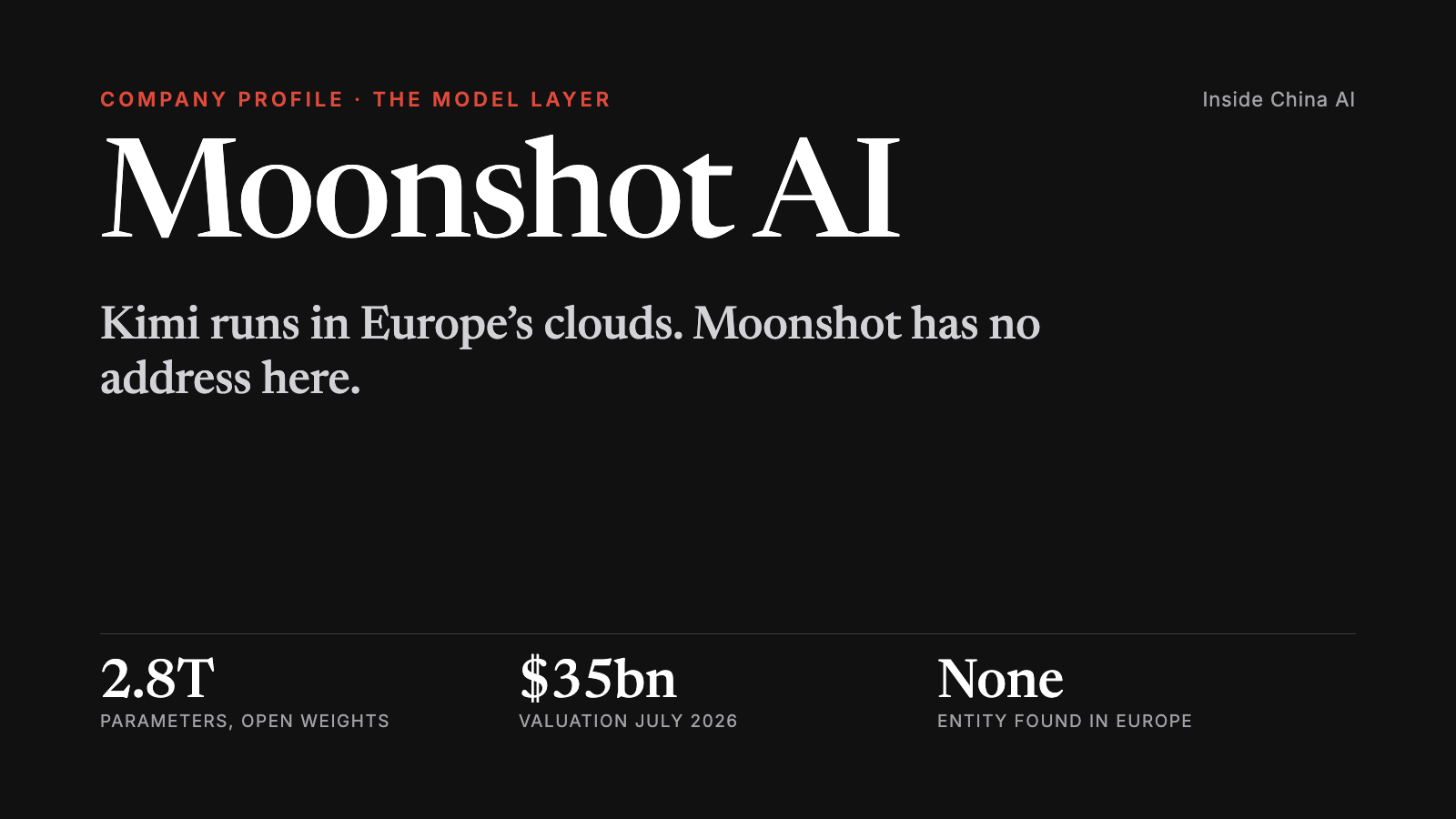
A European company can now switch on Moonshot AI’s newest model from inside Microsoft Azure, Amazon Bedrock or a Swedish data centre. What it cannot do is sign anything with a Moonshot entity in Europe. In less than four years the Beijing lab behind Kimi has gone from start-up to one of the most valuable AI companies in China, with open model weights that developers worldwide build on and a Hong Kong listing in preparation. Its models travel far. The company itself has a Singapore address for the rest of the world, Singapore law in its contracts, and no office, entity or named customer in Europe that we could find — while, according to CNBC, it has been looking for Nvidia chips in European data centres.
Origins and backing
Moonshot AI — Beijing Moonshot Technology Co., Ltd., 北京月之暗面科技股份有限公司 in Chinese (privacy policy), “the dark side of the moon” — was founded in March 2023 by Yang Zhilin, a Tsinghua graduate with a Carnegie Mellon PhD, together with fellow Tsinghua alumni Zhou Xinyu, Zhang Yutao and Wu Yuxin (Caixin). Its first big round, about $1 billion led by Alibaba in February 2024, valued it at some $2.5 billion (Bloomberg via Gulf News).
Then the valuation multiplied. A round of about $2 billion in May 2026, led by Long-Z Investments, the venture arm of food-delivery group Meituan, put Moonshot at around $20 billion (TechCrunch). In July it raised $3.5 billion at $35 billion, more than it had set out to (Bloomberg via The Standard). Bloomberg reported on 6 October that its latest private round had closed at about $50 billion (CTech). Tencent, HongShan and IDG Capital are among the other backers — and one European name: Paris-based Cathay Innovation says it invested in three tranches (Cathay Innovation).
The money is meant to end in a listing. Reuters reported in September that Moonshot had filed confidentially for a Hong Kong IPO, aiming to raise about $3 billion (Reuters via The Edge); Bloomberg later put the possible size at up to $5 billion, with a listing as early as the first quarter of 2027 (CTech). To get there, Moonshot has been dismantling the offshore structure through which its early investors came in: the Wall Street Journal reported on 13 November that it is completing the restructuring, deregistering its Cayman Islands holding company and moving investors’ shares to its main operating company in China; Moonshot declined to comment (WSJ via PANews). As of 17 November, no prospectus has been published.
What they build
Moonshot made its name with Kimi, a chatbot known early for reading very long documents. Its reputation outside China rests on something else: large models whose weights anyone can download. Kimi K2, released in July 2025, had one trillion parameters. Kimi K3, announced in July 2026, has 2.8 trillion, of which 104 billion are active for any one answer, and a context window of one million tokens; Moonshot calls it “the world’s first open 3T-class model” (model card). Its successor, Kimi K3.1 Pro, followed in late October, with weights published on Hugging Face in early November (model card).
“Open” here comes with conditions, which we analysed in Open Weights, Two Meanings. The licence allows commercial use free of charge, but any company that sells model access as a service and has more than $20 million in revenue over twelve months “must enter into a separate agreement with Moonshot AI”, and very large products must display the model’s name (licence text).
Around the models sit the Kimi app, a coding tool, an API, a hosted version of the OpenClaw agent framework called Kimi Claw, and, since 5 November, “Kimi Hosted Agents”, a managed service for running AI agents that is so far documented only on Moonshot’s Chinese platform (pricing page). Growth has strained capacity: in July Moonshot paused new subscriptions, and after the K3.1 Pro launch in October it apologised for rate limits and gave subscribers back a quarter of their monthly quota (Reuters via Deccan Chronicle).
The business is mostly developers and companies paying for API access, and increasingly from abroad. Moonshot told investors its annual recurring revenue passed $1 billion in August, up from $300 million in June, and could reach $2 billion by the end of the year (Bloomberg via Tech Wire Asia). In the United States, Kimi accounts for 61 per cent of company spending on open-source models, according to a Menlo Ventures survey published in November — a large share of a small slice, since open-source models make up only 4 per cent of the spending measured (Menlo Ventures).
Key numbers
- Founded March 2023, Beijing, by Yang Zhilin (CEO) with Zhou Xinyu, Zhang Yutao and Wu Yuxin
- Funding $3.5 billion in July 2026 at a $35 billion valuation (Bloomberg). Earlier: ~$2 billion led by Meituan’s Long-Z (May 2026), ~$1 billion led by Alibaba (February 2024). A further private round at about $50 billion had closed by 6 October, according to Bloomberg.
- Listing Confidential Hong Kong IPO filing reported by Reuters in September; listing possible from Q1 2027, raising up to $5 billion (Bloomberg). Offshore restructuring being completed (WSJ, 13 November). No public prospectus as of 17 November.
- Revenue Annual recurring revenue above $1 billion in August 2026, target $2 billion by December — figures Moonshot gave investors, reported by Bloomberg. Not audited.
- Flagship model Kimi K3.1 Pro: 2.8 trillion parameters (104 billion active), 1-million-token context, open weights under a custom licence with a $20 million revenue threshold for model-as-a-service providers.
- Users No current company figure. Menlo Ventures: 61% of US enterprise spending on open-source models (US survey only).
- Headcount Not disclosed.
The European angle
- Physical presence None found. No European office, legal entity, employee or job listing. Outside mainland China, Moonshot operates through NOVASCENT PRIVATE LIMITED in Singapore, an entity set up in 2023 and renamed in June 2026 (Reuters via The Standard).
- How Europeans reach Kimi today Mostly through others. Microsoft sells Kimi-K3.1-Pro directly on Azure (Microsoft). Amazon Bedrock offers Kimi K3 and, since 10 November, Kimi K3.1 Pro Highspeed only through US, Indian and global routing — not through an option that keeps data inside the EU (AWS, AWS blog). In Europe, Amsterdam-based Nebius lists Kimi models, and Sweden’s Berget AI runs Kimi K3 “entirely on Swedish infrastructure” with no stored prompts (Berget AI). The cloud talks we reported in August, in which Moonshot sought up to 30 per cent of revenue, have since produced listings; no party has disclosed the terms (our report).
- Who a European user contracts with Users of the Kimi website and app outside mainland China contract with Novascent under Singapore law, with disputes settled by arbitration in Singapore (terms). Its privacy policy, updated on 5 November, has a section for US residents but none for Europe; it does not mention the GDPR, names no EU representative and says only that data may be stored “outside of your country of residence” (privacy policy). It states that user content is used to train Moonshot’s models. The developer platform’s older policy does include a section for the EEA, Switzerland and the UK, and says data is stored on servers in Singapore (API privacy policy). In European app stores, the Kimi app is still listed under the Beijing company.
- Regulatory exposure Because its models are offered in the EU, Moonshot is likely covered by the AI Act’s rules for providers of general-purpose AI models. It has not signed the EU’s voluntary Code of Practice for them, which Mistral, Aleph Alpha, OpenAI, Anthropic and Google have; no Chinese lab is on the list (European Commission). We found no action by a European data-protection authority against Kimi. The bigger supply risk sits in Washington, and it rests on allegations. In February, Anthropic said it had traced a distillation campaign of more than 3.4 million exchanges with its Claude models, run through fraudulent accounts, to Moonshot (Anthropic). On 22 July, White House technology adviser Michael Kratsios accused Moonshot of distilling Anthropic’s Fable model to build K3 (Reuters via The Standard), and Treasury Secretary Scott Bessent wrote that for such cases sanctions and Entity List designations “will be on the table” (The Register). Moonshot rejects the accusation: it told China’s National Business Daily that K3’s performance gains came from original changes to its underlying architecture (Reuters via BusinessDay). As of 17 November, the Federal Register shows no designation of Moonshot.
- Europe as a chip source CNBC reported on 5 November that Moonshot had discussed renting capacity from European “neoclouds” running Nvidia’s Blackwell GPUs, including clusters of 8,000 or more, with one source describing offers to pay 30 to 50 per cent more upfront than non-Chinese customers; no provider or country was named, and Moonshot did not respond (CNBC). Separately, Bloomberg reported in November that, according to documents it reviewed, Moonshot had signed a contract in August to rent 32 servers with Nvidia B300 chips located in China; Moonshot says it has “no business relationship” with the company that owns them (Bloomberg via The Star).
- What a European buyer would actually encounter A strong open-weight model available through providers it may already use, and a developer with no European counterparty, Singapore contracts and an unresolved conflict with Washington. For most European companies the practical question is not whether to sign with Moonshot but which host, which data location and which licence conditions apply.
What we could not verify
- A European customer or partner. Cathay Innovation says it introduced Kimi to “a set of European partners”; none is named.
- Which European data centres were in the chip talks, and whether any deal was signed. CNBC names no provider; reports naming countries come from unreliable sites.
- The terms of the Azure and Bedrock listings, including whether Moonshot gets the revenue share it asked for.
- Whether the Singapore entities are one company. The consumer terms name Novascent, the developer platform names Moonshot AI Pte. Ltd.; Reuters’ account suggests a renaming, but we have not confirmed it.
- The distillation allegations. They come from Anthropic and the US government; Moonshot denies them. We have not seen independent technical evidence either way.
- Revenue and valuation. All figures come from investors or people familiar with the matter; there are no audited accounts before a prospectus.
Giacomo Ficari, Moonshot’s international director, spoke at Web Summit in Lisbon (Centre Stage, 12 November, according to the conference programme) about building ecosystems around open models; according to the South China Morning Post, he said science demands more capable models than law, finance or code (via The Decoder). The open question for Europe: when a European bank or carmaker wants Kimi with its data kept in Europe and a contract under European law, who signs?
No responses yet