Graphic: Inside China AI
SenseTime: The Face-Recognition Pioneer Rebuilt Around Models and Compute — With Three US Listings Attached
Company profile · 20 November 2026.
SenseTime made its name with computer vision, the face and image recognition that powered China’s smart-city boom. Today about 80 percent of its revenue comes from generative AI: its SenseNova models, a large computing platform called SenseCore and office and video agents. In the first half of 2026 it reported its first IFRS profit since listing in Hong Kong, helped by gains on investments and on the sale of subsidiaries. For Europe, SenseTime is a test case of a different kind. It has no office, entity or named customer in Europe, but several of its newer models can be downloaded under the Apache 2.0 licence and run anywhere. Anyone who builds on them should know that SenseTime sits on three US lists, two of them over surveillance of Uyghurs in Xinjiang.
Origins and backing
SenseTime was founded in 2014 (SenseTime). Its listed holding company, SenseTime Group Inc., was incorporated in the Cayman Islands on 15 October 2014 and is controlled through weighted voting rights (interim results, 26 August 2026); the operating headquarters is Shanghai SenseTime Intelligent Technology Co., Ltd. on Hongmei Road in Shanghai (SenseTime). Co-founder Tang Xiao’ou died after an illness in December 2023 (Caixin). The company is now led by co-founder Xu Li, executive chairman and chief executive, and co-founder Wang Xiaogang, executive director and chief scientist; both hold the shares with enhanced voting rights (interim results).
SenseTime listed on the Main Board of the Hong Kong stock exchange on 30 December 2021 (annual results 2025), at HK$3.85 per share (allotment results, 29 December 2021), raising $740 million (Caixin), under stock code 0020 (SenseTime). The listing had been postponed after the US Treasury barred US investors from buying its shares on 10 December 2021 (HKEX announcement, 13 December 2021; see below). As of 30 June 2026 the group had 2,668 employees (interim results).
Since 2024 SenseTime has been shrinking its own perimeter. Under what it calls a “1+X” strategy, the group acts as a “mothership” that supplies models and compute, while vertical businesses raise outside money and leave the consolidated accounts (annual results 2025). The autonomous-driving business was deconsolidated in August 2025 (annual results 2025); the company says its edge AI chip and intelligent-driving businesses completed financing rounds and were spun off (SenseTime, 26 March 2026). The inference-chip maker Sunrise, formerly SenseTime’s chip division, was spun off in late 2024 (Yicai, 18 July 2025); according to Caixin it had raised about 4 billion yuan across seven rounds by April 2026 (Caixin). In the first half of 2026 SenseTime sold interests in further subsidiaries, which became joint ventures, and booked a gain of RMB 521 million; the filing does not name them (interim results).
What they build
SenseTime describes itself as three things stacked on each other: SenseCore, its AI infrastructure; the SenseNova foundation models; and SenseFoundry, its computer-vision platform (SenseTime). Since 2026 it frames this as “one model system, one Token Factory, and one Agent Harness”, meaning models, a compute platform that sells tokens, and a layer that turns both into agents (SenseTime).
Models. In 2026 SenseTime released, among others, the native multimodal SenseNova U1 and U1.5 families, SenseNova Vision, the image and design model U1 Pro and a spatial-intelligence model, SenseNova SI-8B (SenseTime). On 5 November it launched the official version of SenseNova 6.8 Flash, a multimodal agent model for office work (SenseTime). On 17 November it released SenseNova Loop-9B, a model with about 9 billion parameters that runs some layers twice and supports a 512,000-token context; its 4-bit weights take about 4.9 GB (SenseTime). The company says its 2026 models “matched or outperformed” Gemini, GPT and DeepSeek on several benchmarks (SenseTime); we have not seen independent confirmation.
The open releases are smaller models. On Hugging Face, SenseNova U1 (8B and a mixture-of-experts variant), U1.5-8B, Loop-9B and the robotics model RoboRSI-27B Preview are published under Apache 2.0; SenseNova Vision-7B carries a non-commercial licence (CC BY-NC 4.0); several SenseNova-SI models and RoboRSI-27B are fine-tunes of other labs’ open models, such as InternVL3 and Qwen (SenseNova on Hugging Face). We found no open weights for the flagship 6.8 Flash or U1 Pro.
Compute. SenseCore is the larger business behind the models. The company says it had 48,000 petaflops of computing power deployed as of 26 August 2026, and that its “Token Factory” also serves four external model developers (SenseTime). Average daily token volume on the platform rose from more than 2.4 trillion in July 2026 to 6 trillion in October 2026, the company says (business update, 18 November 2026). It works with more than a dozen Chinese chipmakers, including Huawei Ascend, Hygon and Cambricon (SenseTime), and says it deployed its first overseas cluster built on Chinese chips in Saudi Arabia (interim results).
Agents and vision. The office agent Raccoon has served Lenovo, Ping An Technology, China’s three large telecoms operators, JD.com and Kylin Software, according to the company; its consumer agents, the Kapi series, had passed 50 million cumulative users by 30 September 2026 (business update, 18 November 2026). With industry partners, SenseTime links its video agent Seko to a distribution network covering 180 countries and regions and “more than 9,000 overseas channels” (business update). Computer vision, the original business, brought in RMB 496.8 million in the first half of 2026, 17 percent of revenue (interim results).
Key numbers
- Founded 2014; listed in Hong Kong on 30 December 2021 (0020.HK); holding company in the Cayman Islands, headquarters Shanghai
- Revenue 2025 RMB 5,014.6 million (+32.9%); loss for the year RMB 1,782.0 million (annual results)
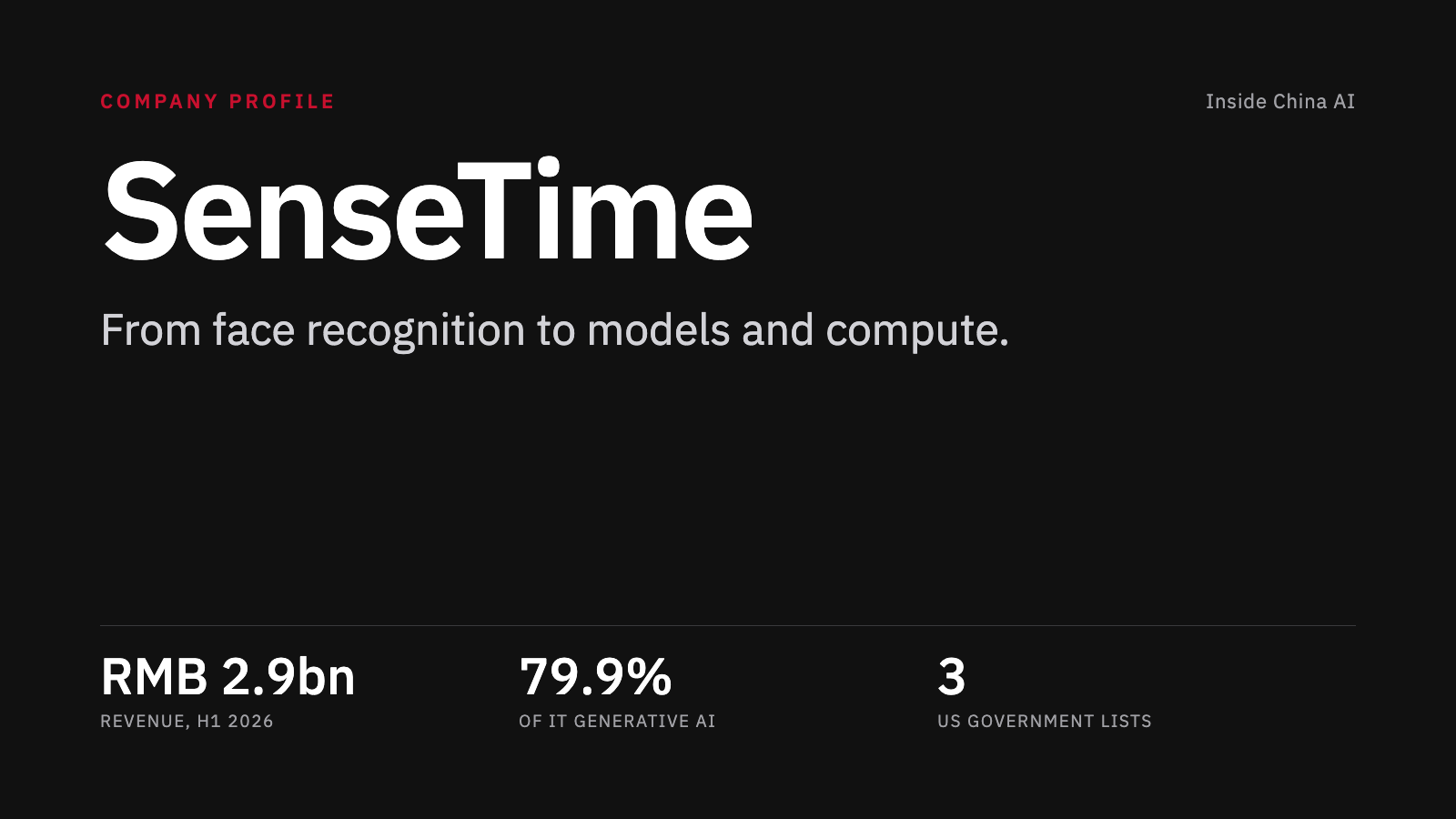
- Revenue H1 2026 RMB 2,910.9 million (+23.4%), of which generative AI RMB 2,327.2 million (79.9%); gross margin 41.4% (interim results)
- Profit H1 2026 RMB 617.3 million, the first IFRS profit since listing, after a loss of RMB 1,489.3 million a year earlier. Net other gains of RMB 2,127.5 million contributed, mainly RMB 1,248.7 million in unrealised fair-value gains on financial assets and RMB 521.0 million from disposing of subsidiaries; on the company’s non-IFRS adjusted measure the net loss was RMB 390 million (interim results, press release)
- First nine months 2026 Revenue RMB 3.79 billion (+30.4%), gross margin 43.4%, unaudited business update without a profit figure (HKEX announcement, 18 November 2026)
- Where the money comes from 86% of H1 2026 revenue from mainland China; Southeast Asia RMB 220.4 million; Europe is not a reported region (interim results)
- Staff 2,668 (30 June 2026)
- Models SenseNova 6.8 Flash (closed), U1 Pro (closed); open: U1 / U1.5, Loop-9B, RoboRSI-27B Preview (Apache 2.0), Vision-7B (non-commercial)
The European angle
- Physical presence None found. SenseTime’s own office list names Hong Kong, five mainland cities, South Korea, Singapore, Malaysia, Abu Dhabi, Dubai and Riyadh, and no European location (SenseTime). Its main subsidiaries are incorporated in mainland China, Hong Kong, Singapore and the Middle East (interim results). On 20 November 2026 we found no company named SenseTime in the UK (Companies House), French (Annuaire des Entreprises), Norwegian and Finnish company registers, and no entity of that name in the global LEI database (GLEIF). In its 2025 results SenseTime said only that new customers from South America and Europe “started to pay more attention” to its vision products; it named none (annual results 2025).
- How Europeans reach the models Through the open weights. The Apache-licensed SenseNova models can be downloaded and run on European hardware without a contract with SenseTime. The company’s developer platform runs under a Chinese domain, sensenova.cn; we found no international API offer and no SenseNova model on OpenRouter as of 20 November 2026.
- US Entity List (export control) SenseTime has been on the US Commerce Department’s Entity List since 9 October 2019, one of 28 entities that the department linked to the “high-technology surveillance” of Uighurs and other Muslim minorities in Xinjiang (Federal Register). Exports of items subject to US export rules to the listed Beijing entity need a licence.
- US investment ban On 10 December 2021 the US Treasury identified SenseTime Group Limited as a Chinese military-industrial complex company under the NS-CMIC programme, which bars US persons from buying its listed securities. Treasury said its wholly owned subsidiary Shenzhen SenseTime Technology “has developed facial recognition programs that can determine a target’s ethnicity, with a particular focus on identifying ethnic Uyghurs” (US Treasury).
- Pentagon 1260H list “SenseTime Group, Inc.” appears on the Defense Department’s list of Chinese military companies published on 7 January 2025 (Federal Register). The list is not a sanction. All three listings were still in place according to our check of the published US lists on 15 November 2026; we found no EU sanctions listing.
- EU AI Act SenseTime has not signed the EU’s Code of Practice for general-purpose AI models (European Commission).
- What a European buyer would actually encounter Small, capable open models that can be self-hosted — from a company whose US listings will trigger questions in any compliance review, especially at firms with US shareholders, US-origin technology or US public contracts.
What we could not verify
- The spin-offs. The names of the driving and edge-chip companies after the spin-off, who invested and how much SenseTime still owns; for Sunrise, the total raised rests on Caixin alone.
- Benchmark claims for the SenseNova models; we saw only the company’s own figures.
- The terms for EU users: whether SenseTime’s paid API is offered in Europe at all, which entity would be the contracting party and where data would be stored.
- Any European customer or partner. We checked the UK, French, Norwegian and Finnish registers and GLEIF; the German commercial register and other national registers could not be searched automatically.
The open question for Europe: will SenseTime’s open models find European users who are willing to work through the US listings — and will the company ever put an entity, or a data centre, on this side of the export-control line?
No responses yet