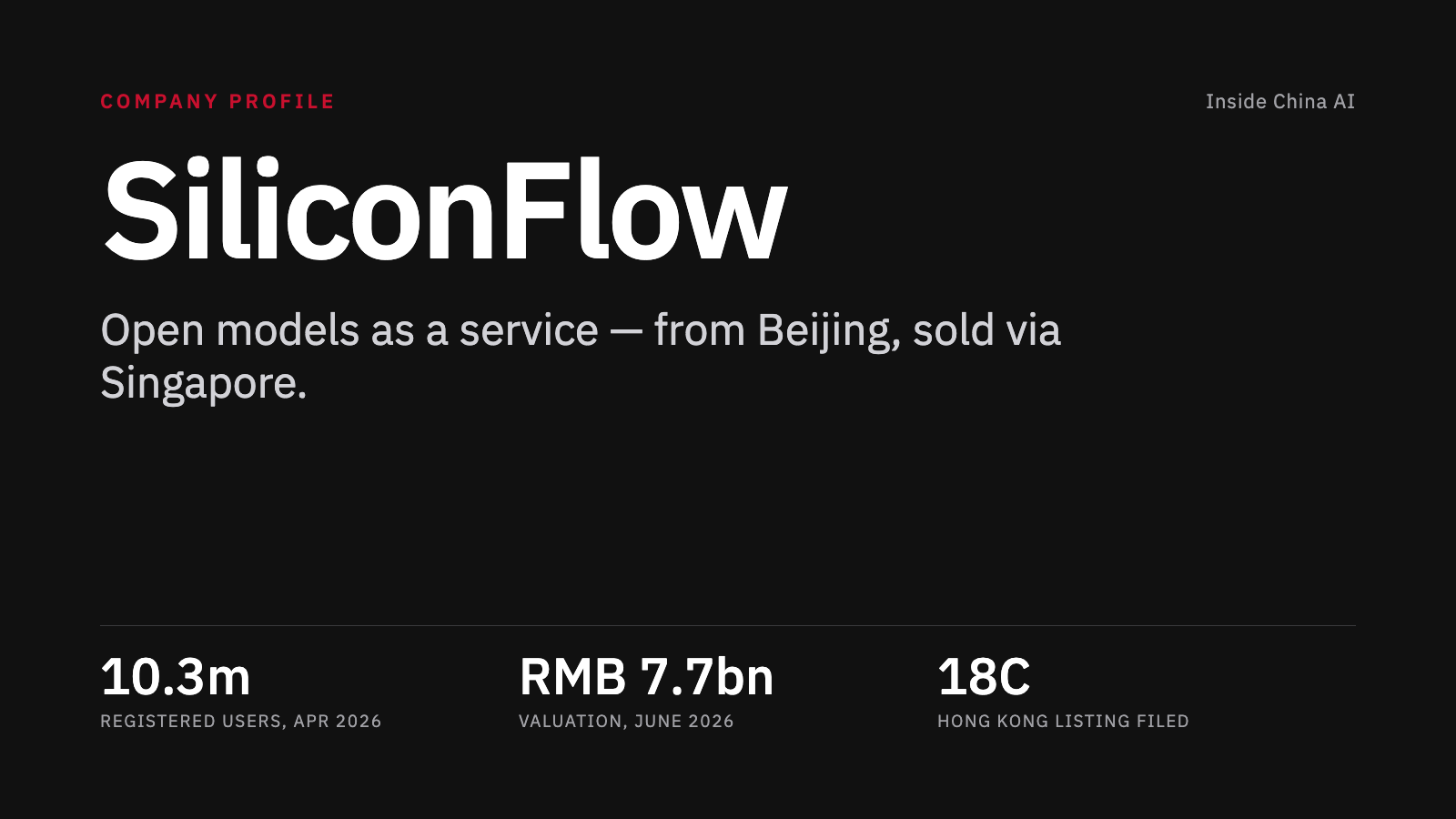
Graphic: Inside China AI
SiliconFlow: The Beijing Platform That Runs DeepSeek on Huawei Chips at Home and Sells to the World from Singapore
Company profile · 20 November 2026.
SiliconFlow does not build AI models. It runs other people’s models, including DeepSeek, Qwen and Kimi, and sells access to them by the token, on Nvidia hardware and on Chinese chips such as Huawei’s Ascend. Founded in Beijing in August 2023, it says it now has more than ten million registered users and has filed for a listing in Hong Kong. For Europe, the international version of the platform is the part to look at. Any developer outside mainland China can sign up at siliconflow.com. The contract is with a Singapore company under Singapore law, the privacy policy refers to Singapore’s PDPA and does not mention the GDPR, and SiliconFlow’s own documents do not say where the servers are.
Origins and backing
SiliconFlow (硅基流动), legally Beijing SiliconFlow Technology Co., Ltd., was incorporated on 29 August 2023 and converted into a joint-stock company on 22 June 2026, according to the application proof it filed with the Hong Kong exchange on 30 June 2026 (HKEX application proof). The document is a draft and may change. Its founder, Yuan Jinhui, is chairman, chief executive, general manager and financial controller at the same time. The filing names four co-founders alongside him. He was a lead researcher at Microsoft in China from 2013 to 2016. From 2017 to 2023 he ran OneFlow, a Chinese deep-learning framework company. The filing says OneFlow is still under his control, and that in June 2026 SiliconFlow agreed to buy a portfolio of OneFlow’s intellectual property for RMB 44.5 million. Two of the co-founders also came from OneFlow: the chief technology officer, Liu Juncheng, and the chief operating officer, Zhao Zhen.
Yuan and four employee shareholding platforms control about 44.48 per cent of the votes. Yuan holds 14.35 per cent directly. The largest outside shareholder is an Alibaba Group entity with 7.42 per cent. Next is Hubble Technology with 4.07 per cent; the filing says its general partner is wholly owned by Huawei Investment & Holding. Sinovation Ventures holds 4.01 per cent, and Meituan and Kingdee each hold about 1 per cent (HKEX application proof).
The filing lists seven funding rounds between December 2023 and June 2026. The last, a Series B+ of RMB 740 million paid on 17 June 2026, valued the company at RMB 7.74 billion after the money (HKEX application proof). On 20 September 2026 SiliconFlow announced a second B+ tranche and a Series C. It put its equity financing for 2026 at nearly RMB 2.9 billion but gave no amount for either round. The new investors include the China Internet Investment Fund, which describes itself as a state-level fund for the cyberspace sector, China Mobile’s 链长 fund and China Orient Asset Management International (投资界). The China Securities Regulatory Commission accepted the company’s filing for the Hong Kong listing on 19 October 2026 (Xinhua Finance). On 20 November 2026 the Hong Kong exchange’s disclosure site still listed the application as active, with only the first application proof of 30 June 2026 and no post-hearing information pack (HKEXnews).
What they build
SiliconFlow describes itself as an independent “token supply platform”. It says it focuses on the infrastructure layer, does not develop models and does not build end-user applications (SiliconFlow). It sells three things: a pay-per-use API for more than 170 models, dedicated instances, and on-premise deployments for organisations that want the platform in their own data centres. It does not own its chips. It leases computing power from partners, and in June 2026 it signed a 60-month lease with a third party for a total fee of RMB 3,491 million (HKEX application proof).
The company is known in China for running DeepSeek on Chinese hardware. Its own timeline lists a DeepSeek R1 and V3 inference service on Huawei Cloud’s Ascend cloud, launched with Huawei Cloud in February 2025. In April 2025 it added DeepSeek-R1 on Huawei’s CloudMatrix 384 supernode (SiliconFlow). In the listing filing, SiliconFlow says it worked with Huawei Cloud to optimise inference on the CloudMatrix cluster and reached more than 1,920 tokens per second per chip on DeepSeek-R1. It also says it runs models on chips from MetaX, Moore Threads, Hygon and Alibaba’s T-Head. These are the company’s own figures. The international site advertises “NVIDIA H100 / H200, AMD MI300” GPUs (siliconflow.com). SiliconFlow does not say which hardware serves which customers.
The platform is aimed at developers. SiliconFlow says nearly a hundred developer tools, including LangChain, Dify and Cherry Studio, offer it as a built-in model provider (SiliconFlow). Citing a Frost & Sullivan report it commissioned, it calls itself China’s largest independent supplier of this kind and one of the top five token suppliers overall by 2025 throughput, with a market share of about 1.5 per cent (HKEX application proof).
Growth has come with heavy losses. Revenue rose from RMB 7.3 million in 2024 to RMB 55.3 million in 2025. The loss for 2025 was RMB 345.5 million. The gross margin went from plus 39.4 per cent in 2024 to minus 24.0 per cent in 2025. The public-cloud business ran at a gross loss margin of 119.0 per cent, while on-premise deployments earned a gross margin of 82.5 per cent. At the end of 2025 SiliconFlow had 100 full-time employees, all of them in mainland China (HKEX application proof).
Key numbers
- Founded 29 August 2023, Beijing, by Yuan Jinhui (chairman and CEO) with four co-founders, according to the filing
- Ownership Founder and employee platforms control about 44.48% of votes; Alibaba entity 7.42%, Huawei-linked Hubble 4.07% (HKEX filing)
- Valuation RMB 7.74 billion post-money after the Series B+ of June 2026; later rounds’ valuation not disclosed
- Funding 2026 Nearly RMB 2.9 billion in equity, the company says (IT之家)
- Listing Hong Kong application under Chapter 18C filed 30 June 2026; CSRC filing accepted 19 October 2026, according to Xinhua Finance; application active on HKEXnews, no hearing published and not listed as of 20 November 2026
- Revenue / loss 2025 RMB 55.3 million / RMB 345.5 million
- Users 10,282,431 registered users at 30 April 2026; more than 13,000 enterprise customers at 21 June 2026, the company says (投资界)
- Staff 100 full-time employees at 31 December 2025, all in mainland China
The European angle
- Physical presence None found. The listing filing names no European office, subsidiary, partner, customer or data centre. In 2025 SiliconFlow’s overseas revenue was RMB 2.1 million, or 3.7 per cent of the total, and the filing says it came “primarily” from the US and Singapore (HKEX application proof). The company plans to build sales and operations teams “in selected overseas markets” but does not name them.
- Who a European developer contracts with The international platform, launched in 2025, is run by SILICONFLOW LABS PTE. LTD., a Singapore subsidiary set up on 7 May 2026. The terms of 9 September 2026 choose Singapore law and arbitration in Singapore. They exclude users in mainland China and send them to siliconflow.cn, but they do not exclude European users (terms of service). From 2023 to 2025 the overseas business ran through a Singapore commercial agent that the filing describes as a connected person; the new subsidiary is to take over that business. The filing also lists a SILICONFLOW TECHNOLOGY PTE. LTD. “under common control” of the founder.
- Data protection The privacy policy of 9 September 2026 refers to Singapore’s Personal Data Protection Act 2012 and does not mention the GDPR. It names no EU representative and gives no server location. It allows data to be shared with affiliates and service providers “whether within or outside Singapore” (privacy policy). For prompts and outputs, SiliconFlow says it acts as a “neutral technology service provider” that processes them only on the customer’s instructions. The homepage promises “No data stored, ever” (siliconflow.com).
- Where the servers are SiliconFlow does not say. Its terms, privacy policy, developer documentation and listing filing name no server location. The only location we found comes from a third party: the model marketplace OpenRouter, which offers SiliconFlow’s models through its own API, lists SiliconFlow with headquarters in Singapore and data centres in the United States (OpenRouter provider data). That entry describes the capacity SiliconFlow provides to OpenRouter; it is not a statement by SiliconFlow and need not apply to its own API at siliconflow.com. We found no data centre in the EU.
- Regulatory exposure SiliconFlow itself is not on the US Entity List, the US Treasury’s CMIC list or the Pentagon’s 1260H list of Chinese military companies (a disclosure list, not a sanction), according to our check of the published lists on 20 November 2026. It is not on the EU’s consolidated financial sanctions list either, according to our check of the 23 October 2026 file. Several companies linked to it do appear on these US lists. Huawei Investment & Holding, whose subsidiary is general partner of the shareholder Hubble (4.07 per cent), is on the CMIC and 1260H lists. Alibaba Group Holding, whose consolidated entity is the largest outside shareholder (7.42 per cent), has been on the 1260H list since June 2026. None of these listings applies to SiliconFlow itself. In its filing, SiliconFlow warns that the US could treat remote access to controlled chips “through … cloud computing … model inference” as falling under export controls.
- What a European buyer would actually encounter An API to Chinese open models such as DeepSeek, Qwen and Kimi (siliconflow.com), reachable from Europe. The contract is with a Singapore company, neither the terms nor the privacy policy mention the GDPR, SiliconFlow names no server location (OpenRouter’s provider data says US), and the chips behind the service are not disclosed.
What we could not verify
- Where European users’ prompts are processed, and on which chips. SiliconFlow names no location; only OpenRouter’s provider data names one (US), for the traffic OpenRouter routes to SiliconFlow.
- Any European customer, partner or reseller. We found none, which does not prove there are none.
- A data-processing agreement or GDPR transfer mechanism for EU customers. None is published with the terms and privacy policy.
- The size of the 2026 rounds. In June 2026 the company announced a Series B of “more than RMB 2 billion” (Sina Finance). The listing filing shows RMB 520 million for the Series B and RMB 740 million for the Series B+, paid on 5 and 17 June 2026. Amounts and valuation for the September rounds were not disclosed.
- Overseas growth in 2026. In June 2026 the company said its overseas revenue had reached several million dollars in a single month. That would be well above the RMB 2.1 million it reported for all of 2025. The claim is not broken down by region.
The open question for Europe: if SiliconFlow wins European business customers, will it offer them an EU contract and EU data centres, or will they keep signing with a Singapore company that does not say where its servers are?
No responses yet