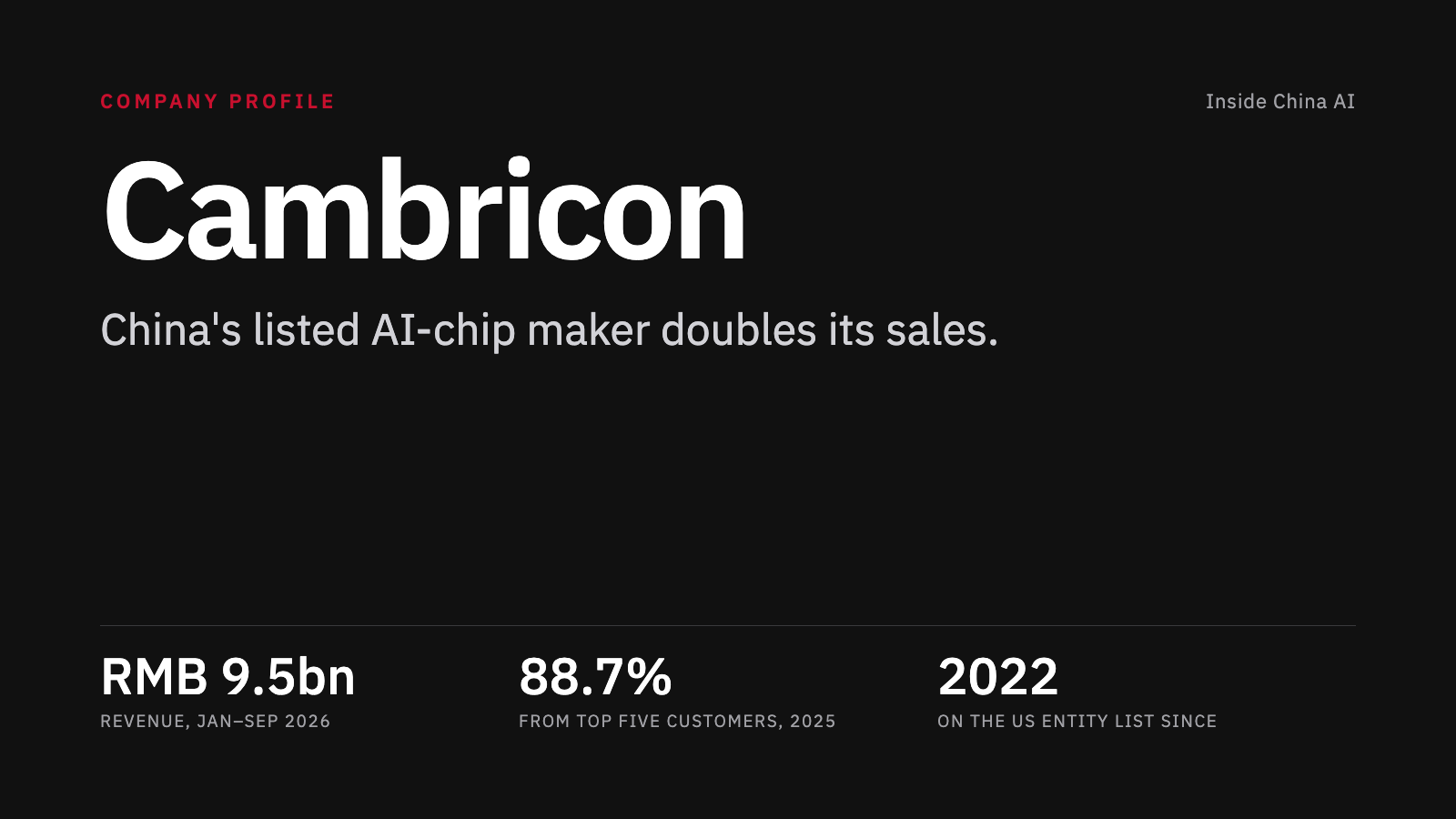
Graphic: Inside China AI
Cambricon: China’s Listed AI-Chip Maker Doubles Its Sales — at Home, With a Handful of Customers
Company profile · 20 November 2026.
Cambricon designs AI chips for data centres and sells them to Chinese internet and finance companies. In the first nine months of 2026 its revenue more than doubled to RMB 9.5 billion and it earned RMB 3.7 billion. In the first half of 2026 all of its revenue was booked in mainland China, in 2025 five customers accounted for 89 per cent of it, and the company has been on the US Entity List since December 2022. For Europe, Cambricon is not a supplier. It matters for two other reasons. It shows how far China’s own AI computing is getting without US chips, and the Entity List entry restricts what European firms may ship to it.
Origins and backing
Cambricon (寒武纪), legally Cambricon Technologies Corporation Limited, was registered in Beijing on 15 March 2016 by Chen Tianshi and Beijing Zhongke Suanyuan Asset Management, and has been listed on the Shanghai Stock Exchange’s STAR Market (688256) since 20 July 2020 (half-year report 2026). Chen, born in 1985, worked at the Institute of Computing Technology of the Chinese Academy of Sciences from 2010 to 2019. He is chairman and chief executive (annual report 2025).
The state is the second-largest owner. On 30 September 2026 Chen held 28.32 per cent of the shares directly, plus 7.26 per cent through a partnership he controls. Zhongke Suanyuan, classed in the filing as a state-owned legal person, held 15.56 per cent (third-quarter report). One of Cambricon’s directors runs Zhongke Suanyuan and also heads the technology development centre of the Academy’s computing institute (annual report 2025). In 2025 Cambricon raised RMB 3.99 billion in a private placement at RMB 1,195.02 per share (annual report 2025).
The market prices in a lot of growth. On 30 June 2026 the shares closed at RMB 1,595.55, at 368.97 times trailing earnings, against 74.86 for its industry. Cambricon itself published a warning about “估值较高的风险”, the risk of a high valuation (risk warning, 1 July 2026).
What they build
Cambricon designs chips but does not make them. Its filings describe a fabless model with suppliers that include IP licensors, server makers, wafer fabs and packaging firms (half-year report 2026). It sells AI chips and accelerator cards for data centres, complete servers built on them, edge chips, processor IP and the software to run them, including its NeuWare platform. The company says all of its chips and software are built on its own MLU instruction set. We found no foundation models of its own.
The business is almost entirely data-centre chips. In the first half of 2026 the cloud product line brought in RMB 5.99 billion of RMB 6.00 billion in revenue (half-year report 2026). Cambricon says its main buyers are leading companies in finance and the internet, which use the chips for large language models, multimodal AI and search and recommendation. Chinese labs run their models on the chips. Zhipu’s GLM-5 models, for example, run inference on Cambricon among other domestic chips (Inside China AI).
The newest chips are not in the filings. The reports and the website name chips only up to the Siyuan 370, a 7-nanometre chiplet design. The half-year report says a new generation of the microarchitecture and instruction set is “in development”. According to Bloomberg, reported by Tom’s Hardware on 12 December 2025, Cambricon planned to ship about 500,000 accelerators in 2026, including up to 300,000 of its Siyuan 590 and 690 chips. Tom’s Hardware also wrote that these chips depend on SMIC’s 7-nanometre-class “N+2” process and, citing Bloomberg, that yields on the largest chips are low. Those reports rest on unnamed sources, and we could not check the Bloomberg original. Cambricon has not confirmed them and does not name its foundry.
Few customers account for most of the sales. Over the past three years Cambricon’s five biggest customers made up 92.36, 94.63 and 88.66 per cent of revenue. The company calls this high customer concentration and lists it as a risk (annual report 2025). Four of the five largest customers in 2025 were new that year. The biggest bought RMB 1.70 billion, about a quarter of revenue. Cambricon does not name them. Press reports point to ByteDance: Bloomberg, as reported by Tom’s Hardware on 12 December 2025, said ByteDance accounted for more than half of Cambricon’s orders. Neither company has confirmed a purchasing relationship. On 18 June 2026 Cambricon’s securities representative told Yicai that circulating notes about chip deliveries to ByteDance were a rumour and that only official disclosures count. On 30 June 2026, 95.08 per cent of receivables were owed by five customers. Purchases were concentrated too: in 2025 one supplier accounted for 55.34 per cent of purchases.
The third quarter showed the strain on supply. Revenue rose 13.5 per cent from the second quarter (our calculation from the filings: RMB 3.53 billion against RMB 3.11 billion). Bloomberg, as reported by The Next Web on 23 October 2026, said that was well short of the RMB 6.26 billion analysts had expected. The Next Web pointed to tight supply of chips and high-bandwidth memory in China. Cambricon’s balance sheet shows it is stockpiling. Prepayments to suppliers rose from RMB 0.74 billion to RMB 3.04 billion in nine months, and notes payable from RMB 0.35 billion to RMB 4.97 billion (Q3 report). The company says the inventory write-down came mainly from raw materials it had stockpiled “strategically” that are now ageing (impairment announcement). Its 2026 share-incentive plan sets a revenue threshold of RMB 13.5 billion for 2026. That is a vesting condition for staff shares, not a forecast. Reaching it would take at least RMB 3.97 billion in the fourth quarter (our calculation).
There is also a large dispute. Liang Jun, a former vice president who left in early 2022, has sued Cambricon in a labour dispute over lost equity awards. On 1 October 2026 the company disclosed that he had raised his claim from RMB 4.29 billion to RMB 27.83 billion. The case has been accepted by the court but not yet heard. Liang has lost six related cases, and the company calls his claims improper (lawsuit announcement).
Key numbers
- Revenue RMB 3.53 billion in the third quarter of 2026 (+104.47%), RMB 9.53 billion in January–September (+106.76%) (Q3 report)
- Net profit RMB 1.40 billion in the third quarter (+147.74%), RMB 3.71 billion in January–September (+131.49%), attributable to shareholders (Q3 report); turned to a full-year profit in 2025, RMB 2.06 billion on revenue of RMB 6.50 billion (company announcement)
- Cash flow and stock Operating cash flow of minus RMB 84 million in the third quarter. Inventory rose to RMB 11.66 billion on 30 September 2026, from RMB 4.94 billion at the end of 2025 (Q3 report), and RMB 502 million of inventory was written down in nine months (impairment announcement)
- Customers Top five customers: 88.66% of 2025 revenue; the largest alone RMB 1.70 billion. Names not disclosed (annual report 2025)
- Incentive thresholds Revenue conditions of its 2026 share-incentive plan, not a forecast: at least RMB 13.5 billion in 2026 and RMB 100 billion cumulative for 2026–2028 (company announcement)
- Staff 1,007 R&D staff, 80.62% of all employees, on 30 June 2026 (half-year report)
- Listing Shanghai STAR Market, 688256, since July 2020; US Entity List since December 2022
The European angle
- Physical presence None. Cambricon lists offices only in Beijing, Shanghai, Shenzhen, Hefei, Xi’an, Kunshan and Nanjing (Cambricon). Its half-year report records no assets outside China. We found no European subsidiary, distributor, partner or named customer.
- Sales Revenue outside mainland China was RMB 67,082 in all of 2025 (annual report 2025). In the first half of 2026 there was none: all RMB 6.00 billion was booked in China (half-year report 2026). Cambricon does hold patents abroad. It had filed 718 patent applications outside China by 30 June 2026.
- Export controls The US Commerce Department added Cambricon and ten affiliated companies to the Entity List, effective 16 December 2022 (rule published 19 December 2022, 87 FR 77505). Besides nine companies bearing the Cambricon name, they include its subsidiary Nanjing Aixi Information Technology. The same rule listed the Academy’s Institute of Computing Technology. One listed company, Cambricon (Hong Kong) Co., Ltd., was dissolved by Cambricon on 11 July 2025 (annual report 2025) but is still on the list. The rule says they acquired or tried to acquire US-origin items “in support of China’s military modernization”. It requires a licence for all items subject to US export rules, including certain foreign-made items under the foreign direct product rule, with a presumption of denial (Federal Register). This concerns European firms too: a supplier in Europe shipping such items to Cambricon needs a US licence. Cambricon says the listing puts the stability of its supply chain at risk (half-year report 2026).
- Sanctions The Entity List is an export control, not a sanction. Cambricon is not on the EU’s consolidated financial sanctions list (version of 23 October 2026) and not on the Pentagon’s 1260H list of Chinese military companies (as downloaded on 14 November 2026), according to our check of the published lists.
- What a European buyer would actually encounter Not Cambricon hardware. Europeans meet it indirectly, as one of the domestic chips that Chinese model makers train or run their models on. That matters when Europeans use those models through Chinese APIs.
What we could not verify
- Who the five big customers are. Only ByteDance is named, and only by the press; neither company has confirmed it.
- Which foundry makes the chips, at what yield, and the specifications of the Siyuan 590 and 690. These rest on reports citing unnamed sources.
- The ownership chain of Zhongke Suanyuan back to the Chinese Academy of Sciences. The filing calls it state-owned but does not show the chain.
The open question for Europe: as more Chinese models are trained and served on chips like Cambricon’s, will their makers disclose which hardware runs the services Europeans use?
No responses yet