
Illustration: AI-generated · Inside China AI
Ox Alpha Was Chinese: What Zhipu’s GLM-5.3-Flash Proves — and What It Doesn’t
For a week in August, the most talked-about model on OpenRouter had no name and no owner. Developers called it Ox Alpha. It was fast, it was cheap, it was good — and nobody knew who made it. On 26 August, Zhipu AI ended the guessing: Ox Alpha was GLM-5.3-Flash, and according to the company, every request during that anonymous week was served on Chinese chips.
The market reacted immediately. Zhipu’s Hong Kong-listed shares closed more than 12 percent higher at HK$1,160. The reason is not the model’s size. It is what the episode appears to demonstrate: that a Chinese lab can run a frontier-class model at global scale without Nvidia — and that developers using it could not tell the difference.
What the model actually is
GLM-5.3-Flash is a 320B-A18B mixture-of-experts model — 320 billion total parameters, roughly 18 billion active per token — with text and vision capability. Zhipu released it under the MIT licence, which is the most permissive of the mainstream open-source licences and the detail most European companies should notice.
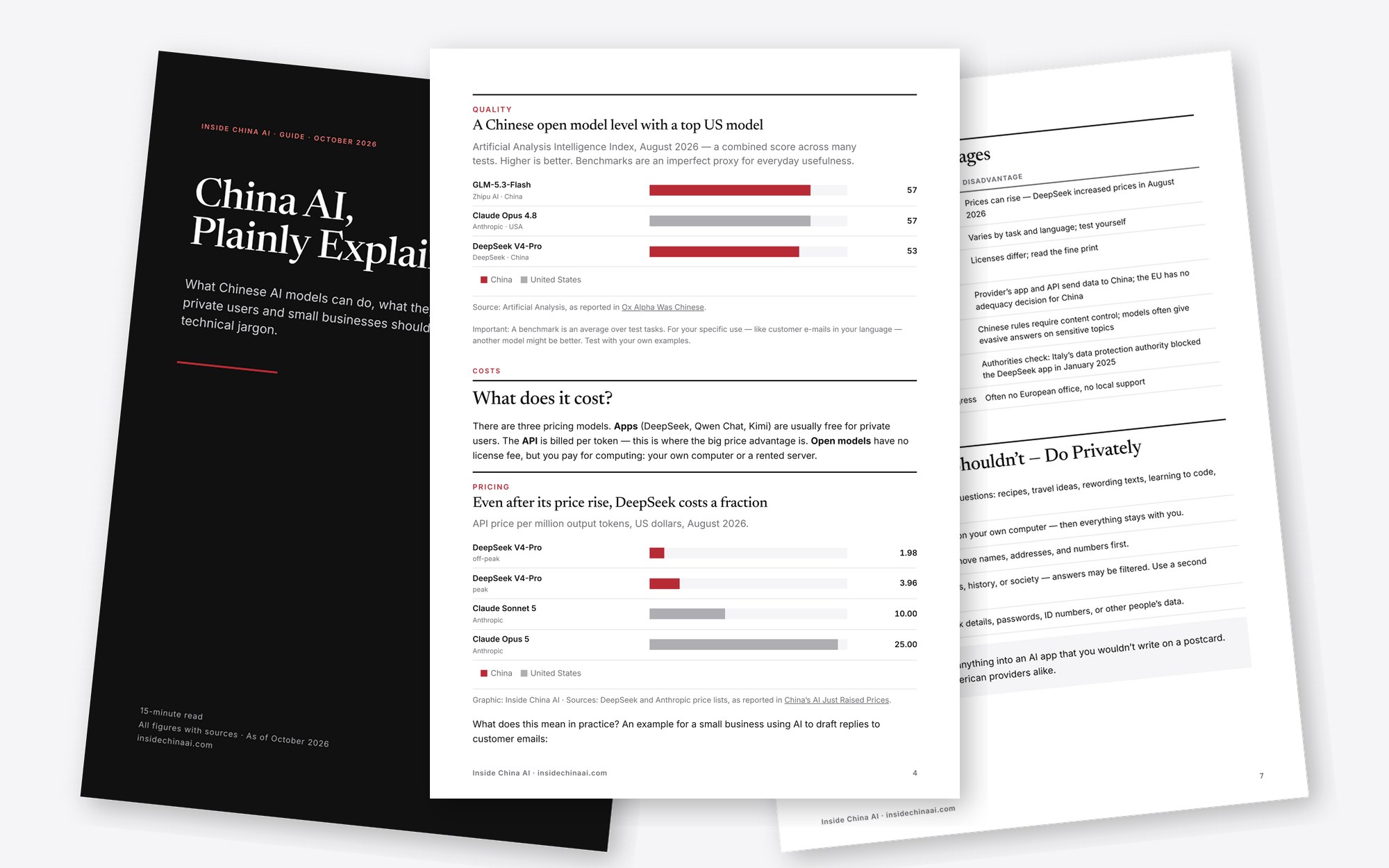
On the Artificial Analysis Intelligence Index it scores 57. That places it level with Anthropic’s Claude Opus 4.8 and above DeepSeek’s flagship V4 Pro, which scores 53. Benchmarks are an imperfect proxy for usefulness, and a composite index compresses a lot of disagreement into one number. But the ranking is not the interesting part. The interesting part is that developers reached for it before they knew where it came from.
The chip claim — and why we are flagging it
Zhipu states that inference is served by more than 100,000 domestically produced chips, and that “hardware efficiency and cost per token have reached levels comparable to mainstream NVIDIA GPUs.”
That claim has not been independently verified. CNBC reported it was unable to confirm it, and no third party has audited the deployment. We report it as what it is: a company statement, consequential if true, and so far unaudited.
There is a second reason for caution, and it is one much of the coverage has blurred. Two different models and two different numbers are being conflated. Zhipu’s larger GLM-5 — a 744-billion-parameter model — was reported as having been trained on roughly 100,000 Huawei Ascend accelerators. GLM-5.3-Flash is a different, smaller model, and the 100,000 figure here refers to inference capacity. Training and serving are different workloads with different hardware demands. Anyone citing “100,000 Chinese chips” should be clear which of the two they mean.
Which chips, and why that question matters
Zhipu has not published a hardware breakdown for this deployment. What is documented is that the GLM-5 family runs inference across a broad range of domestic silicon: Huawei Ascend, Cambricon, Moore Threads, Kunlun Chip, MetaX, Enflame and Hygon, with throughput achieved through kernel optimisation and quantisation rather than raw parity with Nvidia hardware.
That breadth is the actual signal. A single vendor reaching adequacy would be a product story. Seven vendors, plus a software layer that abstracts across them, is an ecosystem story — and ecosystems are considerably harder to constrain through export controls than individual suppliers.
Why it matters for Europe
Three consequences, in order of how soon they arrive.
First, the licence. A model at Claude Opus level released under MIT can be downloaded, modified, self-hosted and commercially deployed by any European company without negotiating terms. For organisations that cannot send data to a US or Chinese API — hospitals, public administration, defence suppliers, anyone under strict data-residency rules — that is not an incremental option. It is the difference between having a frontier-class model on their own infrastructure and not having one.
Second, the price floor. If Chinese labs can serve frontier-class inference on domestic hardware at costs they describe as Nvidia-comparable, the cost structure of the entire market shifts. European buyers negotiating with any vendor now have a credible alternative to point at — as we described in our analysis of China’s AI pricing.
Third, the strategic reading. Export controls were designed on the assumption that restricting advanced accelerators would restrain frontier capability. This episode is the clearest evidence yet that the assumption is being tested — and, on Zhipu’s account, failing. We examined the underlying shift in AI Without Nvidia: China’s Silicon Declaration of Independence. Ox Alpha is that thesis with a benchmark score and a share price attached.
The appropriate European response is neither alarm nor dismissal. It is verification. Somebody outside China should be able to confirm or refute the 100,000-chip claim, because a great deal of policy currently rests on it being false.
Sources: Zhipu AI company statements (26 August 2026); South China Morning Post; Pandaily; CNBC, which reported it could not independently verify the chip deployment; Artificial Analysis Intelligence Index. Corrections and additional information are welcome: press@insidechinaai.com
No responses yet