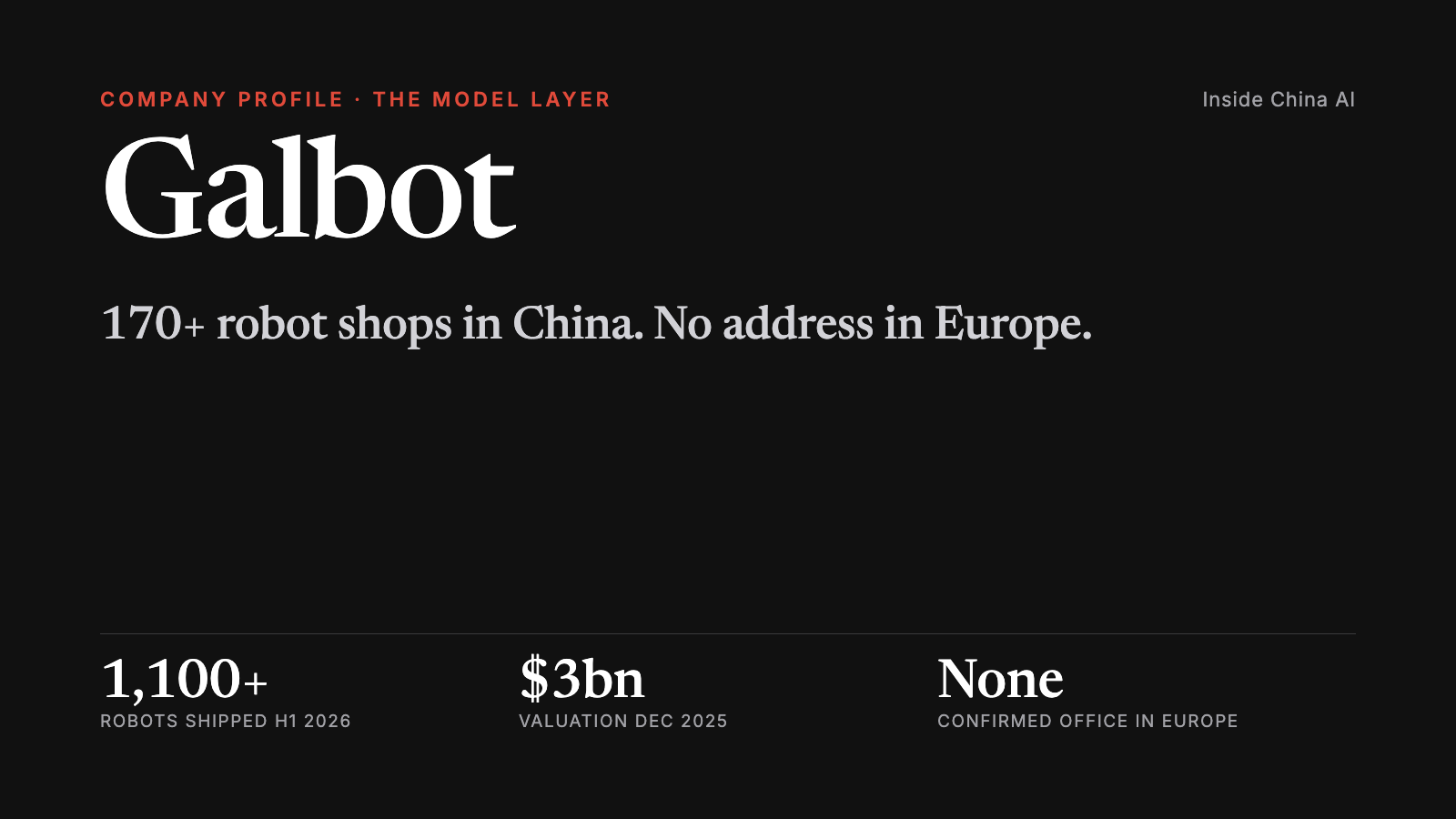
Graphic: Inside China AI
Galbot: China’s Robot Shopkeeper Is Everywhere at Home and Nowhere in Europe
Part of The Model Layer — profiles of the Chinese model and agent companies Europe is about to meet, starting with the ones speaking at Web Summit Lisbon. First sketched in Six Companies Europe Hasn’t Met. Company profile · 22 October 2026.
In Lisbon, Galbot’s listed speakers are its robots. In Munich three days earlier, it is sending its chief strategy officer. Galbot builds wheeled, two-armed robots and the models that drive them, and it has done something few humanoid companies anywhere can claim: put them to work in public, at scale, selling things. Its robot-run kiosks operate in more than 40 Chinese cities, and its robots run pharmacy stockrooms around the clock. It is China’s most valuable unlisted humanoid company by its own account, backed by the national AI fund, Sinopec, CATL and a Bosch investment arm. What it does not have yet is a single confirmed customer, office or partner in Europe.
Origins and backing
Galbot — Beijing Galbot Co., Ltd., 银河通用 in Chinese — was founded in May 2023 by Wang He, a Peking University researcher and Stanford graduate who studies embodied AI (Caixin; MIT Technology Review Innovators Under 35, which lists him as founder and CTO). It raised about RMB 700 million in mid-2024, the same year Hong Kong’s government fund HKIC invested an undisclosed amount and Galbot agreed to set up an embodied-AI lab in the city (Inspenet).
The money then came quickly. In June 2025 battery maker CATL and Puquan Capital led a round of about $150 million; in the same announcement Galbot set up a joint venture with Boyuan Capital, the investment arm of the Bosch Group in China, under a three-way agreement with Bosch China (The AI Insider). A round of about $300 million in December 2025 put the post-money valuation at $3 billion; in March 2026 Galbot raised another RMB 2.5 billion, about $350 million, with Sinopec and Citic among the investors (Caixin). Industry insiders called it the first investment by China’s national AI industry investment fund in an embodied-intelligence company (CCPIT).
What they build
Galbot’s machines are not walking humanoids. The G1 is a wheeled robot with two arms, built to pick items off shelves, pack them and hand them over. The S1, launched in January 2026, is a heavier wheeled two-arm robot for industrial and logistics work; in March the company announced successful tests on CATL production lines (Counterpoint Research). Behind both sits a family of in-house models the company calls AstraBrain, which it describes as an end-to-end model for the robot’s “brain”, “cerebellum” and motor control (company website).
The commercial bet is retail. Galbot’s “Space Capsule” kiosks — small robot-staffed shops — are running at more than 170 sites in over 40 cities, from the Summer Palace in Beijing to Chunxi Road in Chengdu, according to senior vice president Zeng Hui at the World Robot Conference in August (Sina Finance). Three opened in Hong Kong on 1 September (The Standard). In Shanghai, a G1 has run the instant-delivery stockroom of a Laobaixing pharmacy around the clock since September, filling 400 to 500 orders a day, the company says (PR Newswire Asia).
The volumes are real enough to register. Counterpoint Research counts more than 1,100 Galbot units shipped in the first half of 2026 — about 5 per cent of a global market of some 22,000 humanoid robots, third behind AgiBot and Unitree.
Key numbers
- Founded May 2023, Beijing, by Wang He (Peking University)
- Funding RMB 2.5 billion (~$350 million), March 2026, with the national AI industry investment fund, Sinopec and Citic. Earlier: ~$300 million (December 2025), ~$150 million led by CATL (June 2025), ~RMB 700 million (2024).
- Valuation $3 billion post-money after the December 2025 round (Caixin). The March 2026 figure was not disclosed; the company calls itself the highest-valued unlisted humanoid firm.
- Listing Private. Bloomberg reported in December 2025 that Galbot had picked Citic Securities, Huatai and UBS for a Hong Kong IPO; Galbot called that untrue but has since converted into a joint-stock company, a usual step before listing (Humanoids Daily, Caixin). No filing found.
- Shipments More than 1,100 units in H1 2026, about 5% of the global market, No. 3 worldwide (Counterpoint Research).
- Deployments 170+ robot kiosks in 40+ Chinese cities (company, August 2026); robot-run pharmacy stockrooms in Beijing and Shanghai; first stores in Hong Kong.
- Open weights No public model weights found; AstraBrain is proprietary.
- Revenue Not disclosed.
The European angle
- Physical presence None found. No European office, entity, distributor or job listing.
- European customers or partners None confirmed in Europe. The Bosch link is a joint venture with Bosch’s investment arm in China, set up to commercialise industrial robots; we found no report of it operating outside China. CATL, an investor and test customer, runs battery plants in Germany and Hungary — we have seen no announcement that Galbot robots will work in them.
- Where Europe will meet it Galbot is a speaker and event partner at Humanoid Europe 2026, the Europe–China humanoid summit in Munich on 5–6 November, represented by chief strategy officer Zhao Yuli (event website). At Web Summit Lisbon the app lists two of its robots, G1 and ET1, as speakers.
- Regulatory exposure A robot that works next to shoppers or pharmacy staff in Europe would fall under the EU Machinery Regulation, which applies from January 2027, and — where AI is a safety component of such a machine — under the AI Act’s high-risk rules for regulated products. Cameras in shops add GDPR. None of this is unusual for a robot maker; it is simply the work no Chinese humanoid company has yet shown it has done for Europe.
- What a European buyer would actually encounter A company with hundreds of public deployments at home, a state-heavy cap table, and no European counterparty to sign with.
What we could not verify
- Toyota as a customer. Analyst profiles list Toyota among Galbot’s reference customers; we found no primary source.
- Whether the kiosks make money. Store counts and order volumes are the company’s own; unit economics are not published.
- The March 2026 valuation. Chinese media have reported figures well above $3 billion; the company has not confirmed one.
- What ET1 is. The robot is listed as a speaker in Lisbon and on the company’s website, without a public specification.
- The Bosch joint venture’s reach. Whether it will ever sell or deploy outside China.
Galbot’s chief strategy officer speaks in Munich on 5–6 November; its robots are booked for Web Summit Lisbon, 9–12 November. The question we will ask: when a European retailer or carmaker wants a Galbot, who sells it, who services it, and who signs for its compliance? Answers, or their absence, in our Web Summit 2026 coverage.
No responses yet