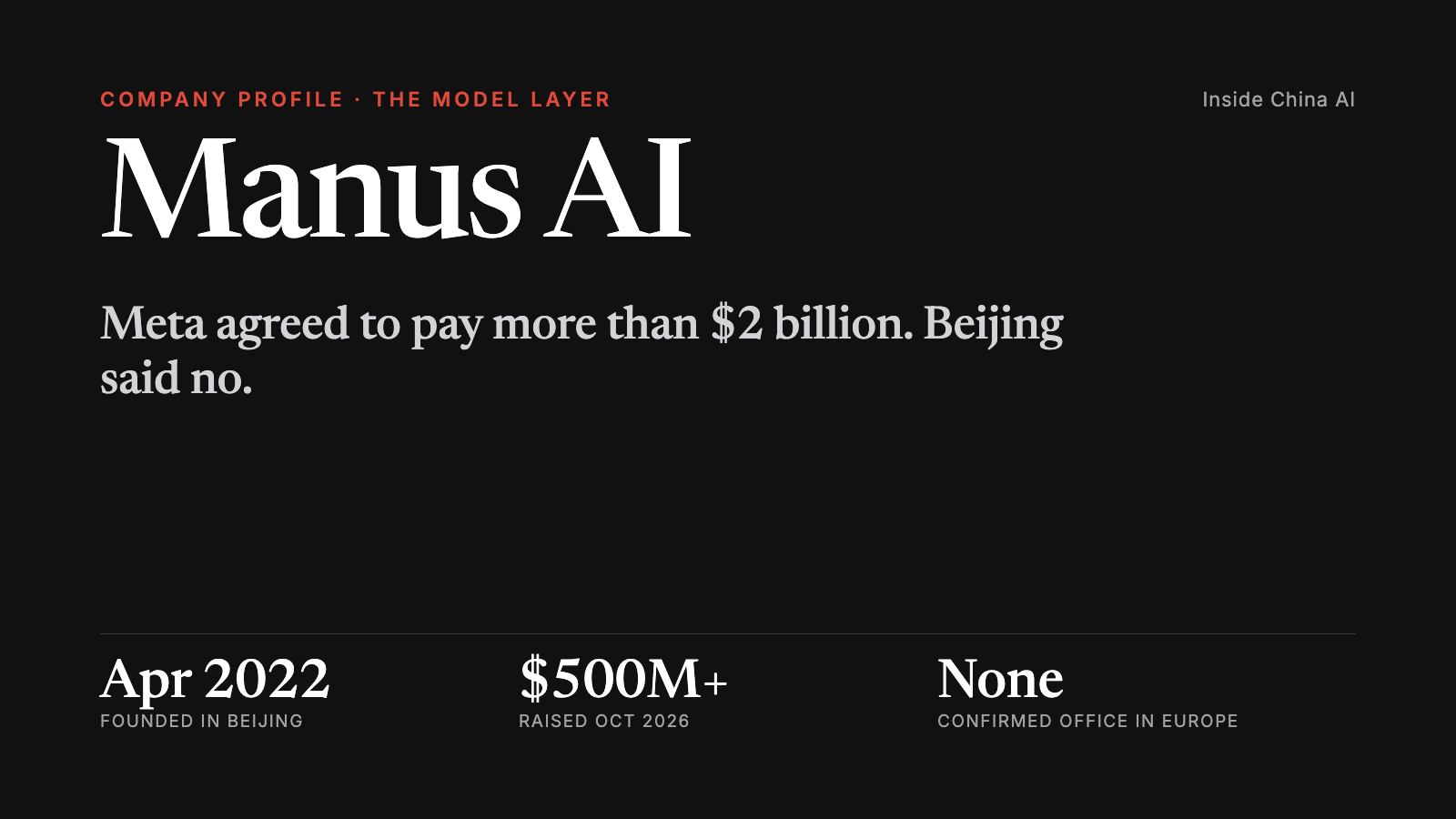
Graphic: Inside China AI
Manus AI: The Agent Company Beijing Would Not Let Go
Part of The Model Layer — profiles of the Chinese model and agent companies Europe is about to meet, starting with the ones speaking at Web Summit Lisbon. First sketched in Six Companies Europe Hasn’t Met. Company profile · 22 October 2026.
Meta agreed to pay more than $2 billion for it. Beijing said no. Six months later, the company raised more than $500 million on its own — and nobody will say what it is worth. Manus builds general-purpose AI agents: software that takes a task, opens a virtual computer and works through it. It was born in Beijing, moved to Singapore, was bought by an American company and un-bought by a Chinese regulator. Its co-founder and chief product officer, Tao Zhang, speaks at Web Summit in Lisbon next month. Whether Manus still counts as Chinese is a question the company would rather you did not ask — and the one European buyers have to.
Origins and backing
Butterfly Effect, the company behind Manus, was registered in Beijing in April 2022 — two months before ChatGPT — by Xiao Hong, known as “Red”, with Ji Yichao (“Peak”) as chief scientist and Tao Zhang as product lead. By 2023 it had set up entities in Hong Kong, the Cayman Islands and Singapore, according to Caijing (Hello China Tech). ZhenFund seeded it; HSG (formerly Sequoia China) and Tencent led a Series A in November 2024; Benchmark led a roughly $75 million Series B in April 2025 at a valuation near $500 million (TechCrunch).
In mid-2025 the headquarters moved to Singapore. Of roughly 120 China-based staff, about 40 core engineers relocated; the rest were laid off (Tech in Asia, via Wikipedia). The move was the beginning of the trouble, not the end of it.
What they build
Manus launched in invitation-only beta on 6 March 2025 and went viral within a day; invite codes were resold for tens of thousands of yuan. The product is an autonomous agent: give it a task — research, a presentation, a working app — and it plans, browses, writes and executes inside its own cloud computer. The company says it has created more than 80 million such virtual computers and processed 147 trillion tokens since launch (company blog). Manus 1.5 marked a growth inflection, Manus 1.6 shipped in December 2025, and Manus 2.0 followed in 2026 on what the company calls a new harness. A standalone app, Cue, gives personal agents their own email address, phone number, wallet and computer, with payments inside user-set limits (TechCrunch).
What Manus does not build is the model. It has always run on third-party foundation models — early on, American ones unavailable inside China — which is why it could be fast, and why its ownership mattered so much to two governments.
The deal that was not allowed
In December 2025 Meta agreed to acquire Manus for more than $2 billion; the Wall Street Journal put the range at $2–3 billion. In January 2026 China’s Ministry of Commerce opened an “evaluative investigation”. In March, exit bans on executives were reported. On 27 April 2026 the National Development and Reform Commission’s foreign-investment security review office prohibited the acquisition and ordered the parties to withdraw — without naming Meta and without giving reasons. Meta said the transaction “complied fully with applicable law”; on 15 June it cut ties, locked Manus staff out of its systems and barred its own employees from using the product. Manus announced its return to independence on 11 August and said it formally resumed independent operations on 1 September (CNBC, Bloomberg, via Wikipedia and Hello China Tech). Some user data had to be deleted as part of the split (TechCrunch).
The reading from Beijing was given to Asia Times by an NDRC-affiliated researcher: not a ban on Chinese firms expanding abroad, but “a ban on evading regulation” — a warning against what the piece calls “Singapore washing” (Asia Times).
Key numbers
- Founded April 2022, Beijing; overseas headquarters Singapore since mid-2025
- Funding More than $500 million announced 8 October 2026, led by Boyu Capital and IDG Capital, with Tencent, HSG and ZhenFund; the first round since the Meta split. Earlier: ~$75 million Series B (Benchmark, April 2025).
- Valuation Not disclosed. A $4 billion target was reported in September (TechCrunch); Manus has not confirmed it. Before the round, Tencent held about 20 per cent as largest single shareholder, per Caijing.
- Listing Private. A Hong Kong IPO is reportedly under consideration, not before 2027 (Reuters source, via Hello China Tech).
- Open weights No. Manus is a proprietary product built on third-party models.
- Headcount 105 across Singapore, Tokyo and San Francisco, per the company in December 2025. Seventeen Beijing-based job listings in October 2026 point to a China product team being rebuilt.
- Revenue $100 million ARR eight months after launch and a $125 million run-rate, per the company in December 2025. Company figures, not audited.
The European angle
- Physical presence None confirmed. A Paris office has been “opening soon” since December 2025; we found no evidence it has opened.
- European customers or partners None named. The product is available to European users through web, desktop and mobile apps.
- Hiring in Europe No European roles found; the company’s October listings are in Beijing.
- Regulatory exposure Three layers at once. GDPR, because user data runs through a Singapore entity owned via the Cayman Islands. The EU AI Act, because an agent that browses, pays and executes on a user’s behalf is the kind of system the Act’s transparency and oversight duties were written for. And the NDRC precedent: Beijing has shown it treats Manus as Chinese regardless of where the headquarters sits. A European enterprise contract with the Singapore entity does not change that.
- What a European buyer would actually encounter A polished agent product with a Singapore counterparty, a Chinese cap table led by Tencent, Boyu and IDG, and a recent history in which a $2 billion ownership change was reversed by a government that was not party to it.
What we could not verify
- The valuation. $4 billion is a reported target, not a confirmed post-money figure.
- The Paris office. Announced as imminent ten months ago; no opening, address or hire has been reported since.
- Which models run Manus 2.0. The company does not say; after the Meta split and with a China product in preparation, the answer may differ by market.
- Who financed the buyback from Meta, and on what terms. Caijing reports the resulting cap table; nobody reports the mechanism.
- Revenue and user figures, which are the company’s own.
Tao Zhang speaks at Web Summit Lisbon, 9–12 November. The question we will ask: which legal entity does a European customer sign with — and which government does that entity answer to? Answers, or their absence, in our Web Summit 2026 coverage.
No responses yet