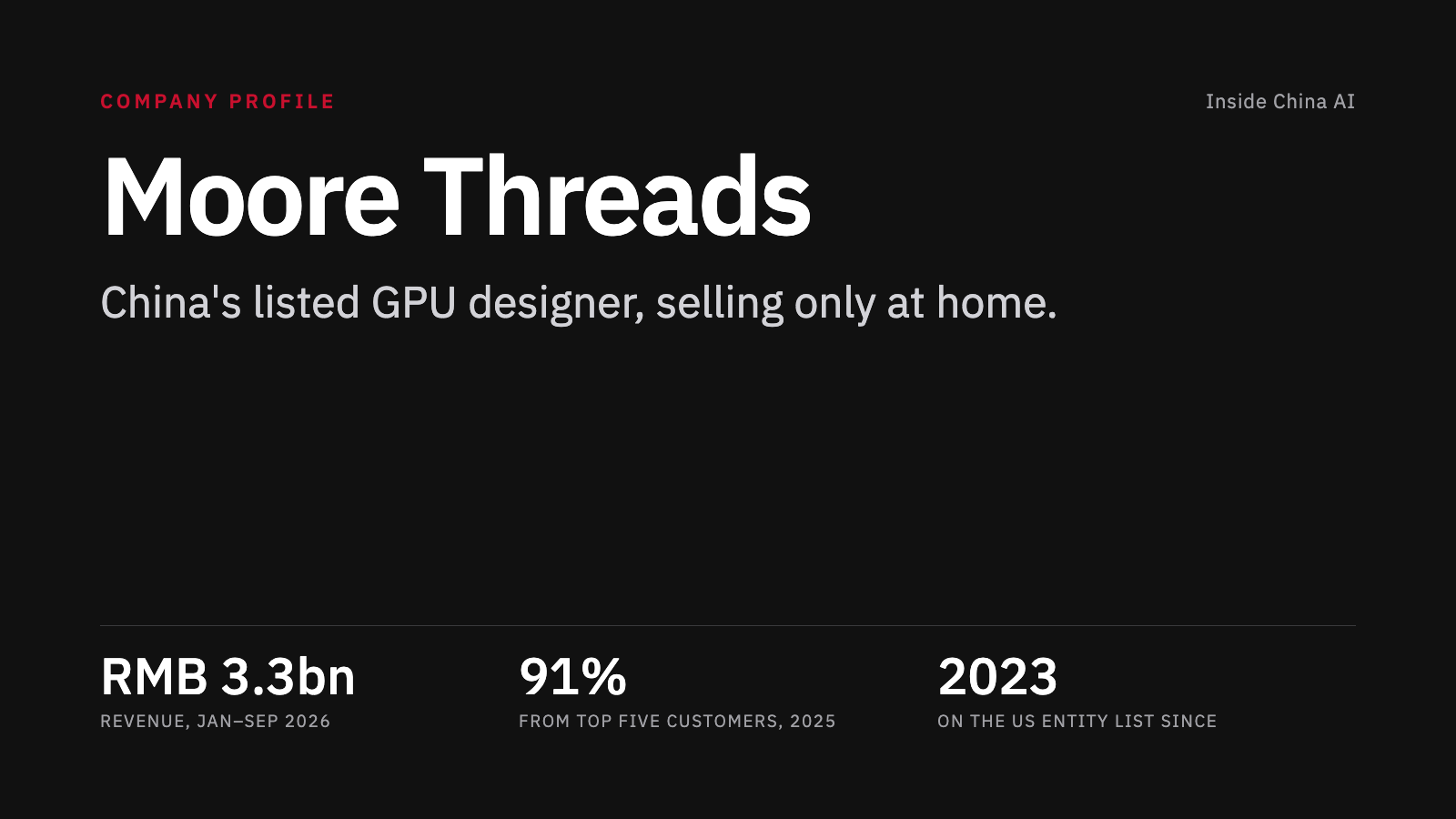
Graphic: Inside China AI
Moore Threads: China’s Listed GPU Designer Turns a Quarterly Profit — on Sales Made Entirely at Home
Company profile · 20 November 2026.
Moore Threads designs graphics processors and AI accelerator cards in Beijing and sells them almost exclusively in China. In the third quarter of 2026 its revenue rose to RMB 1.55 billion and it reported a net profit of RMB 49 million; in the first half of the year it booked no revenue outside mainland China, and in 2025 five customers accounted for 91 per cent of its sales. It has been on the US Entity List since October 2023. For Europe, Moore Threads is not a supplier. It matters as a measure of how far China’s own AI computing gets without US chips, and as a company on the US Entity List.
Origins and backing
Moore Threads (摩尔线程), legally Moore Threads Technology Co., Ltd., was established in Beijing on 11 June 2020 and began operating in October 2020 (listing announcement; Moore Threads). Its founder, Zhang Jianzhong, was a global vice president and general manager for Greater China at Nvidia from April 2006 to September 2020, after posts at HP China and Dell China. He has been general manager since November 2023 and chairman since December 2023, according to the same listing document.
The company listed on the Shanghai Stock Exchange’s STAR Market (688795) on 5 December 2025. It sold 70 million new shares at RMB 114.28 each and raised RMB 8.0 billion gross, RMB 7.58 billion net (listing announcement). On the first day the shares closed at RMB 600.50, up 425 per cent (Xinhua). On 11 December 2025, at a closing price of RMB 941.08, the company itself warned that its price-to-sales ratio of 1,008.84 was far above the sector’s 11.76 (risk warning). On 7 September 2026, the day the first 25.8 million lock-up shares became tradable, the stock fell by its 20 per cent daily limit to RMB 415.48 (Yicai).
There is no controlling shareholder (listing announcement). Zhang held 9.41 per cent directly at 30 September 2026. He has an acting-in-concert agreement with two shareholding platforms, among them the largest shareholder, Nanjing Shen’ao, with 12.38 per cent, and is the managing partner of three employee shareholding platforms, which makes him the actual controller (Q3 report). Shareholders approved a second listing in Hong Kong on 28 August 2026, which the board justified as a step in its internationalisation strategy (announcement; shareholder vote).
What they build
Moore Threads is a fabless chip designer: it buys wafers, packaging and testing from outside manufacturers, which its filings do not name (half-year report 2026). It says it has brought out five GPU architectures since 2020 and calls its chips “full-function” GPUs, meaning one chip handles AI computing, graphics, simulation and video. The newest architecture, Huagang, was announced in December 2025 and is designed for clusters of more than 100,000 cards, the company says.
Almost all of the money comes from data centres. In the first half of 2026, cloud products — the MTT S5000, S4000 and S3000 accelerator cards, servers and the KUAE computing clusters — brought in RMB 1.69 billion of RMB 1.74 billion in revenue (half-year report 2026). The rest comes from the MTT S80 consumer graphics card, a professional card, an edge-AI module built on the company’s own “Changjiang” chip, and two devices, the MTT AIBOOK laptop and the MTT AICUBE home AI box. The MTT S5000 has passed security evaluations by two Chinese state testing centres, the company says.
Its software layer is called MUSA. Moore Threads says it has more than 800,000 developers and that the open-source inference framework SGLang has merged MUSA support into its main code. It also says it supported DeepSeek-V4, MiniMax M3 and Zhipu GLM-5.2 on release day. We found no foundation models of its own; Moore Threads runs and trains other companies’ models. Our own reporting found that Zhipu’s GLM-5 family runs inference on Moore Threads chips among other Chinese silicon (Inside China AI).
Customers are mostly unnamed. On 31 March 2026 Moore Threads announced a RMB 660 million contract for a KUAE cluster and withheld the customer’s name as a trade secret (announcement). In September 2026 JD Cloud announced plans for a cluster of 100,000 Moore Threads GPUs (TechNode). The company also says its cloud-PC products are in commercial use with China Mobile and other carriers in several provinces (half-year report 2026).
Key numbers
- Listing Shanghai STAR Market (688795) since 5 December 2025; offer price RMB 114.28, gross proceeds RMB 8.0 billion
- Revenue RMB 3.29 billion in January–September 2026, up 319 per cent; RMB 1.55 billion in the third quarter alone, up 1,774 per cent (Q3 report)
- Profit Net profit RMB 49.3 million in Q3 2026 and RMB 37.7 million for January–September; excluding one-off items, a loss of RMB 130.7 million for the nine months; unaudited (Q3 report). Net loss in 2025: RMB 1.0 billion (annual report 2025)
- Cash and stock Operating cash outflow of RMB 3.31 billion in January–September 2026, which the company attributes to larger production and strategic stockpiling to secure its supply chain; inventories rose to RMB 3.36 billion from RMB 1.33 billion at the end of 2025 (Q3 report)
- Customers Five largest customers: 91.36 per cent of 2025 sales (annual report 2025)
- Research R&D spending RMB 1.34 billion in January–September 2026, 41 per cent of revenue (Q3 report); 1,019 R&D staff at 30 June 2026, 74 per cent of the workforce (half-year report 2026)
- Revenue outside mainland China RMB 1.9 million in 2025 (0.13 per cent, our calculation); none in the first half of 2026
The European angle
- Presence None that we could find. Moore Threads reported no revenue outside mainland China in the first half of 2026, and foreign assets of RMB 11.9 million, 0.07 per cent of the total (half-year report 2026). It has three wholly owned subsidiaries abroad, listed only as “Subsidiary A, B and C” without a location. In 2025 it booked RMB 1.9 million abroad without naming the countries (annual report 2025).
- Gaming cards The MTT S80 is the product a European consumer is most likely to have heard of. On the English website, both “Buy Now” and the purchase link lead to Moore Threads’ store on JD.com in China (Moore Threads). We found no European distributor or retailer.
- Export controls The US Commerce Department added Moore Threads’ Beijing, Chengdu and Shanghai companies to the Entity List with effect from 17 October 2023; the Beijing entry carries the alias “Moore Threads” (88 FR 71991). The rule says the entities “are involved in the development of advanced computing integrated circuits”. It imposes “a license requirement for all items subject to the EAR, which will be reviewed under a presumption of denial”, and a footnote 4 designation, under which these items “include foreign-produced items that are subject to the EAR pursuant to § 734.9(e)(2)”. The company says the listing limits its purchases of US-made materials and of IP and R&D tools containing US technology. It also says production equipment held at a supplier became unusable as a result (half-year report 2026).
- Other lists Moore Threads is not named in the US Defense Department’s Section 1260H list of 10 June 2026 (91 FR 35189). A name check against the EU’s consolidated financial sanctions list (version of 23 October 2026) found no entry. The Entity List is an export control, not a sanction.
- What a European buyer would actually encounter Today, nothing for sale. For European companies, the relevant fact today is its listing on the US Entity List; we found no sales in Europe.
What we could not verify
- Where the three foreign subsidiaries are, and what they do; the filings anonymise them.
- Which countries the RMB 1.9 million of foreign revenue in 2025 came from.
- Who manufactures its chips, and who the RMB 660 million cluster customer is.
- The company’s performance claims for its chips and clusters, which no independent test we found has confirmed.
The open question for Europe: if Moore Threads lists in Hong Kong in the name of internationalisation, will it ever sell outside China — and could it, while on the Entity List?
No responses yet