Graphic: Inside China AI
Airdoc: Beijing’s Retinal-Screening AI Company and Its CE-Marked Products
Company profile · 28 November 2026.
Airdoc (鹰瞳科技) sells AI that reads photographs of the back of the eye. From a single fundus image, the company says, its software assesses 55 eye diseases and the risk of heart attack, stroke and dementia. Since 2023 it has added a light-therapy device for short-sighted children, and the company says everything now runs on its own medical language model, WanYu. Airdoc listed in Hong Kong in 2021. It says its products carry EU CE marking, and it names Europe as a target market. Its filings name no European customer, partner or subsidiary; the EU’s medical device database lists an authorised representative in Germany and two importers in the Czech Republic. For European health systems, opticians and insurers, Airdoc is one of the more mature Chinese medical-AI vendors. Before buying, they would want to see the certificates and know how its patient data is handled.
Origins and backing
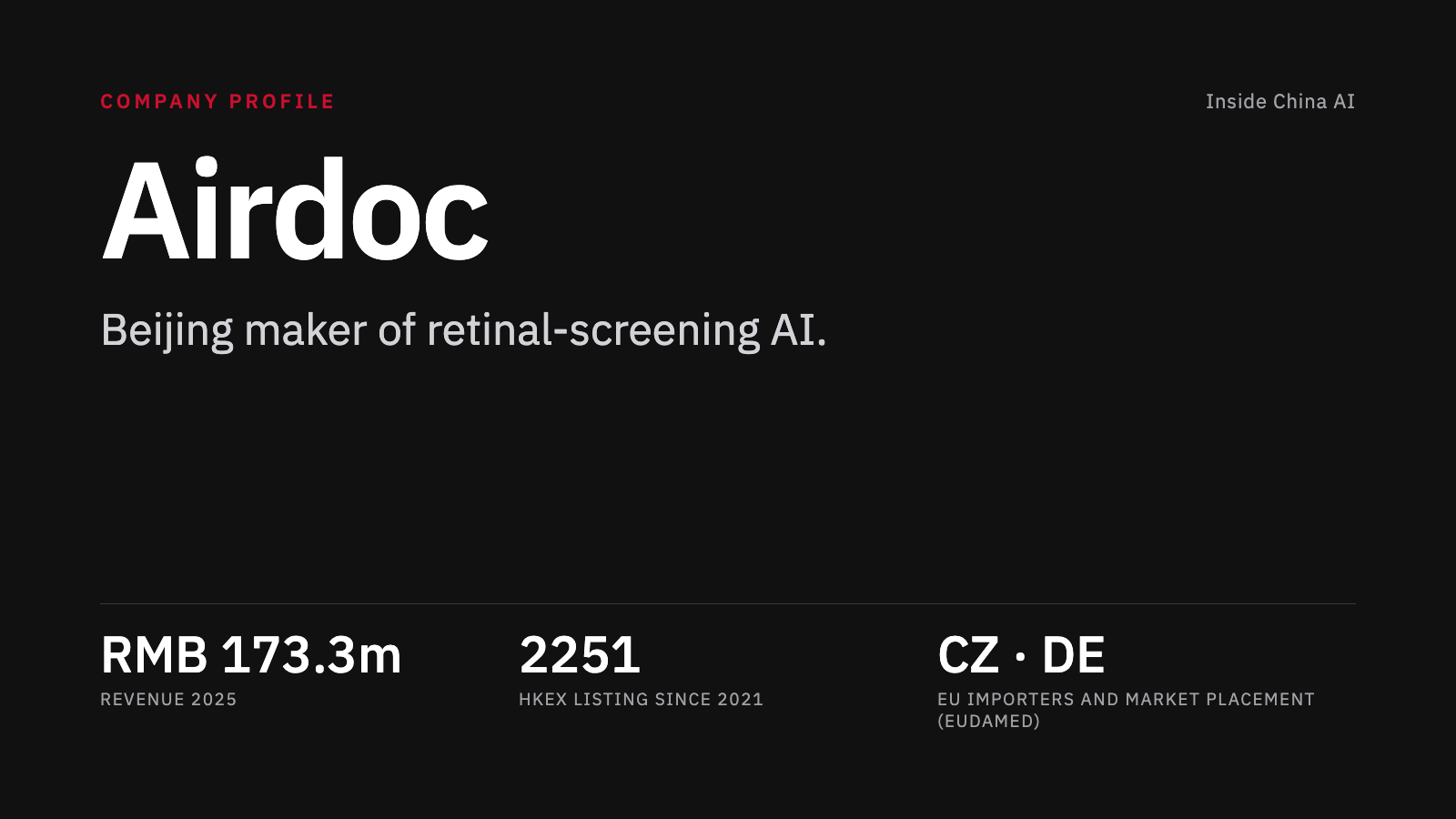
Beijing Airdoc Technology Co., Ltd. (北京鹰瞳科技发展股份有限公司) was set up in Beijing on 9 September 2015. It became a joint-stock company on 28 December 2020 and listed its H shares on the Main Board of the Hong Kong stock exchange on 5 November 2021, under the code 2251. The listing raised net proceeds of HK$1,550.7 million (interim results, 28 August 2026). Its head office is in Haidian District, Beijing (Airdoc).
Founder Zhang Dalei (张大磊) is chairman and chief executive. Before founding Airdoc he was a programme manager in Microsoft China’s Macintosh business unit from 2008 to 2010, then chief technology officer of Ethos Technologies, and briefly product vice president at Sina Technology in 2015 (annual report 2025). At 30 June 2026 he held 17.11 per cent of the shares directly. He held a further 1.89 per cent through an employee incentive platform of which he is general partner, and 0.98 per cent through a family trust. Fosun International held 6.99 per cent and Ping An Insurance 6.92 per cent, each through subsidiaries; one private individual held 11.04 per cent (interim report 2026). On 17 October 2025 Zhang and two other early shareholders ended a voting agreement they had signed in 2016 (HKEX announcement). Airdoc is buying back its own shares, which it holds as treasury shares. On 27 November 2026 it bought 104,000 shares at an average of HK$9.05 (HKEX return).
What they build
Airdoc’s oldest business is retinal screening. The camera photographs the fundus and the software flags disease. In August 2020 its diabetic-retinopathy software received what the company calls the first Class III certificate for a fundus AI device from China’s National Medical Products Administration (interim results 2026). Today the line is called Retina-AI. The company says it ran in 8,523 active service sites in the first half of 2026, from community clinics and health-check centres to optometry shops. Around 3.18 million tests were done in that half-year, and the company counts more than 37 million in total (interim results). Airdoc makes its own fundus cameras in a factory in Changsha, Hunan. It says the factory has been operating since October 2022 and is designed for 100,000 cameras a year.
The second line, PBM-AI, treats myopia in children with low-level light therapy. Airdoc entered it in 2023 by buying Beijing Zhitong Technology, a maker of myopia devices (HKEX announcement, 18 July 2023). A new-generation device received a Chinese Class II certificate in August 2026 for children aged 6 to 15. The third line, Neuro-AI, measures what the company calls stress resilience from eye movements; it was certified in March 2026 and earned RMB 0.4 million in its first half-year (interim results).
All three now run as “agent” applications on WanYu (万语), which Airdoc describes as a medical vertical large language model. The company says the model was built on “nearly 40 million real-world clinical diagnosis and treatment data” and combines agents, retrieval, multimodal algorithms and medical knowledge graphs. It reports that its businesses consumed 402.6 billion tokens in the first half of 2026 (interim results). Airdoc has published no model card, weights or benchmark for WanYu, and we could not test the model.
Key numbers
- Listing Hong Kong Main Board since 5 November 2021 (2251); founder and CEO Zhang Dalei is the largest shareholder
- Revenue RMB 173.3 million in 2025 (2024: RMB 156.4 million); RMB 67.3 million in the first half of 2026, down 19.6 per cent (annual results 2025; interim results 2026)
- Result Loss of RMB 24.4 million in 2025 (2024: loss of RMB 265.1 million); loss of RMB 48.9 million in the first half of 2026, after a profit of RMB 0.4 million a year earlier
- By product, H1 2026 Retina-AI RMB 36.9 million; PBM-AI RMB 27.9 million (up 24.0 per cent); Neuro-AI RMB 0.4 million
- Overseas revenue RMB 19.2 million in 2025; RMB 7.6 million in the first half of 2026, down 26.2 per cent; no regional breakdown
- Cash RMB 565.4 million in cash and cash equivalents at 30 June 2026
- Staff 155 full-time employees at 30 June 2026, down from 181 at the end of 2025 and 248 at the end of 2024
- Customers The largest customer accounted for 21.8 per cent of 2025 sales, the five largest for 50.8 per cent; none is named (annual report 2025)
Airdoc attributes the fall in revenue in the first half of 2026 to “more stringent agent selection policies and the tightening of credit term policies”, meaning stricter rules for its sales agents (interim results). The first-half figures are unaudited. As a Hong Kong Main Board company, Airdoc reports half-yearly and has published no third-quarter figures.
The European angle
- Certification On 8 January 2024 Airdoc announced that its diabetic-retinopathy software Airdoc-AIFUNDUS (1.0) had received CE marking under the EU Medical Device Regulation, “which grants the full access to 27 European Union countries” (HKEX announcement). In its interim results for 2026, a registration table lists CE approval for both Retina-AI and the PBM-AI myopia product (interim results). EUDAMED, the EU’s medical device database, lists the Shanghai subsidiary’s “Retinal Image Intelligent Analysis Software” as a Class IIa device under the MDR, placed on the market in Germany and with the status “on the market”; its EU authorised representative is Luxus Lebenswelt GmbH in Willich, Germany (EUDAMED device entry, checked 27 November 2026). EUDAMED also lists two fundus cameras, AI-FD16M and AI-FD16aN, from the Changsha subsidiary as Class I devices on the market, with SUNGO Europe B.V. in the Netherlands as authorised representative (EUDAMED).
- Presence No own entity found. The 2025 annual report lists Airdoc Technology (HK) Limited in Hong Kong as its only principal subsidiary outside mainland China (annual report 2025). In November 2024 the company showed its AI-FD16H fundus camera at the medical trade fair in Düsseldorf, according to its own press release (company press release via PR Newswire, 11 November 2024). EUDAMED lists two Czech companies as importers: Medicton Group s.r.o. since 17 October 2023 and Novatin s.r.o. since 30 March 2026 for the Shanghai subsidiary, Novatin also since 1 January 2025 for the Changsha subsidiary (EUDAMED, checked 27 November 2026). Airdoc itself names no European distributor, and we found no hospital or optician chain in Europe that uses its products.
- Where it does sell abroad The filings name commercial sales in Saudi Arabia, Oman, Brazil and Mexico, and registrations in Indonesia, Thailand, Vietnam, Malaysia, Singapore, the Philippines, the UAE and South Africa (annual results 2025). The company describes a “multi-layered global business footprint covering Europe, Southeast Asia, the Middle East and the Americas”. It lists Europe among the regions where it wants to expand its channels, but names no European country of sale (interim results).
- Visibility in Geneva In May 2026 Airdoc presented its products at a China-themed side event of the 79th World Health Assembly. It also says it works on research projects funded by the Bill & Melinda Gates Foundation, among them an algorithm that predicts pre-eclampsia from eye images, aimed at low- and middle-income countries (interim results). The company has not named the projects.
- United States Airdoc says its Retina-AI holds US FDA certification (annual results 2025). The FDA’s registration and listing database lists a device registration for the “AI-FD16M / fundus camera” of its subsidiary Changsha Airdoc Health Technology (FDA via openFDA, checked 27 November 2026).
- Data WanYu is trained on Chinese clinical data. Airdoc says operational data from its products may be used for model training “subject to obtaining applicable authorisations, completing data de-identification, and ensuring compliance governance” (interim results).
- Lists Airdoc, its founder and its substantial shareholders Fosun International and Ping An Insurance do not appear on the EU’s consolidated financial sanctions list, the US Consolidated Screening List, which includes the Entity List, or the Pentagon’s Section 1260H list (checked 27 November 2026). We found no proceedings by EU or national regulators.
- What a European buyer would actually encounter An established Chinese screening company with Chinese Class III approval, CE-marked products listed in EUDAMED, its own camera factory and a large Chinese data set. In Europe it works through an authorised representative and registered importers, with no own entity or named reference customer.
What we could not verify
- The CE certificates: notified body, certificate numbers and validity.
- Any European customer, what the two Czech importers sell and to whom, and how much of the overseas revenue, if any, comes from Europe.
- Data processing: where images from users outside China are processed.
- The WanYu model: size, architecture, benchmarks, and whether it has been filed with China’s Cyberspace Administration as a generative AI service.
The open question for Europe: will Airdoc build on its CE marks and Czech importers with named European customers and local data handling, or will Europe stay a small part of its overseas business?

Comments are closed