China AI Weekly — November 29, 2026
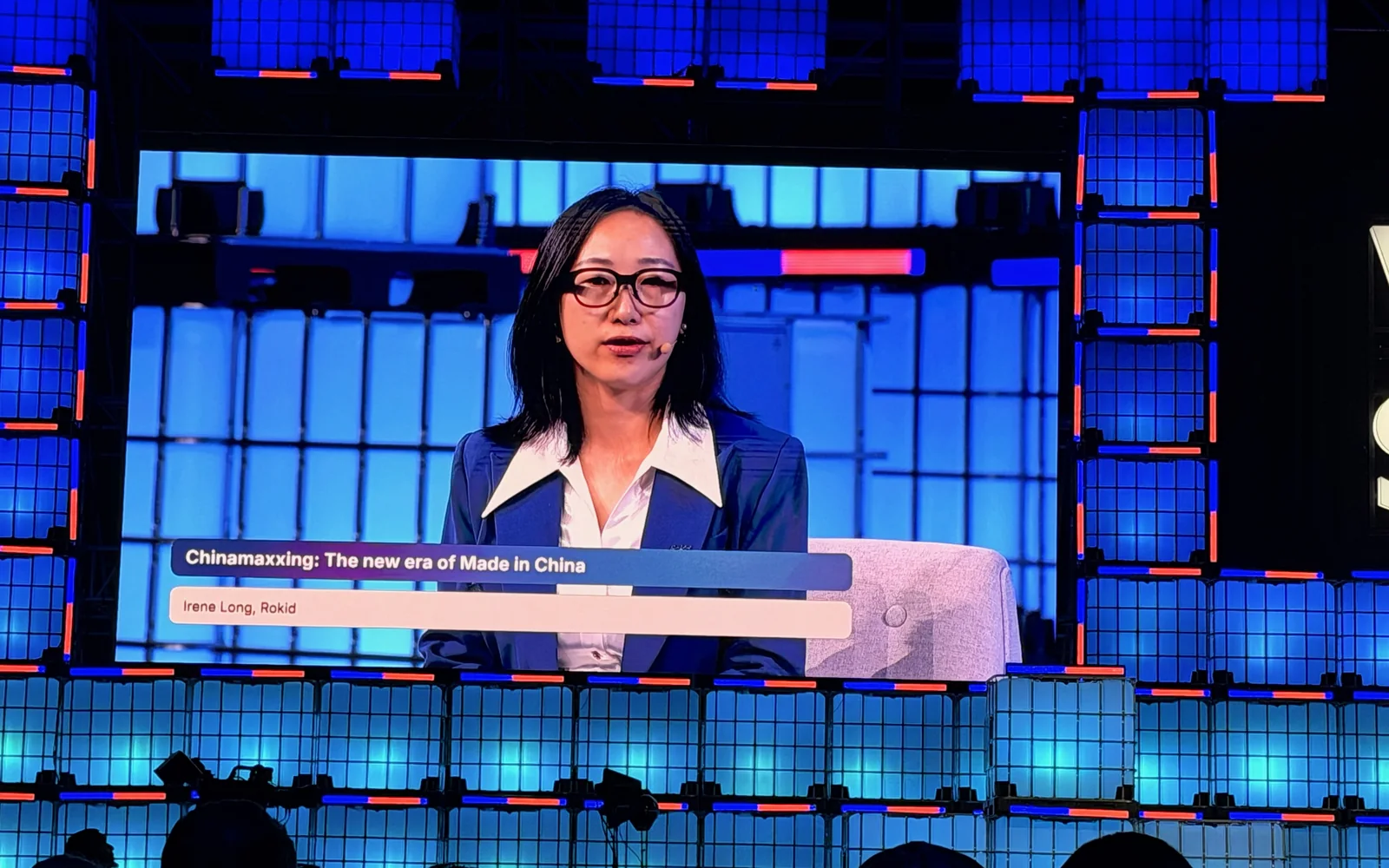
Photo: Irene Long of Rokid on Centre Stage, Web Summit Lisbon · Inside China AI
US chip restrictions and anti-distillation measures are causing delays and strategic shifts for Chinese AI developers such as DeepSeek, Moonshot AI, and Alibaba. DeepSeek, meanwhile, has raised about $15 billion at an implied $86 billion valuation, according to Bloomberg. Alibaba has launched its new Qwen4-Max AI model with 2.4 trillion parameters. Access to advanced chips remains a central challenge as Chinese firms seek to scale up their AI ambitions.
Our report this week · Europe x China
■ After Centre Stage: how Rokid plans to win Europe’s trust
The story: On Web Summit’s Centre Stage in Lisbon, Irene Long, Chief Sales Officer of the Hangzhou smart-glasses maker Rokid, argued that “Made in China” has become a matter of brands. In a follow-up interview she told Inside China AI what that takes in Europe: local partners, shops where people can try the product, and glasses without a camera.
- “The European market is one of the top three in our global expansion strategy,” Long said. Rokid Glasses went on sale in Germany in April and in France in October.
- Offline sales come first: “offline channels are our top priority,” she said. In France Rokid works with the optical chain Krys; for Germany it was still choosing a partner at the time of our call.
- On privacy, Rokid is developing a line of glasses without a camera, to be released in 2027, according to Long. For some new products the company says it will offer the two-year guarantee that EU law requires.
Why it matters for Europe
Smart glasses with cameras raise exactly the questions Europe cares about: privacy, consumer rights and who is the seller of record. Rokid’s answers, from a two-year guarantee to camera-free glasses, show how a Chinese brand adapts to European rules rather than the other way round.
→ Read the full report · Watch it in 90 seconds.
Regulation & Policy · Chips & Compute
■ US chip curbs and anti-distillation measures slow Chinese AI labs
The story: US restrictions on chip access and anti-distillation measures are reportedly causing delays and changes in strategy for Chinese AI developers including DeepSeek, Moonshot AI, and Alibaba.
- Chinese AI developers including DeepSeek, Moonshot AI, and Alibaba have been under pressure since September due to US restrictions (The Decoder).
- Last month, DeepSeek researchers internally estimated that their gap to top US models could grow from three to six months to nine months if distillation disappears completely (The Decoder).
- Moonshot AI has already canceled a $150 million deal for Nvidia Blackwell chips in Indonesia (The Decoder).
Why it matters for Europe
Delays and strategy shifts among Chinese AI developers may affect European buyers and partners relying on Chinese models or hardware. European regulators and companies monitoring supply chains should note potential disruptions, especially as cancelled chip deals and widening model gaps could impact product availability and competitiveness.
→ Go deeper: full story · our DeepSeek profile.
Markets & Investments · Frontier Models & Platforms
■ DeepSeek raises about $15 billion at an implied $86 billion valuation
The story: DeepSeek raised roughly 100 billion yuan ($15 billion) at an implied valuation of $86 billion, according to Bloomberg, citing people familiar with the matter and its own calculations.
- DeepSeek founder Liang Wenfeng’s fortune climbed 45% to $55 billion after the company completed its latest fundraising, according to Bloomberg’s analysis (Bloomberg).
- Liang’s stake in DeepSeek fell to 67.4% from 81.65% in June, according to registry filings (Bloomberg).
- DeepSeek’s implied valuation is $86 billion, based on the roughly 100 billion yuan ($15 billion) that the firm recently raised, according to people familiar with the matter, and calculations by the Bloomberg Billionaires Index (Bloomberg).
Why it matters for Europe
DeepSeek’s $86 billion valuation and $15 billion fundraising highlight the scale of capital flowing into Chinese AI. European companies and investors may face stronger competition from well-funded Chinese firms in global AI markets.
→ Go deeper: full story · our DeepSeek profile.
Regulation & Policy · Smart Vehicles
■ Dutch court bans BYD from selling Ti7 SUV in EU
The story: A Dutch court has banned Chinese carmaker BYD from selling its Ti7 SUV in the EU after finding it infringed Jaguar Land Rover's design rights.
- A court in the Netherlands banned BYD from selling its 'Defender clone' vehicle in the EU (The Guardian).
- The ban will take effect one week after Friday 20 November’s ruling (The Guardian).
- The court banned BYD from producing the vehicle at its new factory in Szeged, Hungary, until the case is resolved (The Guardian).
- BYD said it 'strongly disagrees' with the ruling and will appeal (The Guardian).
Why it matters for Europe
The ban affects European car buyers and dealers, as BYD cannot sell or produce the Ti7 SUV in the EU, including at its new factory in Hungary. The case highlights ongoing intellectual property enforcement in the European automotive market, with potential implications for other Chinese manufacturers and their European operations.
→ Go deeper: full story.
Companies & Startups · Humanoids
■ Xpeng says it aims to double Europe sales and expand local production
The story: Xpeng hopes to double its sales in Europe in 2027 and expand local production there, Nikkei Asia reports; the carmaker is also positioning its robotaxi and humanoid robot businesses against Tesla.
- Xpeng says it hopes to double sales in Europe next year (Nikkei Asia).
- Xpeng says it aims to expand local production in Europe (Nikkei Asia).
- Xpeng showcased the latest version of its humanoid robot Iron in Guangzhou on 25 November (Nikkei Asia).
Why it matters for Europe
Xpeng's plans to double sales and expand production in Europe could increase competition for European carmakers and suppliers, especially in the robotaxi and robotics sectors. European regulators and buyers may face new choices and challenges as Chinese firms target the local market.
→ Go deeper: full story · our Xpeng profile.
Models & Technology · Frontier Models & Platforms
■ Alibaba launches Qwen4-Max AI model with 2.4 trillion parameters
The story: Alibaba has released its new Qwen4-Max AI model, which the company says improves coding, reasoning, and efficiency, and is now available via QwenCloud and related platforms.
- Alibaba has introduced Qwen4-Max, its latest flagship AI model (SoyaCincau).
- Qwen4-Max features 2.4 trillion parameters and a 1 million-token context window, according to the company (SoyaCincau).
- Qwen4-Max is available through QwenCloud via its Token Plan and API (SoyaCincau).
- The standard uncached input rate for the API is USD 1.50 per million tokens, and output costs USD 4.50 per million tokens (SoyaCincau).
Why it matters for Europe
Qwen4-Max’s scale and pricing may influence European AI developers and cloud buyers seeking alternatives to US providers. Regulators and companies will need to assess compatibility, data handling, and cost competitiveness as Chinese AI models expand their presence in global markets.
→ Go deeper: full story.
■ Quick hits
- Z.ai launches 750B-parameter loop transformer model GLM-5.4. Z.ai has introduced GLM-5.4, a 750-billion-parameter model using a loop transformer architecture, which the company says matches the performance of much larger models. (The Decoder).
- Tencent publishes Nature paper on AI-driven drug discovery platform. Tencent Holdings published a Nature paper detailing its AI platform ORIDTP for peptide drug design, with preclinical validation in mice and integration into its WorkBuddy product. (South China Morning Post).
- Nvidia Blackwell Chips Installed at Shanghai Data Centre. Chinese firms installed Nvidia Blackwell semiconductors at a Shanghai data centre linked to Alice Huang, with hardware used as collateral for a 96 million yuan loan. (Bloomberg).
- Huawei claims domestic chip design tool breakthrough amid US curbs. Huawei and a local partner say they have developed a domestic solution to US chip design tool restrictions, enabling next-generation chip design for phones and servers in China. (Nikkei Asia).
- Huawei to Present 4,096-Bit AI Memory Design at ISSCC 2027. Huawei plans to present a high-bandwidth memory design with 4,096 data pins at ISSCC 2027; US export restrictions currently prevent Samsung, SK Hynix and Micron from supplying such memory to Chinese customers. (TechRepublic).
- Ant Group leads $100m investment in Simplexity Robotics. Simplexity Robotics, a Chinese humanoid robot startup, raised $100 million in a pre-series A round led by Ant Group at a $1.6 billion valuation. (Tech in Asia).
- EU proposes Quantum Act and €50bn fund to boost tech sovereignty. The European Commission unveiled the Quantum Act and a €50 billion Sovereign Tech Equity Fund to strengthen Europe's position in quantum and AI technologies and reduce reliance on US and Chinese supply chains. (Euronews).
- Xiong'an launches autonomous buses with Level 4 driving capability. Xiong'an has introduced autonomous minibuses with Level 4 autonomy, completing 12,400 test miles and carrying passengers on 6,800 journeys since August 2026. (Interesting Engineering).
Number of the week
97%
Chinese humanoid robot makers accounted for 97% of global shipments in the first half of 2026. For comparison, the EU’s largest robot manufacturing country, Germany, held less than 10% of the global industrial robot market in 2022.
Graphic: Inside China AI · Source: Tech in Asia, 23 November 2026.
■ From us this week
- New in the directory: 202 company profiles this week. Browse the directory.
Every figure above is linked to its source. Company figures are marked as such. Where we interpret, we say so. Corrections: press@insidechinaai.com · Our editorial standards.
In the directory: BYD · DeepSeek · Rokid · Moonshot AI · Tencent · Ant Group · Huawei — all companies


Comments are closed