Graphic: Inside China AI
XPeng: China’s “Physical AI” Carmaker Already Assembles Cars in Europe
Part of The Model Layer — profiles of the Chinese AI companies Europe is about to meet. Company profile · 26 November 2026.
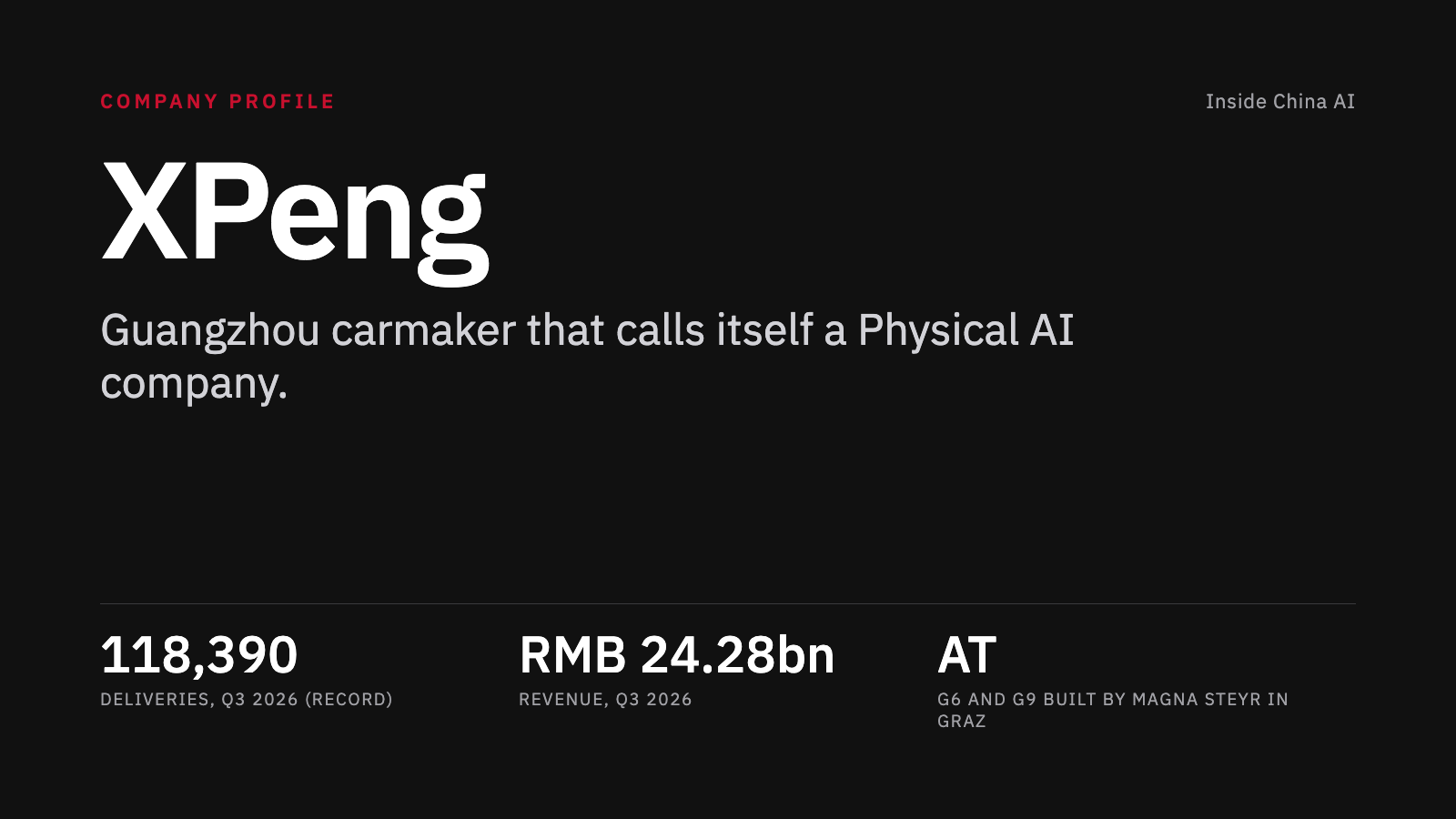
XPeng no longer describes itself as a carmaker. In its quarterly results it calls itself “a leading global Physical AI company” (Q3 2026 results) — one that designs its own AI chips, trains its own driving model, is preparing robotaxis and humanoid robots, and has a flying-car unit that showed its machine in Lisbon in November 2026. In Europe, XPeng is first of all a car brand that has gone further than most Chinese AI companies: cars assembled in Austria, a German company and research centre in Munich, franchised dealers across Germany and a European headquarters in Amsterdam. Its AI also reaches Europe’s carmakers less visibly — Volkswagen uses an electronic architecture developed with XPeng, and XPeng’s chips, in its cars in China.
Origins and backing
XPeng — 小鹏汽车, listed in New York and Hong Kong — says it was founded in 2014; its annual report dates the start of operations to 2015 (20-F). Co-founder He Xiaopeng is chairman and chief executive and controls 69.1 per cent of the votes. The company is based in Guangzhou and had 19,884 employees at the end of 2025, 8,845 of them in research and development and 385 based outside China (same filing).
The most important outside shareholder is Volkswagen. In 2023 it paid about $705.6 million for a 4.99 per cent stake and agreed to develop two VW-brand electric cars for China with XPeng; in 2024 and 2025 the partnership grew into a joint electronic architecture that, under an August 2025 agreement, is to be used across VW’s electric, petrol and plug-in hybrid platforms in China (20-F). VW calls it CEA, the “China Electronic Architecture”, developed by its Chinese technology unit, its software arm CARIAD China and XPeng (CARIAD). The joint SUV ID. UNYX 08, on sale in China since 16 April 2026, runs on two XPeng Turing AI chips and XPeng’s driving model (CnEVPost).
What they build
Cars still pay the bills. XPeng delivered a record 118,390 vehicles in the third quarter of 2026, 2.1 per cent more than a year earlier, and a record 50,237 in October, 13,326 of them outside China (company release). Third-quarter revenue rose 19.1 per cent to RMB 24.28 billion; the net loss narrowed to RMB 0.87 billion from RMB 1.34 billion in the second quarter, but was larger than a year earlier (RMB 0.38 billion). The gross margin was 18.9 per cent, the vehicle margin 13.1 per cent. Services income includes research-and-development services that the annual report says come primarily from Volkswagen; XPeng says lower revenue from these services reduced its services margin in the quarter (Q3 results, 16 November 2026). For the fourth quarter it guides for 169,000 to 174,000 deliveries. It expects overseas sales to pass 100,000 cars for the first time in 2026 (company release) and aims to more than double them in 2027 (company release, 27 November 2026).
The AI story sits on top. XPeng designs its own Turing AI chips — up to four in its newest cars — and runs a “vision-language-action” driving model, VLA 2.0, rolled out in China in March 2026 (XPeng). At its AI Day on 25 November 2026 it presented VLA 3.0, a “Turing Physical AI Architecture” through which its cars, robotaxis, humanoid robots and flying cars are to share computing power, data and safety systems; its driver assistance is to become a paid subscription for new buyers worldwide from the second quarter of 2027 (CnEVPost).
On 26 October 2026 XPeng announced that Guangzhou had approved it for L4 robotaxi demonstration operations (XPeng); it targets passenger service without a safety driver in 2027 (CnEVPost). Its first purpose-built robotaxi, the YoYo-01, is due in 2027, with XPeng acting as technology supplier rather than operator (CnEVPost). The humanoid robot IRON came off a new production line in September 2026 (TechNode); XPeng says hardware mass production starts in January 2027, with IRON working in some Chinese stores from the first quarter, an official launch in the second quarter (CnEVPost, AI Day) and deployment in its overseas showrooms from the second half of 2027 (company release). In August 2026 XPeng agreed to spin robotics into a separate company, Dogotix, with $900 million in commitments at a valuation of about $6.3 billion; the deal had not closed when announced (CnEVPost). (See also Why Carmakers Are Building Robots.)
The flying car
XPeng Aridge, renamed from XPeng AeroHT in October 2025, builds the “Land Aircraft Carrier”: a six-wheeled ground vehicle that carries a detachable two-seat electric aircraft (Electrek). The company says it has more than 7,000 pre-orders, mostly in China, at a price of about $300,000 (Euronews). The aircraft module has not yet received its type certificate from China’s aviation regulator; it has completed the regulator’s test flights and reached the inspection stage (Khaleej Times). Delivery dates have slipped: in April 2026 Aridge targeted customer deliveries toward the end of 2026 (Electrek); in Lisbon in November 2026 it spoke of limited deliveries to partners in China within months and passengers possibly from summer 2027, with the Middle East and Southeast Asia as the clearest early markets abroad (Euronews).
Europe is not first in line. In Lisbon, Michael Du, who presented Aridge, told Euronews that Europe is “definitely a very attractive market” and that the company hoped the event would introduce European consumers, regulators and partners to the product, but named hurdles before entering Europe, among them an affordable product and the right infrastructure and places to fly to (Euronews). We found no sign of an application to EASA, Europe’s aviation regulator.
Key numbers
- Founded 2014 (operations from 2015), Guangzhou; chairman and CEO He Xiaopeng (69.1% of votes)
- Listing NYSE (XPEV) and Hong Kong (9868)
- Deliveries 118,390 in Q3 2026 (record); Q4 guidance 169,000–174,000
- Financials Q3 2026 revenue RMB 24.28 billion (+19.1%), net loss RMB 0.87 billion; cash RMB 45.41 billion (30 September 2026)
- Overseas 83 countries and regions, more than 1,300 stores; over 10,000 cumulative deliveries each in Denmark, Norway, France and Germany (company, 27 November 2026)
- Volkswagen 4.99% stake (~$705.6 million, 2023)
- Robotics Dogotix carve-out, $900 million committed at ~$6.3 billion (not closed at announcement)
- Aridge >7,000 pre-orders (company); no type certificate yet
The European angle
- Physical presence Yes. XPeng has shipped cars to Europe since September 2020, starting in Norway (20-F). Magna Steyr has built XPeng’s G6 and G9 in Graz, Austria, since September 2025 (CnEVPost); the G9L is to be the fourth XPeng model built in Europe (XPeng). The cars arrive as semi-knocked-down kits from China (MERICS). XPeng Motors (Germany) GmbH in Munich runs the German website (XPeng Germany); XPeng opened its first European research centre in Munich in September 2025 and has its European headquarters in Amsterdam and an office in London (Nikkei Asia via KrASIA).
- Sales In Germany XPeng sells through franchised dealers and targets 110 outlets in 2026, up from 50 at the end of 2025 (XPeng Germany). Germany is small: 3,375 registrations in the first half of 2026, a 0.23 per cent share (Nikkei Asia via KrASIA). XPeng says it has delivered more than 10,000 cars in each of Denmark, Norway, France and Germany (company release, 27 November 2026); its goal is 500,000 cars a year in Europe by 2030 — a company target (CnEVPost; Nikkei Asia via KrASIA). The L03 SUV was launched globally in Munich on 16 July 2026 with a European starting price of €35,600 (CnEVPost). The L05 SUV is to launch in Europe at the Brussels Motor Show in January 2027; XPeng also plans its first two X-Energy fast-charging stations in Europe, in Germany and the Netherlands (company release, 27 November 2026).
- Tariffs and factories Cars imported from China pay the EU’s countervailing duty of 20.7 per cent for co-operating companies on top of the standard 10 per cent (Reuters factbox); MERICS describes kit assembly in Graz as XPeng’s way around these duties. In May 2026 Elvis Cheng, XPeng’s managing director for northeastern Europe, said the Graz line was running out of capacity (CnEVPost, citing the FT); in June vice-chairman Brian Gu said XPeng was looking at further sites, new or existing, and could expand the Magna partnership (Elektroauto News). No new European plant had been announced by 27 November 2026.
- Autonomy in Europe XPeng gave public test rides with its VLA 2.0 driving system at the Paris Motor Show in October 2026 (XPeng). Since 23 November 2026 customers can book test rides with the system, called NGP, on city roads from its Paris store (XPeng). After localisation tests in Germany, the Netherlands and France (CnEVPost), XPeng plans to begin rolling NGP out outside China in the first half of 2027, “subject to local validation, regulatory requirements and market readiness” (company release, 27 November 2026), and expects its first EU approvals for urban driver assistance in 2027 (company release, 16 November 2026). For the robotaxi, it says it is in “advanced discussions with several leading European mobility platforms”; none is named.
- What a European buyer would actually encounter A car brand with local assembly, dealers and service — and an AI stack that Europe mostly meets indirectly: in Volkswagen’s China models, in driver assistance that can be tried in Paris but awaits European approval, and in robots and flying cars not yet for sale here.
What we could not verify
- Graz volumes. Neither XPeng nor Magna publishes how many cars are assembled in Austria.
- Europe-wide sales. We found no reliable 2026 total for Europe.
- Which European mobility platforms XPeng is talking to about robotaxis.
- Dogotix closing. XPeng has not said whether all conditions of the robotics financing have been met; the Q3 results do not mention it.
- XPeng’s stake in Aridge and Aridge’s current valuation; Aridge is preparing a Hong Kong listing, but no filing is public.
- Titles in Lisbon. Michael Du is described by Euronews as XPeng’s chief financial officer and by Khaleej Times as Aridge’s. Stage remarks by Aridge founder Zhao Deli in Lisbon are not used; we found no published record of them.
The open question for Europe: when can a European customer buy a car whose driving AI is approved here — and which of XPeng’s other AI products will follow under European rules?

Comments are closed