Graphic: Inside China AI
Huawei: China’s AI Hardware Builder, Whose Open Models May Not Be Used in the EU
Company profile · 26 November 2026.
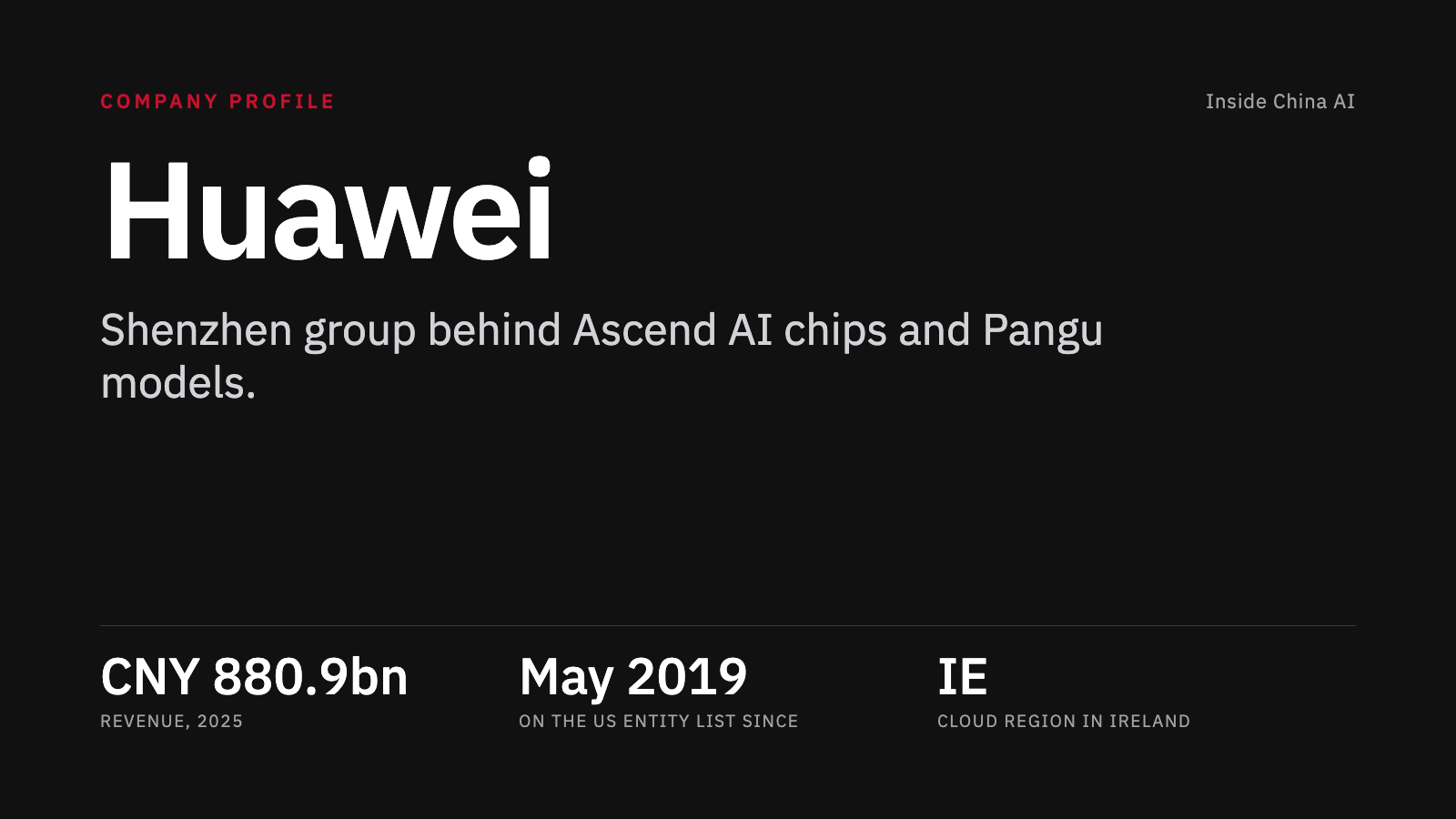
Huawei is the Shenzhen group behind the Ascend AI chips, the CloudMatrix and Atlas “SuperPoD” systems, the Pangu models and HarmonyOS. It has been on the US Entity List since May 2019 (Federal Register) and is building China’s alternative stack for AI computing, from the chip to the cluster. In Europe it runs companies, research centres and a cloud region in Ireland. Its open-weight openPangu models, however, come with a licence that forbids any use within the European Union. Germany’s mobile operators must remove critical Huawei parts from their 5G core networks by the end of 2026 (Bundestag). Washington warns companies “in the United States and abroad” that using some of Huawei’s Ascend chips risks violating US export controls (BIS). On 24 November 2026 a federal jury in Brooklyn convicted Huawei on 10 of 12 criminal counts; its lawyer said the company expects to appeal (Courthouse News; CNN).
Origins and backing
Huawei was founded in 1987 and says it employs about 213,000 people in more than 170 countries and regions (Huawei). Its headquarters is in Bantian, in Shenzhen’s Longgang district. It is not listed. It describes itself as “privately owned by employees”: its shareholders’ meeting has two members, the employee shareholding Union and the founder, Ren Zhengfei (Huawei corporate governance).
Liang Hua chairs the board. Xu Zhijun (Eric Xu), Meng Wanzhou (Sabrina Meng) and Wang Tao (David Wang) are deputy chairs, and Ren Zhengfei sits on the board as a director (Huawei corporate governance). The board and its executive committee are led by rotating chairs, each serving six months. Eric Xu holds the rotating chairmanship from 1 October 2026 to 31 March 2027 (Huawei).
Huawei publishes audited annual results. For 2025 it reported revenue of CNY 880.9 billion and net profit of CNY 68 billion, and spent CNY 192.3 billion, or 21.8 per cent of revenue, on research and development (Huawei annual report release, 31 March 2026). In the first half of 2026, the latest reported period, revenue rose 9.6 per cent to CNY 467.82 billion, while net profit fell about 36 per cent to CNY 23.81 billion as R&D spending climbed to 25.9 per cent of revenue. Huawei said its full-year outlook remained under review (Reuters, 31 August 2026). We found no figures for the third quarter.
What they build
Huawei sells telecom networks, phones, cloud services, power electronics and car technology. In AI its focus is hardware. “Huawei’s AI strategy is centered on computing power, with a focus on monetizing hardware,” the company said at its Shanghai conference on 17 September 2026 (Huawei). Huawei says its Ascend AI chips will get a new generation every year: the 960DT is due in the first quarter of 2027 and the 960PR in the third quarter, followed by the 970 in 2028 and the 980 in 2029.
Its selling point is scale: many chips linked into one system, which Huawei calls a SuperPoD. Huawei Cloud’s AI service, launched in June 2025, runs on CloudMatrix 384 supernodes, which connect 384 of Huawei’s own AI processors and 192 Kunpeng server CPUs into what the company calls a “super AI server” (Huawei Cloud). By September 2026, Huawei said, more than 1,000 of its Atlas 900 A3 SuperPoDs had been deployed and its Atlas 950 SuperPoD was in “large-scale commercial use”. Its next system, the Atlas 960E, will hold up to 4,096 processors linked by optics (Huawei). In March 2026 The Register reported that Huawei had decided to sell its Ascend systems outside China (The Register).
Huawei also builds AI models. The proprietary Pangu models, version 5.5 since June 2025, are aimed at industry and sold through Huawei Cloud (Huawei Cloud). Its open line is called openPangu. Huawei Cloud’s model service in China offers openPangu-2.1-Pro, in a version dated 15 November 2026, as the latest generation (Huawei Cloud); by 27 November 2026 we found no published weights for it. openPangu 2.0 Pro is a mixture-of-experts model trained on Ascend chips. It has about 505 billion parameters, of which about 18 billion are active, and a context of 512,000 tokens. The smaller openPangu 2.0 Flash has 92 billion parameters (model card; deployment repository).
On devices, Huawei plans to “completely redefine” HarmonyOS as an operating system for AI agents (Huawei); more than 36 million devices ran HarmonyOS 5 or 6 at the end of 2025 (TechNode).
Key numbers
- Founded 1987, Shenzhen; owned by employees through the Union and by founder Ren Zhengfei; not listed
- Leadership Chairman Liang Hua; rotating chairman Eric Xu (1 October 2026 to 31 March 2027, Huawei)
- 2025 Revenue CNY 880.9 billion, net profit CNY 68 billion, R&D CNY 192.3 billion (21.8% of revenue), audited by KPMG (Huawei)
- H1 2026 Revenue CNY 467.82 billion (+9.6%); net profit CNY 23.81 billion, down about 36% (Reuters)
- Staff About 213,000, of whom 114,000 worked in R&D at the end of 2025 (Huawei)
- AI Ascend chips (960DT due Q1 2027, Huawei); CloudMatrix 384 and Atlas SuperPoDs; Pangu 5.5; openPangu 2.0 Pro (≈505B parameters) and Flash (92B), whose licence excludes the EU
- US measures Entity List since May 2019 (84 FR 22961, Federal Register), today 136 Huawei entries; Pentagon 1260H list; Treasury CMIC investment list
- US criminal case Convicted on 10 of 12 counts on 24 November 2026; sentencing 14 September 2027 (US Justice Department; CNN; CNBC)
The European angle
- Physical presence Yes, extensive. HUAWEI TECHNOLOGIES Deutschland GmbH is based in Düsseldorf (imprint). Its German research centre is in Munich; around 2020 Huawei said it ran 23 research centres in 12 European countries, the first opened in Stockholm in 2000 (Huawei). The US Entity List names Huawei companies in Belgium, Denmark, France, Germany, Italy, the Netherlands, Portugal, Romania, Sweden, Switzerland and the UK, including the Munich research centre, added in 2019 and 2020 (US Consolidated Screening List, checked 27 November 2026).
- Cloud and AI services Huawei Cloud runs a region in Ireland through Sparkoo Technologies Ireland Co. Limited in Dublin. In October 2025 it announced a third availability zone for early 2026, which is to host its AI agent platform Versatile (Huawei Cloud). The company names European customers: Óbuda University in Hungary uses its “AI Compute Service”, Eniro Group has moved to Huawei Cloud and the hotel group Barceló is moving its core systems there.
- Manufacturing None confirmed. A plant in Brumath, Alsace, built to make 4G and 5G components, was completed in 2025 but had not started production by November 2025. French media reported that Huawei was considering selling it, and Huawei did not comment (Le Journal des Entreprises, 3 November 2025).
- 5G restrictions Under federal contracts, Telekom, Vodafone and Telefónica in Germany may use no critical Huawei or ZTE components in their 5G core networks after the end of 2026. By the end of 2029 they must also replace critical Huawei and ZTE network-management functions in their access and transport networks (Bundestag, 1 April 2026). On 20 January 2026 the European Commission proposed a revised Cybersecurity Act that would enable “the mandatory derisking of European mobile telecommunications networks from high-risk third-country suppliers” (European Commission). The proposal names no company and still needs the approval of Parliament and Council.
- Bribery investigation In March 2025 Belgian federal prosecutors detained several people on suspicion of bribing members of the European Parliament for Huawei’s benefit since 2021. The Parliament suspended access for Huawei’s representatives on 14 March 2025 (Euronews). By 4 April 2025 eight people had been charged with corruption, money laundering and participation in a criminal organisation, the prosecutor’s office said. No one has been convicted. Huawei said it has “a zero tolerance policy towards corruption” (Reuters). On 16 June 2026 the Parliament waived the immunity of one of four MEPs named in the prosecutors’ requests (European Parliament) and refused to waive it for the other three (1, 2, 3).
- Licences and export controls Under the openPangu licence, an agreement with Huawei Technologies Co., Ltd., users warrant that they will not “access, download, install, run, deploy, integrate, modify, or otherwise use the Model, directly or indirectly, within the European Union”. The clause is in versions 1.0 and 2.0 (1.0, 2.0). Users must also indemnify Huawei against third-party claims; “third party” explicitly includes “supervisory authorities”. The licence gives no reason for excluding the EU. For hardware, the US Commerce Department warned on 13 May 2025 that using Huawei’s Ascend 910B, 910C and 910D chips “risks violating U.S. export controls and may subject companies to BIS enforcement action”. The guidance addresses companies “in the United States and abroad” (BIS guidance).
- Regulatory exposure Huawei Technologies has been on the US Entity List since 16 May 2019 (Federal Register) and is on the Pentagon’s 1260H list of “Chinese military companies” (most recent edition June 2026) and on the US Treasury’s list of Chinese military-industrial companies whose securities US persons may not buy, according to our check of the published lists on 27 November 2026. The Entity List is an export control, the 1260H list a designation, not a sanction. Huawei is not on the EU’s financial sanctions list. In the US criminal trial in Brooklyn, the jury on 24 November 2026 convicted Huawei of bank and wire fraud and of conspiracies to steal trade secrets, to violate US sanctions law and to launder money, and acquitted it of racketeering conspiracy and conspiracy to obstruct justice (Courthouse News; CNN). According to the Justice Department, three Huawei subsidiaries were also convicted. Huawei called the remaining charges “equally without legal or factual merit” (CNBC; US Justice Department). Huawei is not among the signatories of the EU’s Code of Practice for general-purpose AI models (European Commission).
- What a European buyer would actually encounter An established supplier with European companies and cloud customers, whose equipment is being removed from German 5G cores, whose AI chips carry a US enforcement warning, and whose open models may not be used in the EU.
What we could not verify
- Whether any Ascend-based system runs in Europe, and whether Huawei Cloud’s AI compute in Ireland uses Ascend chips.
- Whether the third Irish availability zone has opened, and the current number of Huawei’s European research centres and staff.
- What happens to the Brumath plant: we found no report after November 2025.
- The state of the Belgian case since June 2026: by 27 November 2026 we found no statement from the Belgian prosecutor’s office online and no report of a trial date.
- Why openPangu excludes the EU: the licence does not say.
The open question for Europe: will Huawei ever license openPangu for use in the EU, and will European customers be offered Ascend computing despite the US warning?

Comments are closed