Graphic: Inside China AI
Biren Technology: A Shanghai GPU Designer Multiplies Its Revenue After a Hong Kong Listing — With Sales Almost Entirely at Home
Company profile · 21 November 2026.
Biren Technology designs general-purpose GPUs and computing clusters for AI in Shanghai and sells them almost only in China. Revenue rose to RMB 1.24 billion in the first half of 2026, 21 times the level a year earlier (our calculation), while the net loss narrowed to RMB 377 million. In 2026 it has raised money in Hong Kong three times: at its listing on 2 January and in two share placings. The company itself and several subsidiaries have been on the US Entity List since October 2023. Biren is not a supplier in Europe. For European readers it matters as one of the companies building China’s AI computing without US chips, and as a company on the US Entity List.
Origins and backing
Biren (壁仞科技), legally Shanghai Biren Technology Co., Ltd., was incorporated in the People’s Republic of China on 9 September 2019 and is headquartered in Minhang District, Shanghai (annual report 2025). Its founder, Zhang Wen, has been chairman since October 2019 and chief executive since November 2019. Before founding Biren he was president of SenseTime from January 2018 to October 2019, according to the same report. He still held both posts when the company announced the completion of a share placing on 12 October 2026 (HKEX announcement).
Before listing, Biren went through ten funding rounds, from Pre-A to a strategic round that raised RMB 2.40 billion between February and June 2025 and a pre-IPO round that raised RMB 1.91 billion between July and September 2025 (annual report 2025). There is no majority owner. At 30 June 2026 Zhang held 7.51 per cent directly and controlled another 7.84 per cent through the employee platform Shanghai Biliren under acting-in-concert and voting-proxy agreements. Other substantial holders included a Zhuhai investment company 51 per cent owned by China Cinda Asset Management, with 3.31 per cent, and Yang Huiyan through Country Garden entities, with 2.73 per cent (interim report 2026).
Biren listed on the Main Board of the Hong Kong Stock Exchange (6082) on 2 January 2026, the exchange’s first listing of the year. It sold 284.8 million H shares at HK$19.60, the top of the range, and raised HK$5.58 billion; retail investors subscribed about 2,348 times the shares on offer. The shares closed the first day at HK$34.46, up 76 per cent (Reuters). Cornerstone investors included 3W Fund, Qiming Venture Partners and Ping An Life, Reuters reported. With the over-allotment option exercised, net proceeds came to about HK$6.20 billion (interim report 2026).
Two placings followed. On 8 July 2026 Biren sold 153 million new H shares at HK$46.20, raising HK$7.07 billion gross (interim report 2026). On 12 October 2026 it completed the sale of 130 million more at HK$31.08, a 9.76 per cent discount to the HK$34.44 close on 7 October, raising HK$4.04 billion gross (placing announcement; completion). About 70 per cent of that money is meant for buying supplies, reserving capacity and preparing production of the next product generation. The company justified the raise with “tight supply, rising prices and long lead time across critical upstream inputs”, and said key customers, including internet companies, now demand stricter inventory readiness. After the placing, 2,730,075,650 shares were in issue.
What they build
Biren is a fabless chip designer: outside foundries make its chips and other suppliers package and test them, and the filings do not name them (prospectus). Its hardware is sold under the name BILI (壁砺). The current range, according to the company, consists of the 166L (a liquid-cooled module, 600 watts), the 166M (an air-cooled module, 550 watts), the 166C (a PCIe inference card, 300 watts), the 106M and the 106B (Biren). The company says it brought the BR106 and BR166 chips into volume production in 2025 and planned to launch the next series, BR20X, in 2026 (annual report 2025). On 8 October 2026 it said its new-generation product had completed bring-up and entered post-silicon validation, with customer sampling and volume production expected “over the coming quarters” (placing announcement).
An increasing proportion of customer demand is for whole systems rather than single cards, the company said on 8 October 2026 (placing announcement). It says it offers 16-GPU servers, 128-GPU racks and 1,024-GPU clusters, and that its optically switched “LightSphere” SuperPod is commercially deployed at a scale of thousands of GPUs (interim report 2026). Its software stack, BIRENSUPA, supports “more than a thousand models out of the box”, the company says, and it lists release-day support for DeepSeek-V4, MiniMax M3, Zhipu‘s GLM-5 series, Qwen3.6, Kimi K2.6 and StepFun‘s Step 3.7 Flash, among others. We found no foundation models of its own; Biren’s hardware and software run and train other companies’ models. In 2025 it set up a joint laboratory with StepFun and Shanghai Yidian AI Computing Services (annual report 2025).
The filings do not name customers. Biren describes them as internet companies, model developers, national AI computing platforms, telecom operators and AI data centres, and says it passed supplier qualification and began volume deliveries to “major internet customers” in the first half of 2026 (interim report 2026). Three unnamed customers each accounted for more than 10 per cent of revenue in that period, together RMB 919.8 million (interim report 2026), or 74 per cent of revenue (our calculation). The only public reference to a named site that we found is a single report on China Daily’s regional Hohhot page of 11 February 2025, which said China Mobile‘s computing centre in Hohhot “supports various domestic AI chips, including Ascend, Biren, Tianshu, and Kunlun” (China Daily). It gives no volumes and does not say whether China Mobile buys from Biren directly.
Key numbers
- Listing Hong Kong Main Board (6082) since 2 January 2026; offer price HK$19.60; net IPO proceeds about HK$6.20 billion; further placings of HK$7.07 billion (July 2026) and HK$4.04 billion (October 2026), gross (interim report 2026; completion announcement)
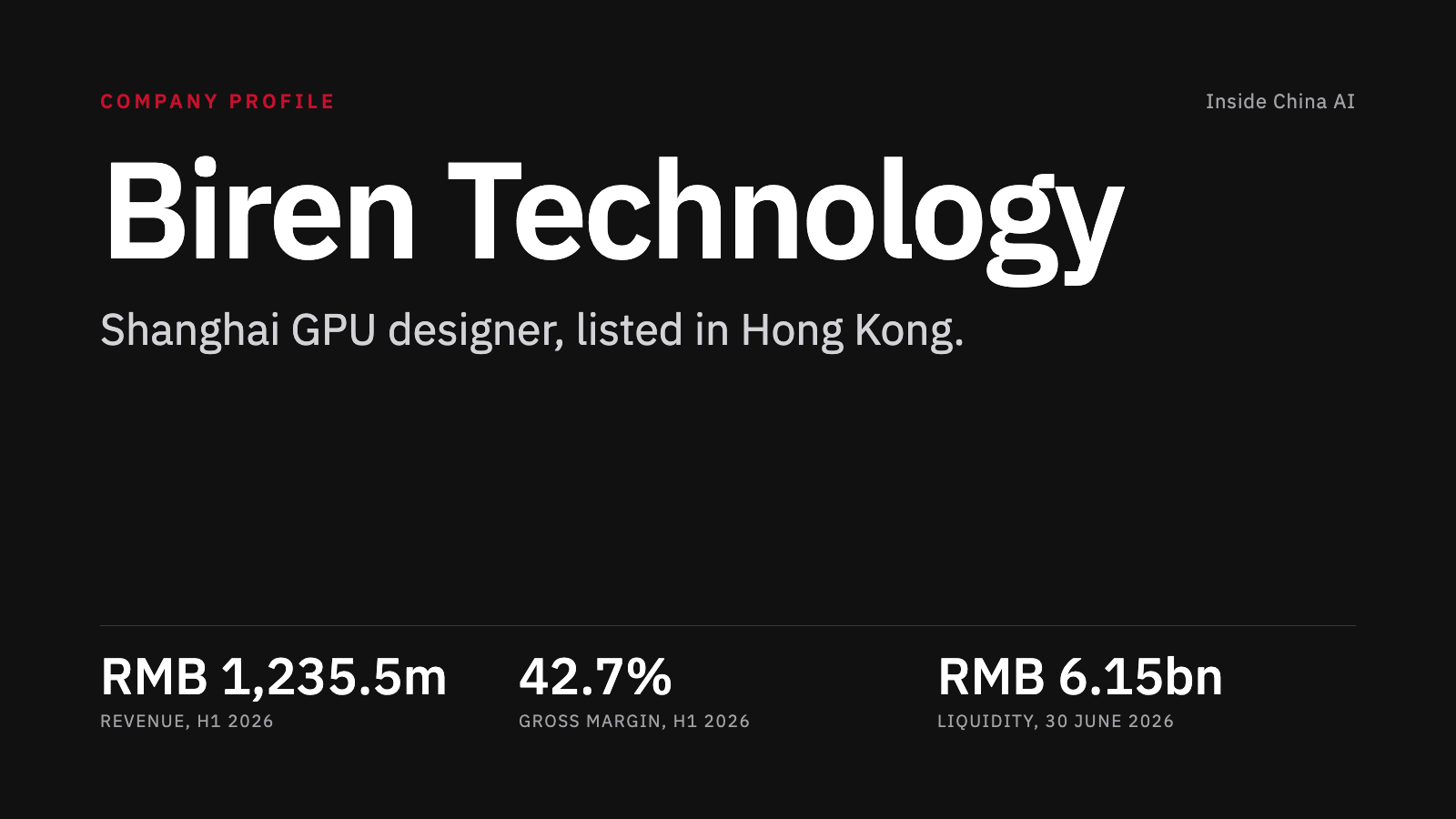
- Revenue RMB 1,235.5 million in January–June 2026, up 1,997.6 per cent; RMB 1,034.6 million in 2025 (interim report 2026; annual report 2025). Biren reports half-yearly; there are no third-quarter figures
- Margin and loss Gross margin 42.7 per cent and net loss RMB 377.2 million in the first half of 2026, unaudited (interim report 2026). The 2025 net loss of RMB 16.49 billion was mostly a non-cash charge of RMB 15.47 billion for changes in the carrying value of redemption liabilities: rights of earlier investors which, the company says, “shall automatically terminate immediately upon the completion of the listing”. Its adjusted loss for 2025, which also leaves out share-based compensation and listing expenses, was RMB 873.8 million (annual report 2025)
- Research R&D spending RMB 804.4 million in the first half of 2026, 65 per cent of revenue (our calculation); 910 employees at 30 June 2026 (interim report 2026). R&D staff make up more than 80 per cent of the headcount, the company says (annual report 2025)
- Customers Five largest customers: 71.3 per cent of 2025 revenue (annual report 2025); three customers: RMB 919.8 million, or 74 per cent of revenue, in the first half of 2026 (our calculation from the interim report 2026)
- Cash Liquidity of RMB 6.15 billion at 30 June 2026, before both placings; inventories RMB 1.21 billion and prepayments for inventories and services RMB 1.53 billion (interim report 2026)
- Revenue outside mainland China Not disclosed separately; “substantially all” revenue comes from the PRC
The European angle
- Presence None that we could find. Biren gives no regional breakdown of revenue because “substantially all of the Group’s revenue is derived from the PRC” (interim report 2026). Its foreign subsidiaries are in Hong Kong, the United States and Singapore (annual report 2025). We found no European office, distributor, customer or partner.
- Export controls The US Commerce Department added eight companies of the Biren group to the Entity List with effect from 17 October 2023: seven Biren companies in Beijing, Guangzhou, Hangzhou, Shanghai and Zhuhai, and Suzhou Xinyan Holdings, which the prospectus lists as a group company now named Shanghai Xinzhili. The entry for Shanghai Biren Intelligent Technology carries the aliases “Biren” and “Biren Technology” (88 FR 71991). The rule says the entities “are involved in the development of advanced computing integrated circuits (ICs)”. It imposes a licence requirement for all items subject to US export rules, reviewed under a presumption of denial, with a footnote 4 designation that extends to certain foreign-made items. On 11 April 2024 the alias “Shanghai Biren Technology” was added (89 FR 25503). The prospectus confirms that the listed company itself, Shanghai Biren Technology Co., Ltd., is among the listed entities (prospectus). Citing its US legal adviser, it says neither the listing nor the US affiliates rule described below should have a material impact, and it warns that partners, “particularly among western financial institutions”, may de-risk. A US rule that would extend the same restrictions to companies 50 per cent owned by listed entities is suspended through 10 January 2027 (91 FR 70789).
- Other lists Biren is not named in the US Defense Department’s Section 1260H list of 10 June 2026 (91 FR 35189). A name check against the EU’s consolidated financial sanctions list (version of 23 October 2026) found no entry. The Entity List is an export control, not a sanction.
- What a European buyer would actually encounter Today, nothing for sale. For European companies the relevant facts are the Entity List entry and, for investors, the Hong Kong-listed shares.
What we could not verify
- Who the customers are. The filings anonymise them, including the three that made up 74 per cent of revenue in the first half of 2026. Press reports that name Biren as a supplier to a telecom data centre in Qinghai were behind paywalls and disagree on the operator.
- Who manufactures the chips, and on which process.
- When the next generation reaches customers. We found no filing after 8 October 2026 on sampling or volume production.
- What the US and Singapore subsidiaries do.
- The company’s performance claims for its chips and SuperPods, which no independent test we found has confirmed.
The open question for Europe: Biren has raised more than HK$17 billion in Hong Kong in 2026 (our calculation: about HK$6.42 billion from the listing including the over-allotment, plus HK$7.07 billion and HK$4.04 billion from the placings, gross; net, the three add up to about HK$17.26 billion). Will any of that turn into sales outside China while the company remains on the Entity List?

Comments are closed