Graphic: Inside China AI
Edge Medical: The Shenzhen Surgical-Robot Maker Now Operating in European Hospitals
Company profile · 26 November 2026.
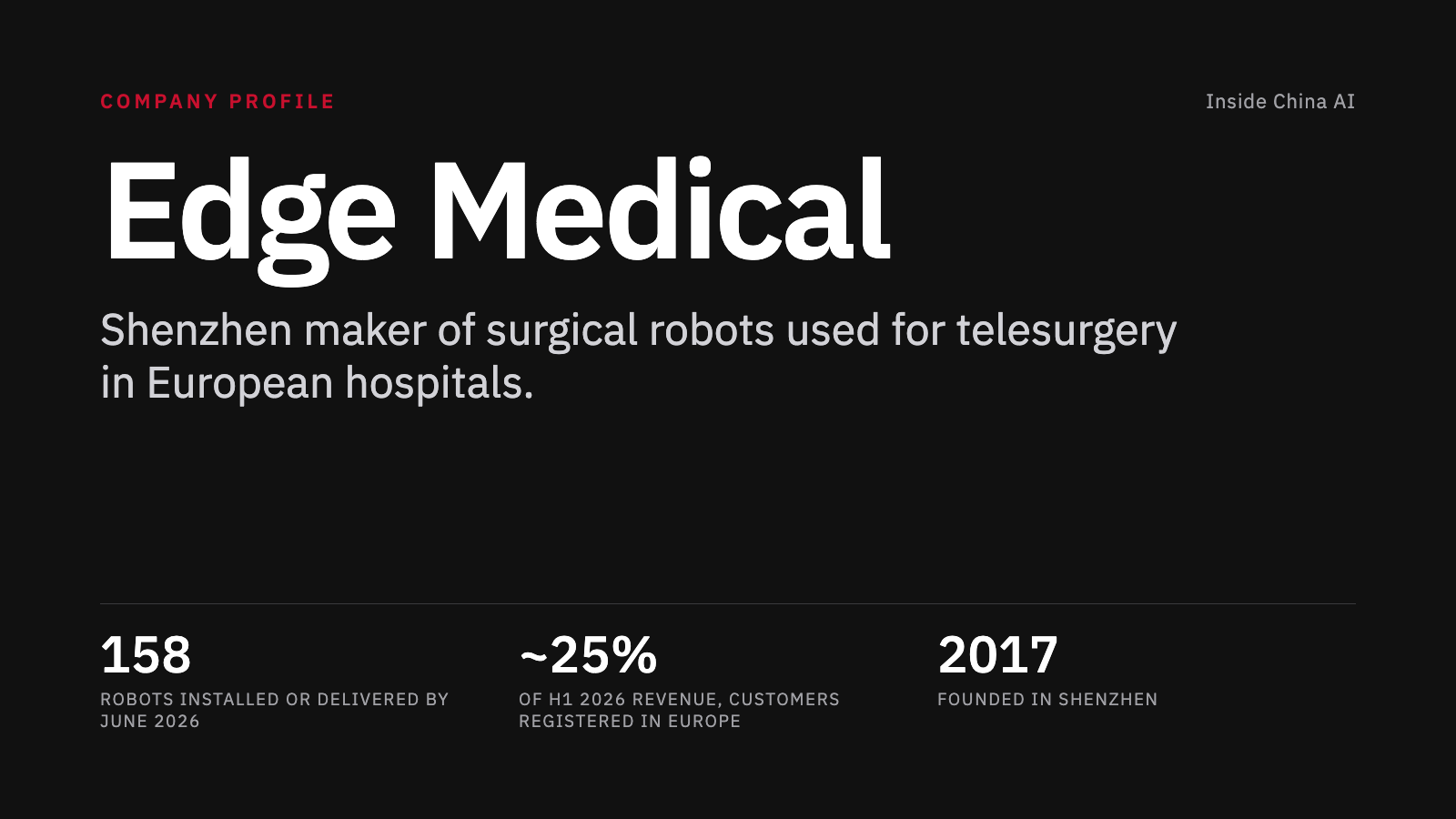
Edge Medical (精锋医疗) builds surgical robots in Shenzhen and sells them in Europe through local distributors. Its robots have been used for remote surgery between hospitals in Poland and in Spain, and on 26 October 2026, the company says, its telesurgery system received an EU CE certificate. In the first half of 2026, customers registered in Europe, mostly distributors, accounted for a quarter of its revenue. The company has been listed in Hong Kong since January 2026, is still loss-making and is now preparing a second listing in mainland China. Its AI work, beyond navigation software in one robot, is at the research stage.
Origins and backing
Edge Medical was founded in Shenzhen on 4 May 2017 by two mechanical engineers from Tianjin University, Dr. Wang Jianchen and Dr. Gao Yuanqian, who are married (listing document, listing document). Before the listing they controlled about 46.37 per cent of the shares. Wang is both chairman and chief executive, an arrangement the company explains in its interim results of 28 August 2026 as a departure from Hong Kong’s governance code (interim results 2026). Financial investors named in the listing documents include Boyu Capital, 3H Health, LYFE Capital, Legend Capital, a GF Securities fund (listing document) and Temasek (listing document).
The H shares began trading on the Main Board of the Hong Kong exchange on 8 January 2026 (stock code 2675) under Chapter 18A, the listing rules for biotech companies. Edge sold 27,722,200 new shares at HK$43.24, plus 4,158,300 from the over-allotment on 9 February 2026; net proceeds came to about HK$1,289.2 million (interim results 2026). Cornerstone investors included the Abu Dhabi Investment Authority, UBS, Tencent and OrbiMed, according to the law firm Clifford Chance (Clifford Chance). Since June 2026 the company has been buying back its own shares, in October at prices of about HK$31 to HK$33, below the offer price (monthly return, October 2026).
On 11 September 2026 the board announced that Edge would explore an initial public offering of A shares in mainland China and had filed for pre-listing tutoring the same day. The plan still needs approval from the board, the shareholders and the regulators (HKEX announcement).
What they build
Edge makes robots for minimally invasive surgery. Its main product is a multi-port laparoscopic robot, the MP1000 and its successor MP2000, approved in China since December 2022, followed by the single-port SP1000, a platform that combines both, and the CP1000 bronchoscopy robot for lung lesions (interim results 2026). The multi-port and single-port robots share the same surgeon’s console. Edge Cloud, its telesurgery system, lets a surgeon at one console operate a robot elsewhere; by 30 June 2026 it had been used in more than 700 remote operations, and Edge had set up remote-control centres in eight Chinese provinces, the company says.
The AI component is limited so far. The CP1000 uses what Edge calls an “AI-based algorithm” to plan the path to a lung lesion and to help position the catheter (listing document); it is approved in China, and we found no CE marking for it. In July 2026 Edge invested an undisclosed amount in PrimalVerse, a Beijing start-up working on “4D world models”, to explore what it calls “AI + surgical robots” and an “embodied AI surgical robot business” (HKEX announcement). We found no autonomous or AI-driven surgical function in any approved Edge product.
Key numbers
- Revenue RMB 455.7 million in 2025 (+184.8%), net loss RMB 88.6 million (annual results 2025); RMB 319.3 million in the first half of 2026 (+113.8%), net loss RMB 19.3 million (interim results 2026)
- Europe RMB 79.4 million of first-half 2026 revenue (about 25%) from customers registered in Europe, against RMB 24.3 million a year earlier; Edge counts revenue by where the customer is registered, and it sells mainly through distributors (interim results 2026). By delivery location, Europe accounted for RMB 73.0 million (16%) of 2025 revenue (annual results 2025)
- Abroad 69.8% of first-half 2026 revenue from products sold to end users outside China
- Installed base 158 robots installed or delivered by 30 June 2026, 103 of them for end users outside China
- Cash RMB 1,260.1 million, plus RMB 536.8 million in financial assets (30 June 2026)
- Staff 604 full-time employees (30 June 2026)
- AI navigation algorithm in the CP1000 bronchoscopy robot; investment in the world-model start-up PrimalVerse
- Listing HKEX 2675 since 8 January 2026; A-share listing in preparation
The European angle
- Approvals The MP1000 received the CE mark in March 2025, the single-port SP1000 and the combined single/multi-port platform in October 2025 (interim results 2026), the latter under the Medical Device Regulation, the company says (Edge Medical). On 26 October 2026, according to Edge, the Edge Cloud telesurgery system was CE-certified under the MDR for remote surgery in urology, general surgery, thoracic surgery and gynaecology (Edge Medical); we found no exchange announcement on it. Edge has not published the notified body or certificate numbers.
- Distributors Edge lists no European subsidiary (listing document) and sells mainly through distributors. Dornier MedTech, a subsidiary of Advanced MedTech, has distributed the MP1000 for urology in Spain and Portugal since March 2025 (Dornier, 21 March 2025) and in Germany and Austria since November 2025 (Dornier, 5 November 2025); it has named no German or Austrian customer. In Poland the distributor is Meden-Inmed (Zwrotnik Raka).
- Hospitals On 1 August 2025 surgeons of the State Medical Institute of the Ministry of the Interior (PIM MSWiA) in Warsaw, seated at a console in the ministry’s hospital in Gdańsk, used an MP1000 to perform two remote operations, a cardiac bypass and a prostatectomy, on patients in Warsaw; the Polish cancer portal Zwrotnik Raka called them the first telesurgeries between hospitals in Europe (Zwrotnik Raka, 3 August 2025). Hospitales Universitarios San Roque in Las Palmas de Gran Canaria introduced the MP1000 in January 2026 (RTVC), and in February 2026 Fundació Puigvert in Barcelona and San Roque completed ten urological telesurgeries over more than 3,000 kilometres on infrastructure developed by Edge Medical (EFE via Diario de Avisos). The Policlinico di Milano announced two new surgical robots “from China” on 4 August 2026 without naming the maker (Quotidiano Sanità); Edge says its multi-port robot is in clinical use there (Edge Medical). Edge also names IFO in Rome and the National Institute of Oncology in Budapest as customers (interim results 2026), and reports first operations in Skopje, North Macedonia (Edge Medical), and an installation at Lefkos Stavros – The Athens Clinic in Greece (Edge Medical); we found no confirmation of these from the hospitals.
- Training and demonstrations Edge says it opened a training centre in Milan in March 2026 (Edge Medical) and reported on 23 November 2026 a first hands-on course at IRCAD in Strasbourg (Edge Medical). At the congress of the European Association of Urology’s robotics section in September 2024, Prof. Alberto Breda operated from Bordeaux on a patient in Beijing using an Edge robot (EAU Robotic Urology Section).
- Procurement Under a measure the European Commission adopted on 19 June 2025, companies from China are excluded from EU public tenders for medical devices above €5 million (European Commission; Implementing Regulation (EU) 2025/1197).
- Lists Our check of the US Consolidated Screening List (including the Entity List), the Pentagon’s 1260H list and the EU sanctions list found no entry for Edge Medical (name match for “Edge Medical” and “Jingfeng Medical” in the lists as downloaded on 24 November 2026, checked 26 November 2026).
- What a European hospital would actually encounter A Chinese surgical robot with CE marks for multi-port and single-port surgery, sold and serviced through a European distributor such as Dornier MedTech or Meden-Inmed rather than by the maker itself, and built for remote surgery, which Polish and Spanish hospitals already use.
What we could not verify
- The CE certificates: notified body, certificate numbers, the EU authorised representative, and the telesurgery certificate of 26 October 2026, which we know only from Edge’s own news post.
- How many Edge robots are installed in Europe, and in which countries; the filings give no breakdown.
- The customers named only by Edge: the Policlinico di Milano as maker of its robots, IFO Rome, the National Institute of Oncology in Budapest, Skopje and The Athens Clinic.
- Customers in Germany and Austria since Dornier took over distribution there.
- Whether any AI function of an Edge robot is covered by a European approval.
The open question for Europe: once telesurgery is certified, will hospitals let a Chinese-built network connect their operating theatres, and who will be accountable when the link is the risk?

Comments are closed