Graphic: Inside China AI
Huiying Medical: A Beijing Radiology-AI Pioneer Whose European Business Has Gone Quiet
Company profile · 26 November 2026.
Huiying Medical (汇医慧影, also HY Medical) makes AI software that reads X-rays and CT scans, from bone fractures to lung nodules, and in 2020 and 2021 sold a lung-screening tool to hospitals abroad, mainly through Huawei’s cloud marketplace. Its filings show that overseas revenue fell to RMB 126,754 in 2025 and to zero in the first half of 2026, and the only CE certificate its filings list with a number ran until May 2024. The Beijing company is quoted on China’s National Equities Exchange and Quotations (NEEQ), publishes audited accounts, and is loss-making. For European hospitals, Huiying is a case study in how a pandemic-era export can fade once the emergency is over.
Origins and backing
The company was founded in Beijing in April 2015 and became a joint-stock company in December 2021. Its legal name is 慧影医疗科技(北京)股份有限公司, in English Huiying Medical Technology Co., Ltd.; “汇医慧影” is the brand and the name of a wholly owned subsidiary (public transfer statement, 18 December 2023). Its shares have been quoted on the base tier of the NEEQ, sometimes called the “New Third Board”, since 8 January 2024 under the code 874245 (annual report 2025).
According to the 2025 annual report, Chai Xiangfei (柴象飞) is chairman and Guo Na (郭娜) is director, general manager and chief financial officer. The two founders jointly control 44.39 per cent of the shares, and there is no controlling shareholder. The largest outside holders at the end of 2025 were BRVAI Holdco (14.03 per cent), a vehicle of BlueRun Ventures’ BRV Aster Fund I; Delta Capital Hong Kong (10.62 per cent); Long Star Growth Group (7.31 per cent), held through a CDH fund; and Intel Asia-Pacific R&D (4.95 per cent) (annual report 2025; transfer statement). The company’s website lists a Series C round from Intel Capital and SPC in 2018 and a C2 round from the Shougang Fund in 2020, each described only as “hundreds of millions”, without a currency (Huiying). We found no later round and no published valuation.
In a notice dated 24 April 2026, which it called a belated disclosure, the company said that all 2,306,550 shares held directly by Chai Xiangfei, 7.69 per cent of the company, had been frozen, according to the shareholder register of 20 April 2026. It said it had received no legal documents and therefore did not know the reason (notice 2026-012). The interim report of 26 August 2026 adds that his stakes in four holding vehicles are also judicially frozen and that, if the dispute is not resolved, a court disposal of the shares and a resulting change of control cannot be ruled out (interim report 2026).
What they build
Huiying sells task-specific imaging software, not a general-purpose AI model. Its filings describe three product lines: AI-assisted diagnosis products and platforms, an AI research platform, and an imaging data platform that organises a hospital’s image archive (annual report 2025). On its website these appear as Dr.Turing (diagnosis), RadCloud (radiomics research) and NovaCloud (imaging cloud and digital film), with modules for fractures, lung nodules, tuberculosis, mammography, liver cancer, the prostate, bone density and aortic dissection (Huiying).
In China its fracture-detection software for X-rays received a Class III registration from the National Medical Products Administration on 28 April 2021, and its lung-nodule CT software on 29 April 2022 (transfer statement). The company says it was the first to develop a medical image-to-text large-model base (interim report 2026). It names no such model, and we found no paper, benchmark or public weights for it.
The business is now overwhelmingly Chinese. Its five largest customers in 2025 were all Chinese, among them the health-check chain iKang, and it earns usage-based fees from government-led regional imaging platforms: in Chongqing, and since the first half of 2026 also in Beijing and Shanxi (interim report 2026). Huawei Cloud was its second-largest supplier in 2025 (annual report 2025).
Key numbers
- Founded April 2015, Beijing; quoted on the NEEQ (874245) since 8 January 2024
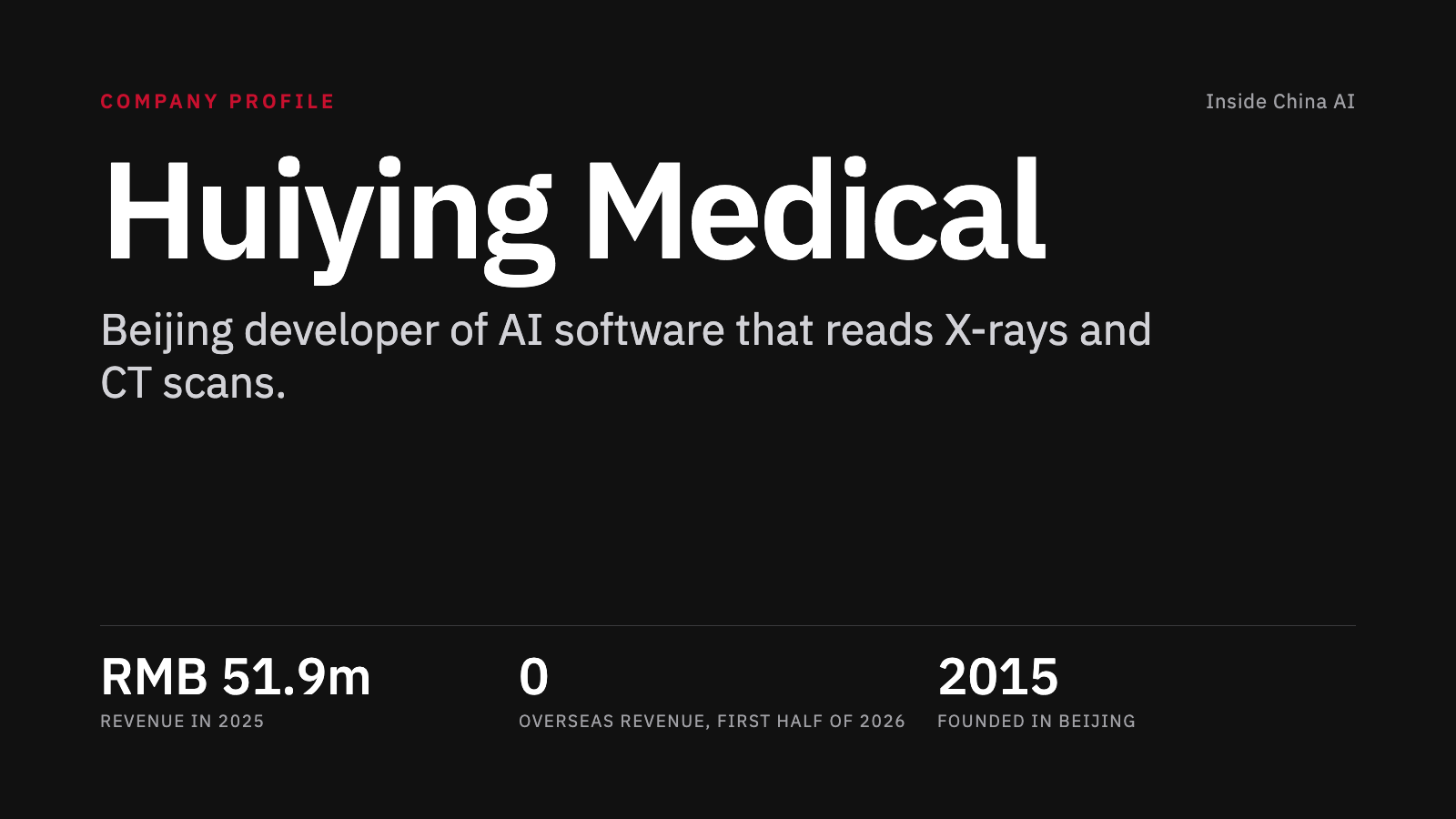
- Revenue RMB 51.9 million in 2025 (+3.3 per cent); RMB 11.1 million in the first half of 2026 (−8.1 per cent, unaudited)
- Net result loss of RMB 4.9 million in 2025; loss of RMB 12.5 million in the first half of 2026; accumulated losses of RMB 300.6 million at the end of 2025
- Overseas revenue RMB 3.16 million in 2021, RMB 126,754 in 2025, none in the first half of 2026
- Cash RMB 16.3 million at 30 June 2026, down from RMB 31.8 million six months earlier; debt ratio 80.8 per cent
- Staff 83 at 30 June 2026
Sources: annual report 2025 (audited); interim report 2026; transfer statement 2023. As a base-tier NEEQ company, Huiying does not publish quarterly figures. The company attributes the fall in its gross margin, from 76.3 to 53.1 per cent in the first half of 2026, to price cuts under China’s volume-based procurement.
The European angle
- How it reached Europe In 2020 and 2021 Huiying sold a lung-screening system abroad mainly through Huawei’s cloud marketplace and Huawei distribution, to end customers in Europe, South America, Africa and South-East Asia, with small direct sales in Japan, Turkey and Peru. Huawei collected the fees and kept 15 per cent. In its 2023 listing document the company itself described these pandemic-driven sales as not sustainable, and it named no European customer (transfer statement).
- Research use The only independent European trace we found is research use: a 2020 Covid-19 drug trial run in Wuhan and at a hospital in Gravedona, Italy, quantified chest CT scans with a Huiying platform (Pang et al., Nature Communications, 2021).
- Certification The 2023 listing document says the company held one EU CE certificate: BSI certificate CE695439 for its image transmission and processing software (a PACS system), Class IIa, issued on 28 May 2020 and valid until 26 May 2024 (transfer statement). In a table dated 10 August 2023, the same document also claims EU CE marking for its lung CT, chest X-ray and fracture diagnosis systems, without certificate numbers; the website calls its fracture software “dually certified by CE and NMPA” (Huiying). Under the rules in force in 2020, low-risk software could carry a CE mark on the manufacturer’s own declaration, without a notified body. We could not establish whether any Huiying product holds a valid certificate under the EU Medical Device Regulation today. The EU’s device database, EUDAMED, refused our automated queries, and we found no EU authorised representative for the company.
- Presence No European subsidiary, office or staff. The only foreign subsidiary is Huiying Medical Image HK Limited, which handles overseas sales (annual report 2025). The company says it is actively developing international markets.
- Data Huiying says its operations depend on cloud systems that hold large volumes of medical images and that it follows China’s national data-security rules (interim report 2026). We found no privacy policy or GDPR statement addressed to European users, and no information on where European images processed through the Huawei Cloud service were stored. European hospitals would need these answers before sending patient scans to any cloud version of its software.
- Lists Huiying does not appear on the EU’s consolidated financial sanctions list, the US Consolidated Screening List, which includes the Entity List, or the Pentagon’s Section 1260H list (checked 26 November 2026). We found no proceedings by EU or national regulators.
- What a European hospital would actually encounter A Chinese radiology-AI vendor with Chinese Class III approvals, a history of pandemic-era sales via Huawei, and no current European revenue, entity or verifiable MDR certificate.
What we could not verify
- Whether any Huiying product is registered in EUDAMED, who its EU authorised representative is, and whether the BSI certificate was extended or replaced after May 2024.
- Why the chairman’s shares were frozen, and whether a court case lies behind it.
- The image-to-text large model the company says it has developed.
- Whether the NMPA registration for the fracture software, which ran until 27 April 2026, has been renewed.
The open question for Europe: does Huiying still intend to sell here — and if so, under which certificate and through which EU representative?

Comments are closed