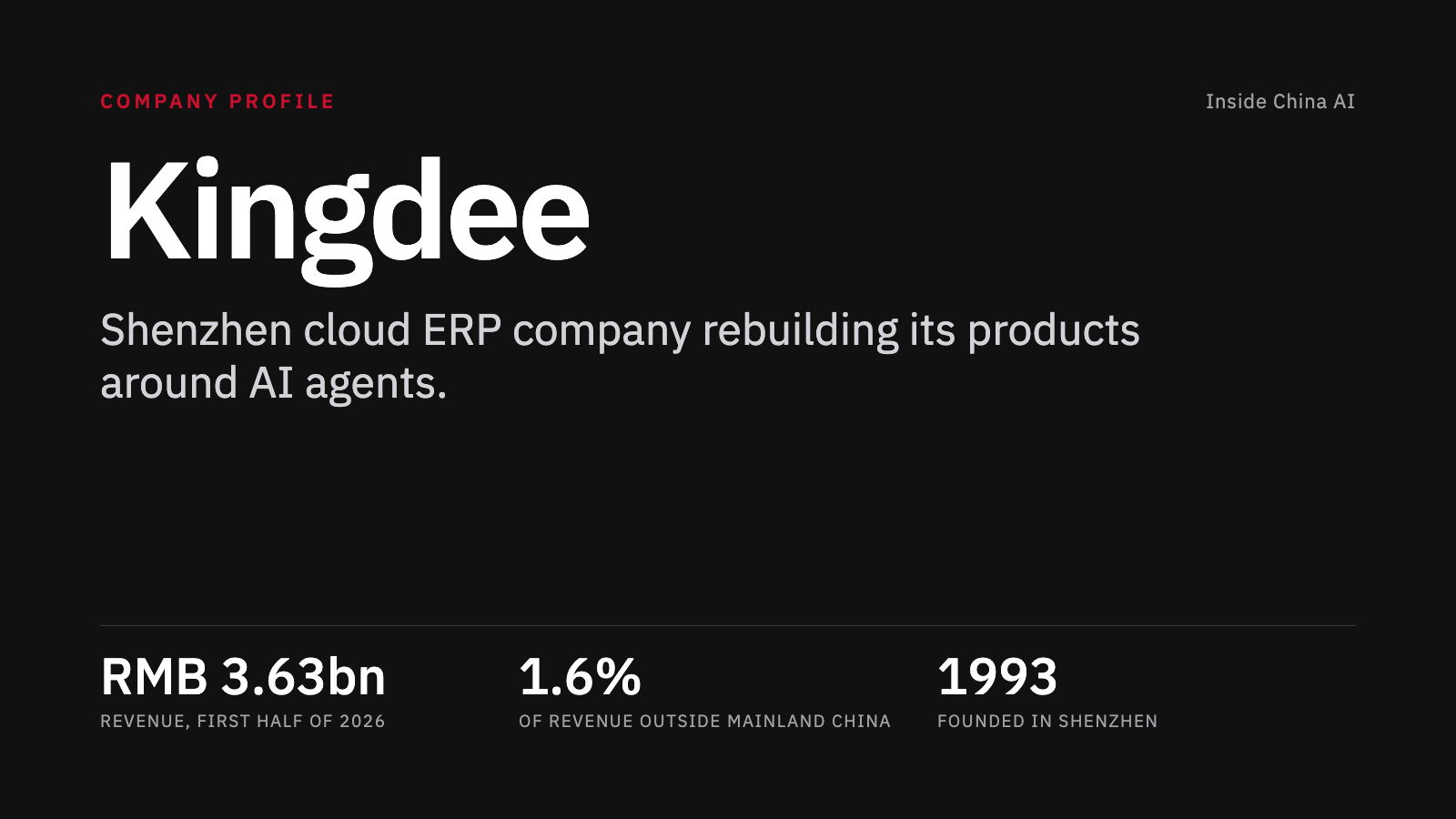
Graphic: Inside China AI
Kingdee: China’s Cloud ERP Veteran Rebuilds Around AI Agents — Europe Is Not Yet on Its Map
Company profile · 26 November 2026.
Kingdee sells the accounting, tax, HR and supply-chain software that runs a large part of Chinese business, and since May 2026 it has been rebuilding that software around AI agents under the name Lingee. Its AI-native products grew 189 per cent in the first half of 2026. For Europe, Kingdee is so far less a vendor — it has no office, subsidiary or named customer here — than a supplier to Chinese companies expanding abroad, which is the core of its international strategy. In its latest filing Kingdee names service networks in Southeast Asia and Qatar, not in Europe, and earns about 1.6 per cent of its revenue outside mainland China.
Origins and backing
Xu Shaochun founded Kingdee (金蝶) in Shenzhen in 1993, according to the company. The listed parent, Kingdee International Software Group Company Limited, is incorporated in the Cayman Islands and has had its primary listing in Hong Kong since 15 February 2001; it trades under stock code 268 (HKEX interim results, 11 August 2026). Xu is still in charge: the same filing lists him as both Chairman of the Board and Chief Executive Officer, a combination the company reports as a deviation from the Hong Kong corporate governance code. Lin Bo is Chief Financial Officer.
Xu is also the largest shareholder. Through companies he wholly owns and his own holdings he controlled 19.86 per cent of the shares on 30 June 2026; BlackRock (8.95 per cent) and JPMorgan Chase (8.62 per cent) were the other disclosed holders above five per cent (HKEX interim results). On 14 December 2023 Kingdee issued 154.6 million new shares at HKD 10.10 each to Al-Rayyan Holding, a subsidiary of the Qatar Investment Authority, for about USD 200 million (HKEX annual results, 18 March 2024); according to Kingdee’s legal adviser, that was about 4.26 per cent of the enlarged share capital (Slaughter and May). Kingdee had 10,517 employees at the end of June 2026.
After a loss in 2024 Kingdee has returned to profit. For 2025 it reported revenue of RMB 7.01 billion, up 12.0 per cent, and a profit attributable to shareholders of RMB 92.9 million, after a loss of RMB 142.1 million in 2024 (HKEX annual results, 17 March 2026). The company reports results half-yearly; the interim results of 11 August 2026 are its latest full figures. In a voluntary update on 12 October 2026 it said annual recurring revenue from subscriptions had reached about RMB 4.60 billion at 30 September 2026, up 19.3 per cent, and that contracts for its AI-native products signed in the first nine months totalled RMB 1.00 billion (Kingdee voluntary announcement, 12 October 2026).
What they build
Kingdee’s core is enterprise software sold mainly as cloud subscriptions: ERP for large, mid-sized and small companies, plus finance, tax, treasury, HR and supply-chain modules. Cloud services made up 86.0 per cent of revenue in the first half of 2026. Citing IDC, Kingdee says its market share in China’s enterprise application software market has ranked first for 22 consecutive years (HKEX interim results).
The AI layer has changed shape several times. In August 2023 Kingdee launched “Cosmic GPT” (金蝶云·苍穹GPT), which China Securities Journal described as a large-model platform inside Kingdee’s Cosmic cloud platform that connects general-purpose models such as Baidu‘s ERNIE Bot and Microsoft’s OpenAI service and adds domain-specific models (China Securities Journal, 9 August 2023). The company says it launched “the industry’s first financial LLM” that year (Kingdee). In February 2025 Kingdee said its own “Sky” model (the English name it uses for Cangqiong, 苍穹) had passed the large-model filing of the Cyberspace Administration of China, and that it had integrated DeepSeek across its cloud applications (Kingdee, 6 February 2025). Its 2025 annual results, however, stress partnerships: Kingdee says it integrates “mainstream large model capabilities” from Volcano Engine, Alibaba Cloud, Huawei Cloud and others into its products, and that 41 per cent of newly added code in 2025 was written by AI (HKEX annual results). Kingdee, in other words, has a model of its own for enterprise management, but it is primarily an application company that builds much of its AI on other firms’ foundation models.
The current product is Lingee, which Kingdee calls an “Enterprise AI Operating System” and unveiled at its AI summit in Shenzhen on 20 May 2026 (Kingdee). It is meant to turn a company’s business data, rules and records into context that AI agents can work with across finance, procurement and manufacturing. At the launch Kingdee announced a strategic partnership with the model developer StepFun covering model platforms and joint product development, and named Moonshot AI and SiliconFlow among its ecosystem partners; it did not say which models run inside Lingee. StepFun confirmed the partnership on its own site (see our StepFun profile).
By the end of June, Kingdee says, Lingee had signed 26 customers and more than 40 agents had been deployed. Pilot customers include Hytera, the GPU developer Moore Threads and the AI chip company Kunlunxin. The company claims that its expense-review agent frees 20 to 30 per cent of the staff time needed for that task and that its closing agent improves closing efficiency by 30 per cent (HKEX interim results). These are the company’s own figures.
Key numbers
- Listing Hong Kong, stock code 268, since 15 February 2001; incorporated in the Cayman Islands
- Revenue RMB 3.63 billion in H1 2026 (+13.6%); RMB 7.01 billion in 2025 (+12.0%)
- Subscriptions RMB 2.03 billion subscription revenue in H1 2026 (+20.4%); annual recurring revenue about RMB 4.41 billion at 30 June 2026 (+18.3%) and about RMB 4.60 billion at 30 September 2026 (+19.3%)
- AI AI-native products (Lingee and Kingdee AI Suite) RMB 296 million in H1 2026 (+189.0%); contract value RMB 605 million in H1 2026 and RMB 1.00 billion in the first nine months
- Profit RMB 54.5 million attributable to shareholders in H1 2026, after a loss of RMB 97.7 million a year earlier; gross margin about 67.7%
- Outside mainland China RMB 57.2 million revenue in H1 2026, about 1.6% of the total
- Staff 10,517 at 30 June 2026
Source for H1 2026 figures: HKEX interim results, 11 August 2026; for 2025: HKEX annual results, 17 March 2026; for 30 September 2026 (unaudited operating data): Kingdee voluntary announcement, 12 October 2026.
The European angle
- Physical presence None found. Kingdee’s interim report names local service networks in Malaysia, Thailand, Vietnam, Indonesia, Singapore and Qatar (HKEX interim results); its careers page lists offices in the same six countries (Kingdee). We found no European subsidiary, office, data centre, reseller or event. The only data centre outside China named in the filing is in Singapore.
- Strategy When Kingdee presented its internationalisation plan in August 2023 it said it would begin in Southeast Asia, with Singapore, Malaysia and Thailand, and aim to complete a global footprint within five years; Europe was not mentioned (China Securities Journal). Its current formula is “Chinese enterprises going global + overseas native customers” (HKEX interim results).
- Product readiness The closest link to Europe is in the product. In December 2024 Kingdee said its Tax Cloud can calculate income tax and VAT for the United States, Germany, the United Kingdom and six other countries and regions (Kingdee). In August 2026 it said tax compliance for six countries is “ready for direct delivery”, without naming them.
- Customers Kingdee signed about 140 international customers in the first half of 2026, the company says; none of those it names is European. One customer story describes a Chinese car-parts maker expanding plants “across Europe, North America, and Southeast Asia” (Kingdee), but does not say that Kingdee software runs at a European site.
- Lists Kingdee does not appear on the EU’s consolidated financial sanctions list, the US Consolidated Screening List (which includes the Entity List) or the US Department of Defense’s 1260H list, according to our name check of 26 November 2026. One of its Lingee pilot customers, the GPU developer Moore Threads, has been on the US Entity List, an export-control list, since 17 October 2023 (US Federal Register); this concerns the customer, not Kingdee.
- What a European company would actually encounter Most likely Kingdee software inside the European subsidiary of a Chinese manufacturer — something we could not confirm for any named case — rather than a Kingdee sales team.
What we could not verify
- Which AI models run inside Lingee, how large Kingdee’s own model is, and its regulatory filing: we could not check Kingdee’s statement against the regulator’s published lists.
- Any European customer, partner or entity, and where data from European users would be processed.
- Which six countries the “ready for direct delivery” tax compliance covers.
- Whether the Qatar Investment Authority still holds its 2023 stake, which falls below the five per cent disclosure threshold.
The open question for Europe: will Kingdee follow its Chinese customers into their European plants with its own service network — or leave that to partners it has yet to name?

Comments are closed