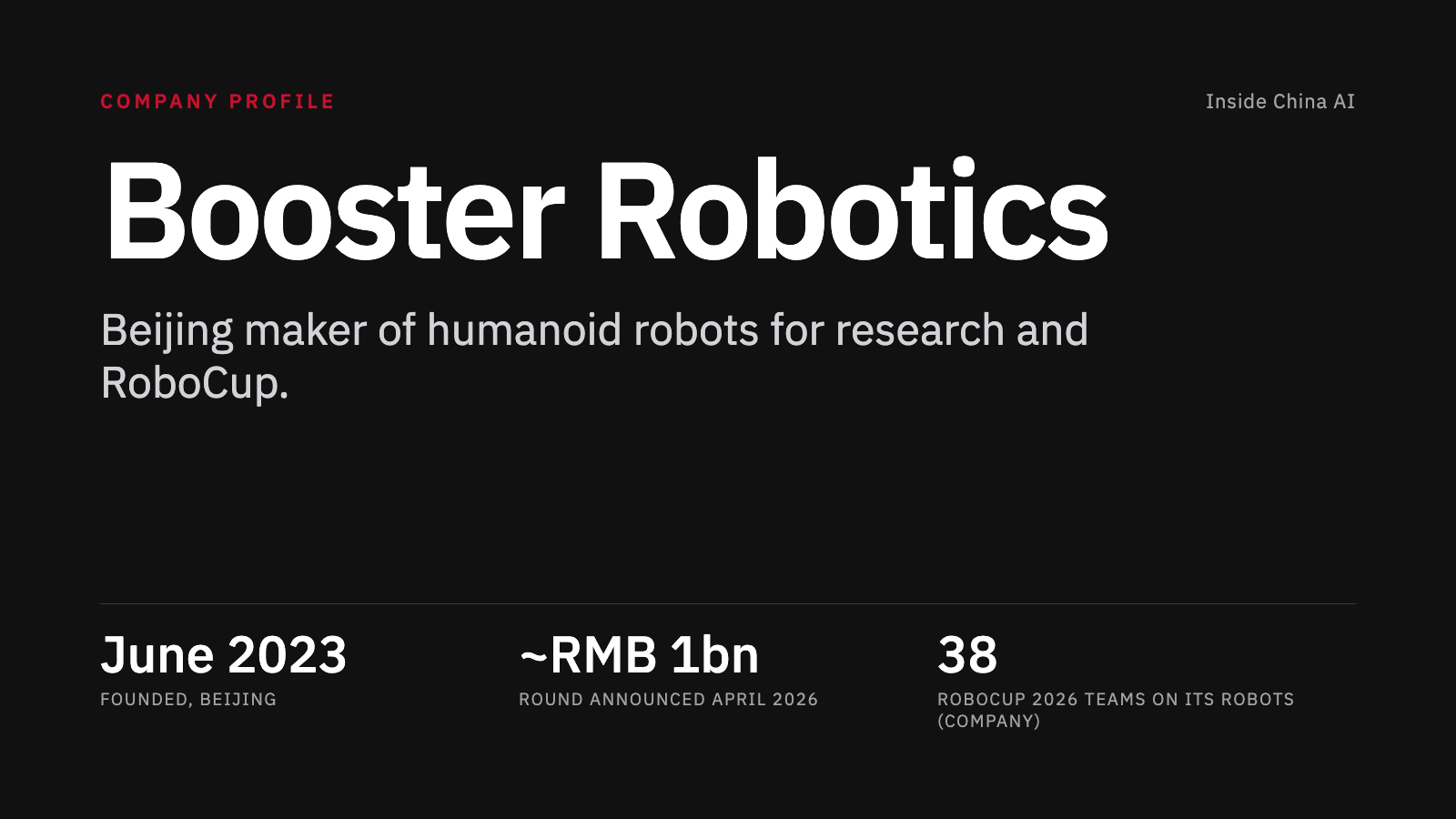
Graphic: Inside China AI
Booster Robotics: The Beijing Humanoid Maker Whose Robots Europe’s RoboCup Champions Play With
Company profile · 22 November 2026.
Booster Robotics is a Beijing start-up, founded in June 2023 by former members of Tsinghua University’s robot football team, that sells small and mid-sized humanoids to universities, schools and developers rather than to factories. In 2026 its 95-centimetre K1 was the robot every team used in RoboCup’s new Middle Division, according to the University of Bremen, which means that the two German teams in that division’s 2026 world final, Bremen’s B-Human and Leipzig’s HTWK Robots, played on Chinese hardware with software of their own. For Europe, Booster is less a visitor than a supplier already inside research labs: its robots are sold by German and French dealers and the common platform of a RoboCup division in which eight European teams qualified in 2026. What it does not yet have here is a company of its own, an industrial customer or a privacy policy written for the GDPR.
Origins and backing
Booster Robotics — 加速进化, legally 北京加速进化科技有限公司, a limited liability company — was set up in Beijing in June 2023 (Booster Robotics). Its founder and chief executive, Cheng Hao, studied at Tsinghua University, and the company says its core team came from Tsinghua’s robot control lab and its RoboCup team, Tsinghua Hephaestus (Booster Robotics). According to an interview piece published by Xinhua Finance on 13 November 2026, Cheng joined the team, founded by the Tsinghua researcher Zhao Mingguo, in his first year and later became its third captain; many of its members became Booster’s first staff (Xinhua Finance).
The money came in many small rounds, then one large one. After angel and pre-A rounds in 2023 and 2024, Shenzhen Capital Group led a Series A in June 2025 and two Beijing industry investment funds for robotics and for AI led a Series A+ in July 2025 (Booster Robotics), worth more than 100 million yuan according to Caixin (Caixin). A further round led by IDG Capital brought its Series A financing to nearly 500 million yuan, TMTPost reported on 12 January 2026 (TMTPost). On 17 April 2026 Booster announced nearly 1 billion yuan — nearly $150 million, the company says — co-led by Beijing’s High-Tech Industries Investment Fund, the Jingguosheng Fund and the Huakong Fund, with IDG, Shenzhen Capital Group and other existing investors adding money (Huxiu). The company says the money is meant for a global delivery network, embodied-AI algorithms and new products. Booster has not disclosed a valuation, revenue or profit.
What they build
Booster makes humanoid robots as development platforms. The company says its early strategy is “oriented towards scientific research and education scenarios” (Booster Robotics). Three robots define the range:
- T1, about 1.2 metres tall and 30 kilograms, built around an NVIDIA AGX Orin computer (reichelt) and first shown at the World Robot Conference in Beijing in August 2024 (Booster Robotics). It is the robot with which Tsinghua won RoboCup’s largest humanoid class in 2025 (AdultSize) and 2026 (Large Division), the company says. It no longer has its own page on Booster’s website.
- K1, about 95 centimetres and 19.5 kilograms, with 22 degrees of freedom (Booster Robotics), launched formally on 24 October 2025 (Booster Robotics) after Leipzig’s HTWK Robots had already won RoboCup 2025’s KidSize title with it (reichelt). The first 100 units were offered at 29,900 yuan and sold out in 20 minutes, according to Beijing’s Zhongguancun Science City (Zhongguancun Science City via ncsti.gov.cn).
- T2, launched on 10 July 2026: about 1.4 metres, 42 kilograms and 31 degrees of freedom, with an optional gripper or dexterous hand; the Professional edition runs on NVIDIA’s Jetson Thor (Booster Robotics).
Booster’s own AI is mainly about movement. Cheng describes the company’s strength as the robot body and whole-body motion control — the “cerebellum” — while a joint research centre with Tsinghua’s Department of Automation is to work on skill and reasoning models (Xinhua Finance). We found no foundation model, model card or released weights from Booster. What is public is tooling: a reinforcement-learning framework for humanoid walking, an SDK, training and deployment code and an Apache-licensed RoboCup demo on GitHub (GitHub). On 30 June 2026 the company launched Booster Studio, a development environment that covers agent development, “Vibe Coding”, simulation and deployment to the robot (Booster Robotics); it does not say which language models are behind it.
Some research credited to Booster is others’ work. A paper on vision-driven soccer skills published in Science Robotics on 19 August 2026 is a Tsinghua paper, written with ByteDance Seed and China Agricultural University; Booster supplied the robot platform and test facilities (Tsinghua University).
Key numbers
- Founded June 2023, Beijing; founder and CEO Cheng Hao
- Funding Nearly 1 billion yuan announced 17 April 2026 (nearly $150 million, the company says); Series A rounds totalling nearly 500 million yuan by January 2026 (TMTPost). No valuation published
- Deliveries More than 700 robots to more than 200 customers by November 2025, more than half abroad (company); 1,200 in the first half of 2026, a sevenfold rise on a year earlier, according to Xinhua Finance’s interview piece with Cheng (Xinhua Finance); not independently verified
- Abroad Customers in more than 40 countries; overseas share of revenue above 50 per cent in October 2026, up from 49 per cent in the first half, according to the same Xinhua Finance piece (Xinhua Finance); the company publishes no accounts
- Cash flow First month with positive operating cash flow in December 2025, the company says (Booster Robotics)
- Competitions 38 teams used Booster robots at RoboCup 2026, the company says, and teams on its robots won every bipedal humanoid division (Booster Robotics)
- AI Motion control and reinforcement-learning tooling; Booster Studio; no own foundation model found
The European angle
- Research users In 2026 RoboCup merged its Standard Platform League — for years played with the NAO robot — and its Humanoid League into one Humanoid Soccer League (RoboCup HSL). In the new Middle Division, in which 16 teams played in 2026, “all teams currently use the same robot platform”, the Booster K1, the University of Bremen wrote on 6 July 2026 (Universität Bremen). The K1 is not mandatory but a “pre-approved” robot under the league’s rules (HTWK Robots). Eight European teams qualified for that division in 2026: B-Human, Berlin United, HTWK Robots, HULKs and Ruhrbot Devils from Germany, Rhoban from France, RoboEireann from Ireland and whIRLwind from Amsterdam; all eight name the Booster K1 in the robot specifications they filed with the league (RoboCup HSL).
- Named users B-Human, the joint team of the University of Bremen and the German Research Center for Artificial Intelligence (DFKI), switched to the K1 in 2026, won the German Open in Cologne in March (Universität Bremen) and the world title in Incheon in July, beating HTWK Leipzig 6–0 in the final (Universität Bremen). The university credits the win partly to software of B-Human’s own: “While many participants relied on movements provided by the robot manufacturer, B-Human developed its own solutions for running, shooting, and standing up.” Booster lists B-Human under “Customer Cases” on its K1 page (Booster Robotics). HTWK Leipzig says it has had access to the robots “since April 2025 thanks to a partnership”; its professor Jens Wagner said the collaboration had “solved a number of technological problems for which we were unable to find European partners” (HTWK Leipzig via idw).
- Sales channel The German electronics retailer reichelt added Booster robots in August 2025 and calls itself one of the first distributors in the German-speaking region (reichelt). The French dealer Generation Robots lists the K1 from €7,500 (Generation Robots) and the T2 from €22,500 (Generation Robots), both before VAT, as of 22 November 2026. Booster runs a partner programme with “territory protection” (Booster Robotics) but publishes no list of authorised European partners.
- Physical presence None found: no European company, office, service centre or plant.
- Data The website’s privacy policy names the Beijing company as controller, says servers are deployed “in China, Singapore and other regions” and does not mention the GDPR (Booster Robotics).
- Regulatory exposure Booster Robotics is not on the US Entity List, the Treasury’s list of Chinese military-industrial complex companies (CMIC), the Pentagon’s 1260H list or the EU’s consolidated sanctions list, according to our check of the published lists on 22 November 2026. The T1 and T2 run on NVIDIA computers.
- What a European buyer would actually encounter A research and teaching robot that many of Europe’s RoboCup teams already use, bought through European electronics and robotics dealers — and a manufacturer whose only European relationships so far are with universities and resellers.
What we could not verify
- Booster’s ranking among humanoid makers. Xinhua Finance reported that an IDC report put Booster in the global top three by shipments; IDC’s public summary of 29 September 2026 does not name the company.
- Total deliveries. The company’s figures differ by date and source, and an undated partner page claims more than 3,000 robots.
- Whether European teams bought their robots or received them through partnerships (HTWK Leipzig speaks of a partnership; B-Human’s university does not say), and which European dealers Booster has authorised.
- CE marking and EU declarations of conformity for the K1 and T2.
- A European company customer, outside universities.
The open question for Europe: will a company whose robots European university teams already play with build a presence here — and will its customers move from the pitch into the lab and the factory?

Comments are closed