Graphic: Inside China AI
CATL: The Ningde Battery Maker Says It Uses AI in Research and Production, and Makes Cells in Germany
Company profile · 23 November 2026.
CATL does not build AI models for sale. It builds batteries, for cars, trucks and power grids, and it is applying AI to how those batteries are invented and manufactured. For Europe the company matters for a simpler reason: it has made battery cells in Thuringia since December 2022, started trial production in Hungary on 22 September 2026, and is building a plant in Spain with Stellantis. It also sits on the US Department of Defense’s Section 1260H list of “Chinese military companies”, a designation CATL rejects. The list is not a sanction.
Origins and backing
Contemporary Amperex Technology Co., Limited (宁德时代) was established in 2011 in Ningde, Fujian, by the founding team of ATL, a maker of lithium-ion batteries for consumer electronics set up in 1999, according to the company’s profile. Its A shares have traded in Shenzhen since 2018 (300750). It added a Hong Kong listing on 20 May 2025 (3750), according to its 2026 interim report.
The company is controlled by its founder. Zeng Yuqun (Robin Zeng) signed the third-quarter report of 20 October 2026 as chairman of the board, executive director and general manager. The largest shareholder, Xiamen Ruiting Investment, held 22.04 per cent of the shares on 30 September 2026. The interim report states that Zeng owns Xiamen Ruiting, directly and through a company he wholly owns. Pan Jian is co-chairman, according to CATL’s investor-relations page.
CATL has also invested in AI elsewhere. On 17 June 2026 TrendForce, citing The Information, reported that CATL had put RMB 5 billion into DeepSeek‘s first external funding round (TrendForce), and on 17 July 2026 Caixin named CATL as one of the round’s backers (Caixin Global). CATL has not confirmed the amount: we found no CATL announcement, and its 2026 interim report does not mention DeepSeek.
What they build
CATL’s products are hardware: battery cells and packs for passenger cars and commercial vehicles, energy-storage systems sold under the TENER name, battery-swap networks, and a skateboard chassis called Bedrock. In 2025 CATL shipped 661 GWh of batteries, and it expects to pass 1,000 GWh in 2026, the company says (CATL, 31 October 2026). CATL says it has ranked first worldwide in EV battery usage for nine consecutive years (interim report); its profile names SNE Research as the data source.
AI enters through research and production. In its 2026 interim report CATL says it “has integrated AI into its R&D and manufacturing processes”. In its account of Zeng’s speech at the World Laureates Forum in Shanghai on 31 October 2026, CATL says it is “using large models to drive R&D” and is building an “AI-native research system” that draws on 600 TB of data and more than one trillion test data points and links simulated and physical experiments. According to CATL, the system has screened more than 1,600 compounds and identified seven promising candidate materials (CATL, 31 October 2026). The company did not say which models it uses, or whether it built them itself.
In manufacturing, CATL says its factories use “AI, image recognition, machine learning, predictive algorithms and 5G”, with more than 7,000 quality-control points monitored in real time (CATL smart manufacturing). The World Economic Forum has named three CATL plants (Ningde, Yibin and Liyang) to its Global Lighthouse Network of advanced factories, according to CATL. In CATL’s December 2023 release on the Liyang plant, the company quotes the World Economic Forum on “deep learning to optimize process controls and energy management” and describes AI-supported quality inspection (CATL via PR Newswire).
AI is also a market for CATL. The company says it supplies “full-scenario energy and power supply solutions for AI data centers” (interim report). We found no published evidence of AI in CATL’s battery-management systems or its Bedrock chassis. On 29 April 2026 the chassis unit agreed with Turkey’s Togg to co-develop a platform for a new B-segment vehicle family (CATL via PR Newswire).
Key numbers
- Listing Shenzhen (300750) and Hong Kong (3750, since 20 May 2025)
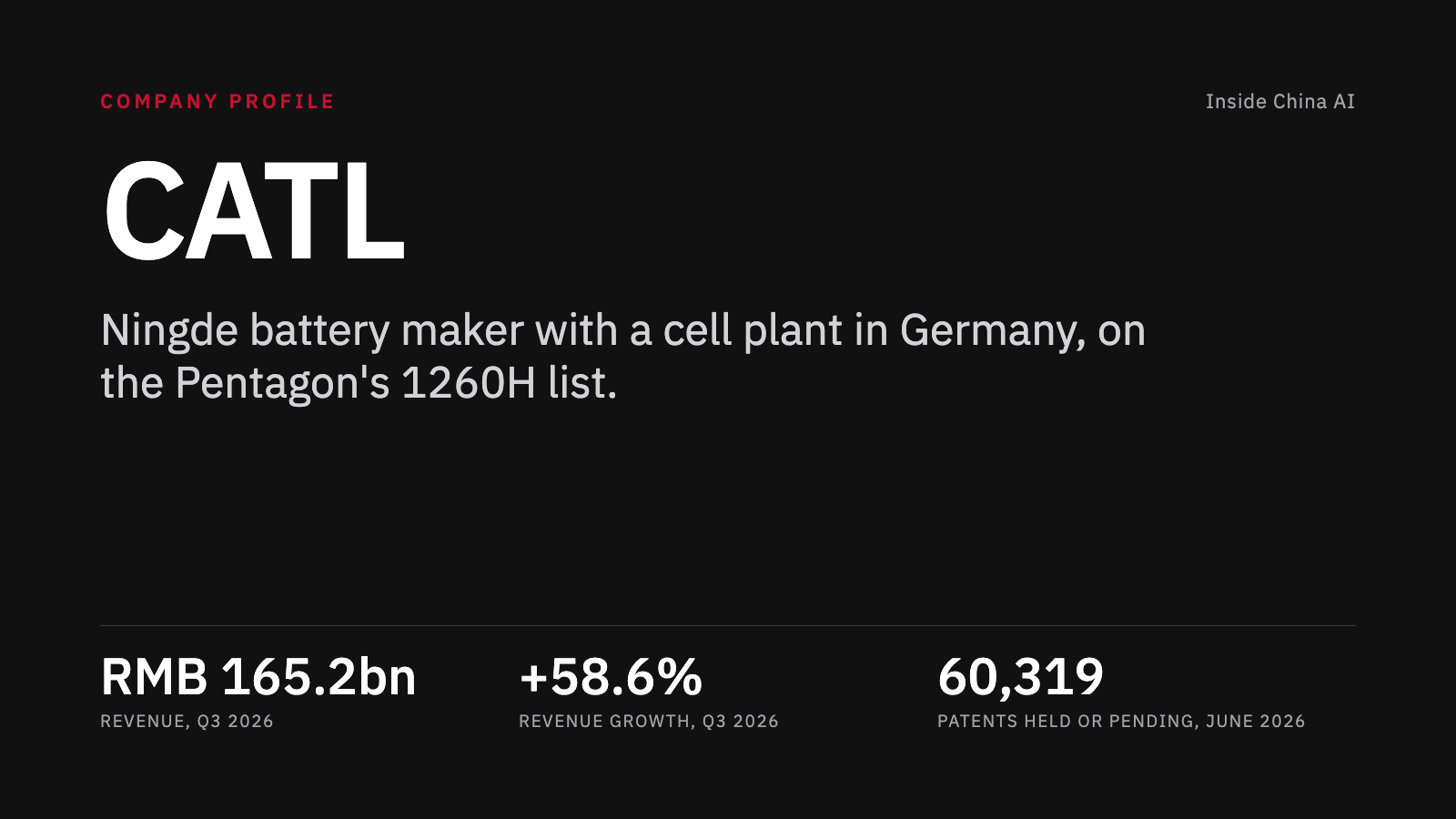
- Revenue RMB 165.22 billion in Q3 2026, up 58.58 per cent; RMB 442.14 billion in January–September, up 56.19 per cent (Q3 report, unaudited)
- Net profit RMB 21.25 billion attributable to shareholders in Q3 2026, up 14.54 per cent; RMB 64.53 billion in January–September, up 31.60 per cent
- R&D costs RMB 18.52 billion in January–September 2026, against RMB 15.07 billion a year earlier
- Patents 60,319 held or pending at the end of June 2026 (interim report)
- AI Large models in materials research and AI in manufacturing, the company says; no AI model of its own published
- Europe Arnstadt (Germany) in series production since December 2022; Debrecen (Hungary) in trial production since 22 September 2026; Spanish joint venture with Stellantis under construction
The European angle
- Germany CATL’s first subsidiary outside China, Contemporary Amperex Technology GmbH, opened in Munich in March 2014. Contemporary Amperex Technology Thuringia GmbH, founded in 2018, runs the company’s first European EV battery plant near Arnstadt. It started series production of lithium-ion cells in December 2022 (CATL Germany). On 15 October 2025 the trade publication electrive reported that production was running, that the plant supplied cells for the Porsche Macan built in Leipzig, and that 1,700 people worked there (electrive). On 23 March 2026 electrive reported that Porsche had so far used cells only from Arnstadt for the Macan Electric, and that cars sold in South Korea would switch to Samsung SDI cells (electrive). We found no output figure for 2026.
- Hungary The Debrecen plant began trial production on 22 September 2026. Its first two lines are in trial operation, and it is designed for 100 GWh a year, the company says (CATL). CATL has allocated 90 per cent of the net proceeds of its Hong Kong listing, about HK$36.6 billion, to phases I and II of the Hungarian project. By 30 June 2026 it had spent HK$2.36 billion of that, and the rest is due to be used by the end of 2030 (interim report). Local residents have challenged the plant’s permits in court since 2023, and on 29 November 2023 Hungary’s supreme court, the Kúria, annulled its disaster-management permit and ordered a new procedure (Telex).
- Spain CATL and Stellantis are building a plant for LFP cells and modules in Figueruelas, near Zaragoza, through a 50:50 joint venture. The plant will cost up to €4.1 billion and have up to 50 GWh of annual capacity. Construction officially began in November 2025, and the project has secured more than €300 million in EU funding (electrive). When the venture was announced in December 2024, the partners aimed to start production by the end of 2026 (Stellantis; AFP via Fortune).
- Customers and partners CATL names VW, Stellantis, BMW and Volvo among its overseas customers (interim report) and describes BMW as a partner since 2012 (CATL). In energy storage, CATL signed a memorandum with Germany’s INTILION on 3 GWh of TENER systems for Germany, Switzerland, Austria and other markets over five years. The two companies have completed more than 30 projects in Germany since 2022 (CATL, 27 October 2026). In the UK, CATL and its subsidiary Ampace signed a memorandum with Octopus Energy on home storage on 26 October 2026 (CATL). CATL and Octopus Energy have also announced a joint venture for a heavy-truck battery-swap network in Europe (interim report).
- US lists The US Department of Defense named CATL on its Section 1260H list of “Chinese military companies” in the update published in the Federal Register on 7 January 2025 (Federal Register) and kept it on the list published there on 10 June 2026, which states that CATL “is indirectly affiliated with MIIT and is directly and indirectly affiliated with SASAC” (Federal Register). The list is not a sanction. On 7 January 2025 CATL said in a statement: “CATL has never engaged in any military-related business or activities, so this designation by the Department of Defense is a mistake” (Fortune). On 15 April 2026 Bloomberg reported that co-chairman Pan Jian had lobbied Pentagon officials, and a CATL representative said: “We are exploring legally available options to address the false designation” (Bloomberg via Transport Topics). We found no lawsuit. CATL is not on the US Consolidated Screening List, which includes the Entity List and the Treasury’s Chinese military-industrial complex list (trade.gov, version of 23 November 2026), nor on the forced-labour (UFLPA) entity list (Federal Register, 29 October 2026).
- What a European buyer would actually encounter Mostly an industrial supplier rather than a brand: cells in European-built cars, storage containers on European grids, and from 2026 cells from Hungary. CATL’s AI work stays inside its own labs and factories.
What we could not verify
- Arnstadt’s output in 2026, in cells or GWh; the most recent independent report of running production dates from October 2025.
- Which large models CATL uses in research, and whether they are its own.
- The size of CATL’s DeepSeek stake from a CATL or regulatory document, and whether CATL took part in a further DeepSeek round reported in October 2026.
- When the Spanish plant will produce: electrive reported in November 2025 that construction was expected to be completed in March 2028, later than the original end-2026 target.
- The current state of the Debrecen permit cases; we found no court document or original report on a decision in 2026.
The open question for Europe: when Debrecen and Zaragoza reach volume, will CATL’s AI-driven research and factory systems run in Europe too, and on whose data?

Comments are closed