Graphic: Inside China AI
Cheetah Mobile: From Utility Apps to Service Robots and AI Cloud Services
Company profile · 28 November 2026.
Cheetah Mobile, a Beijing company listed in New York since 2014, built its name on utility apps. Today it sells service robots under the OrionStar brand — cleaning, delivery, reception and warehouse robots, plus lightweight robot arms — and provides cloud and AI infrastructure services, which it says are in demand from companies expanding overseas. For Europe the group matters more than its profile suggests: in 2025 it booked RMB 318.4 million of its revenue from customers in Europe, according to its annual report — more than from Japan or the United States. Its robots, on the other hand, are only starting to reach European buyers, through trade fairs and distributors.
Origins and backing
Cheetah Mobile (猎豹移动) was founded in November 2010 by Fu Sheng and listed on the New York Stock Exchange on 8 May 2014 (Cheetah Mobile). Fu has been chief executive since 2010 and also chairman since March 2018; Thomas Jintao Ren has been chief financial officer since January 2020 (investor relations). The company is headquartered in Chaoyang District, Beijing. Like many US-listed Chinese internet companies it runs part of its Chinese business through two variable interest entities, Beijing Cheetah Mobile Technology and Beijing Cheetah Network Technology (annual report, exhibit 8.1). Tencent is a shareholder and has reported its stake to the US Securities and Exchange Commission since 7 May 2014, most recently in an amendment signed on 17 April 2025 (Schedule 13D/A).
The turn to AI began in 2016, when Fu announced an “All in AI” strategy and Cheetah set up the service-robot company OrionStar (猎户星空); in 2023 Cheetah took control of it, the company says (Cheetah Mobile). Beijing Orion Star Technology was incorporated on 19 September 2016 and is 74.0 per cent owned by Cheetah on a fully diluted basis; a second company in Jiujiang, Jiangxi province, manufactures the robots (annual report, note 1). Fu Sheng is also president of OrionStar (OrionStar).
What they build
Cheetah now reports three businesses. Internet services are the older core: utility software for PCs and phones; paid memberships and other value-added services made up 77.6 per cent of the segment’s revenue in the second quarter of 2026. Global enterprise services comprise cloud and AI infrastructure services and advertising-agency services. Robotics and others covers OrionStar’s robots and UFACTORY, a maker of lightweight robot arms in which Cheetah acquired a controlling stake on 29 July 2025 (Q2 2026 results).
OrionStar’s range covers CleaniBot floor-cleaning robots, LuckiBot delivery robots for restaurants, GreetingBot reception robots, CarryBot warehouse robots, the UFactory xArm arms and the Orion X1 for “smart mobility” (OrionStar). In March 2026 Fu announced a consumer-facing smart wheelchair built on the same autonomous-navigation technology (FY2025 results). OrionStar says it has shipped more than 60,000 robots to over 20,000 customers in more than 60 countries and regions since 2016 (OrionStar, 19 November 2026).
The AI behind the robots is partly its own. In January 2024 OrionStar published Orion-14B, a language model with 14 billion parameters trained on 2.5 trillion tokens in Chinese, English, Japanese, Korean and other languages; the code is under Apache 2.0, the weights under OrionStar’s own community licence (model card). A mixture-of-experts model, Orion-MoE8x7B, followed on Hugging Face in October 2024, and the model series passed China’s algorithm filing with the Cyberspace Administration, the company says (Cheetah Mobile). In 2025 OrionStar released AgentOS, which it calls a “robotic agent operating system” with built-in language-model interfaces and conversation in nine languages (OrionStar; Cheetah Mobile). GreetingBot Nova, its reception robot, combines OrionStar’s language model with third-party models, including ChatGPT, and speaks more than 30 languages, the company says (OrionStar). On the software side Cheetah launched EasyClaw, an “AI coworker platform” for building AI agents; monetisation “remains at an early stage”, Fu said in March 2026 (FY2025 results).
The fastest-growing line is cloud. Revenue from “services of cloud and AI infrastructure” rose 83.1 per cent to RMB 59.1 million in the second quarter of 2026, driven, the company says, by demand “from enterprises expanding overseas for cloud resources, computing power and AI model services”. Customers’ gross billings passed RMB 500 million in the quarter (Q2 2026 results). Its cloud subsidiary Juyun became an AWS Premier Tier Services Partner in 2025, Cheetah says (Cheetah Mobile).
Key numbers
Figures are those of the listed company, Cheetah Mobile Inc. Cheetah will publish its third-quarter 2026 results on 4 December 2026 (announcement). Its 2026 reports use different segments from the 2025 annual figures (then “Internet business” and “AI and Others”), so the 2025 and 2026 segment figures are not directly comparable.
- Listed NYSE: CMCM, since 8 May 2014; founded November 2010 by Fu Sheng (chairman and CEO)
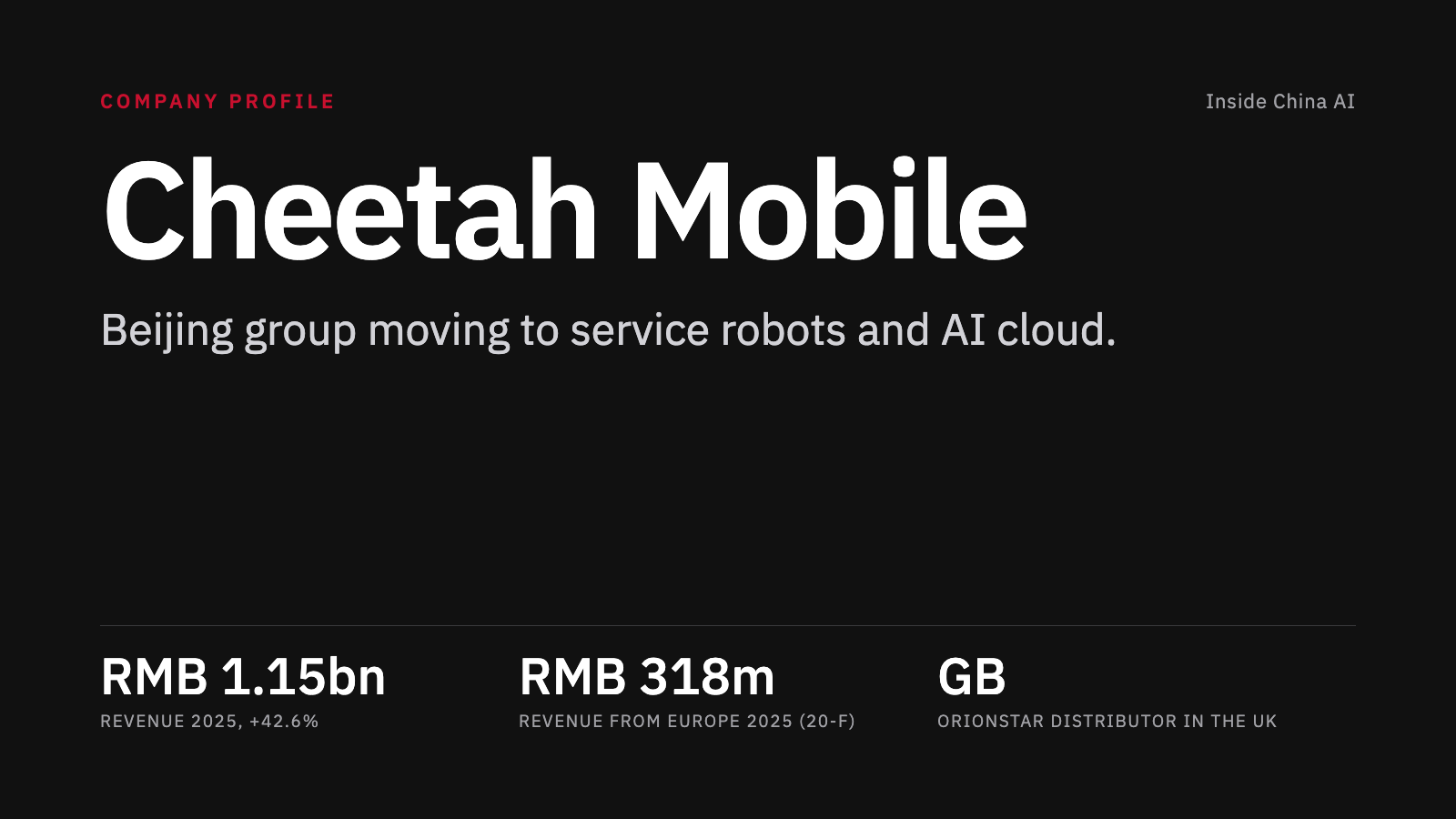
- Revenue 2025 RMB 1,150.4 million (US$164.5 million), up 42.6 per cent; operating loss RMB 179.4 million, non-GAAP operating profit RMB 14.2 million (FY2025 results)
- Revenue Q2 2026 RMB 266.1 million (US$39.2 million), down 9.9 per cent year on year, mainly because advertising-agency revenue fell 70.0 per cent after “changes in rebate policies implemented by a major global advertising platform”; operating loss RMB 33.6 million (Q2 2026 results)
- Robotics and others, Q2 2026 RMB 54.5 million, up 72.5 per cent, 20.5 per cent of revenue; adjusted operating loss RMB 34.0 million
- Cloud and AI infrastructure, Q2 2026 RMB 59.1 million, up 83.1 per cent, 22.2 per cent of revenue
- Cash RMB 1,271.0 million (US$187.3 million) at 30 June 2026
- Revenue from Europe, 2025 RMB 318.4 million (US$45.5 million), after RMB 137.1 million in 2024 and RMB 92.5 million in 2023 (annual report, geographical information)
- OrionStar 74.0 per cent owned; more than 60,000 robots shipped since 2016, the company says
The European angle
- Revenue Europe is Cheetah’s largest region outside China. In 2025 it booked RMB 318.4 million from Europe, compared with RMB 139.2 million from Japan and RMB 99.0 million from the United States. The company assigns revenue by customers’ registered addresses and does not say which of its businesses the European revenue comes from (annual report).
- Physical presence None found. The subsidiaries listed with the 2025 annual report are in mainland China, Hong Kong, Singapore, Japan, the British Virgin Islands and the Cayman Islands (exhibit 8.1). OrionStar’s German-language website names a country manager for Germany but no German company (OrionStar Germany).
- Distribution In the United Kingdom, Robots of London describes itself as “the official distributor of OrionStar in the UK”, offering sales, service and maintenance; the page is not dated; its footer carries a 2022 copyright notice (Robots of London). We found no distributor in the European Union named by OrionStar itself.
- Trade fairs OrionStar exhibited at Automatica in Munich from 27 to 30 June 2023 (OrionStar) and showed its cleaning robots at CleanPro Expo in Friedrichshafen from 15 to 17 September 2026, where it wanted to meet “European distributors, cleaning service providers” and others (OrionStar).
- Customers OrionStar’s case list shows videos captioned with an e-commerce fulfilment centre in Italy and a hotel in Spain, and its German site describes a tool-delivery robot in an unnamed German car workshop (OrionStar; OrionStar Germany). None is dated, so we do not count them as confirmed European customers.
- Regulatory exposure Cheetah Mobile, OrionStar and UFACTORY are not on the EU’s consolidated financial-sanctions list, the US Consolidated Screening List (including the Entity List) or the Pentagon’s 1260H list, according to our check of the published lists on 27 November 2026.
- What a European buyer would actually encounter Cleaning, delivery and reception robots from a Beijing group, sold through local distributors, with language models partly developed in-house — and a parent company whose European business so far rests mostly on software, advertising and cloud services.
What we could not verify
- Third-quarter 2026 figures, due on 4 December 2026.
- Shareholder structure: the current stakes of Tencent and of Fu Sheng.
- Which business generates the European revenue, and how many OrionStar robots work in Europe.
- A named, dated European customer or a European subsidiary of OrionStar or UFACTORY.
The open question for Europe: will OrionStar follow its trade-fair appearances with its own European company and named customers — or stay a brand that Europeans buy through distributors?

Comments are closed