Graphic: Inside China AI
Cloudsky: The Cloud-Gaming Network Turning Its GPUs to AI at the Edge
Company profile · 24 November 2026.
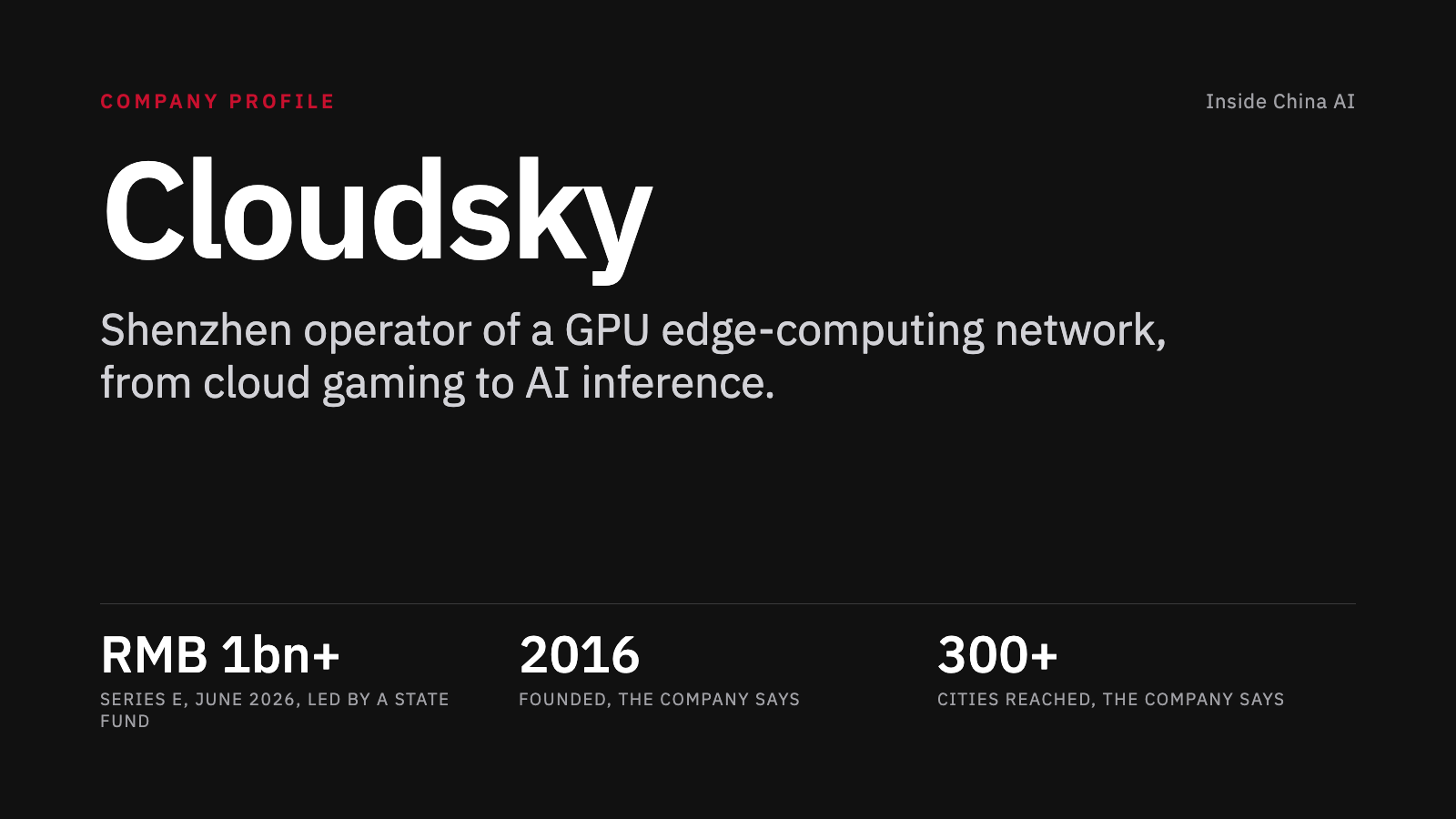
Cloudsky (云天畅想) is a Shenzhen company that runs a network of graphics processors close to end users. It started with cloud gaming. Today it sells real-time computing for AI inference, car cockpits, digital humans and rendering, and calls itself a “GPU-native Edge Cloud provider” (PR Newswire). In June 2026 it raised more than RMB 1 billion in a round led by the China Internet Investment Fund, a state fund set up by China’s internet regulator and the Ministry of Finance. For Europe, Cloudsky is so far a name from trade fairs: we found no European company, node or customer.
Origins and backing
Cloudsky says it was founded in 2016 (PR Newswire, 11 June 2026). Its Shenzhen operating company, 深圳云天畅想信息科技有限公司 (Shenzhen Yuntian Changxiang Information Technology Co., Ltd.), was registered on 5 August 2020 (36Kr database). The business magazine Huxiu, citing China’s national company register, gives the same two dates: business since 2016, company since August 2020 (Huxiu, 30 June 2026). The website gives an address in Shenzhen. The STAR Market Daily describes a Beijing headquarters (STAR Market Daily, 11 June 2026). Which entity sat above the business before 2020, and which entity the investors hold, has not been published. Cloudsky is not listed, and we found no listing application.
The founder and chief executive is Mao Xiaodong (茅晓东), according to the investment portal Pedaily (Pedaily, 17 June 2026). The STAR Market Daily (科创板日报) writes that he worked on Intel’s first generation of GPUs and later, as a chief architect at Sony, on the chip architecture of the PlayStation 3, PlayStation 4 and PlayStation VR (STAR Market Daily, 17 June 2026). He studied computer science at Fudan University (NetEase, 28 July 2026). A June 2023 news item on Cloudsky’s website calls him chairman and chief executive (Cloudsky). In English press releases the company names a “Crusoe Mao” as “founder and chairman” (PR Newswire, 12 November 2023), who “has led Sony’s PlayStation VR project”, according to China Daily (China Daily, 26 February 2024). The career and the title match, so Crusoe Mao is probably Mao Xiaodong’s English name. No source we found names both together.
Co-founder Kevin Xu (徐公美) is chief strategy officer and runs the company’s own venture fund, C12K (Huxiu, NetEase). The chief scientist is Zhang Lintao (张霖涛), formerly of Microsoft Research Asia (NetEase).
The investors show how the company moved from consumer technology towards state-backed infrastructure:
- Series C, August 2022: tens of millions of US dollars, led by Intel Capital (STAR Market Daily, 36Kr).
- Series C+, May 2023: tens of millions of US dollars, with funds of Sichuan Development and Chengdu’s high-tech zone (36Kr).
- Series D, July 2025: more than $100 million, led by the Liangxi Digital Mother Fund from Wuxi (36Kr Japan, STAR Market Daily).
- Series E, announced 17 June 2026: more than RMB 1 billion, led by the China Internet Investment Fund (中国互联网投资基金), with CICC Capital and others (Pedaily, STAR Market Daily).
By June 2026 Cloudsky had raised more than RMB 3 billion in total, Huxiu reports (Huxiu). No valuation has been published.
The lead investor of the last round matters. The China Internet Investment Fund was set up in January 2017 with State Council approval, initiated jointly by the Cyberspace Administration of China (CAC), the country’s internet regulator, and the Ministry of Finance (CAC). The STAR Market Daily calls it a national fund for the internet sector. It has invested in more than 150 projects, most of them at an early stage (STAR Market Daily). Cloudsky’s round was a regular growth round. The size of the fund’s stake and any rights attached to it have not been disclosed.
What they build
Cloudsky places GPUs in edge sites near the user and rents out their computing power by use. It buys much of the hardware itself. It also gives mobile operators software and scheduling tools, so they can turn existing machine rooms and base stations into computing nodes (NetEase). The idea: applications such as a car’s voice assistant, a game or a digital human need answers within milliseconds, and a distant data centre is too slow for that.
The core technology is StackGPU. This software pools several GPUs, including cheaper and mixed hardware, into one large virtual GPU and spreads workloads across the network (36Kr Japan, NCSTI, 3 November 2026). Cloudsky says it works with about 90 per cent of China’s domestic chip makers (Huxiu). Which chips run in its own nodes, it has not said. The only hardware cooperation described in its website news is with Intel: a cloud-gaming solution on Intel Xeon processors and Intel Data Center GPU Flex cards, shown in 2023 (Cloudsky).
The business began with cloud gaming and cloud e-sports, which the company says still provide stable cash flow (NetEase). In June 2026 Cloudsky repositioned itself as a “real-time intelligence” provider. Its named uses are AI inference, smart cockpits in cars, AI PCs, real-time rendering and cloud live streaming (STAR Market Daily, 11 June 2026, Pedaily). Cloudsky does not build its own AI models. It sells the computing on which other companies’ models run.
Its website shows the logos of China Mobile, China Unicom and China Telecom, of Intel and AMD, and of the video platforms Kuaishou, Bilibili, iQIYI and Douyu (Cloudsky). It names no contracts behind the logos. In May 2023 Cloudsky said it worked with more than 100 customers (36Kr).
Key numbers
- Founded 2016, the company says; Shenzhen operating company registered 5 August 2020
- Funding more than RMB 3 billion in total; Series E of more than RMB 1 billion in June 2026, led by the China Internet Investment Fund
- Edge nodes figures differ: more than 140 in China (August 2025 and November 2026), more than 150 in China (June 2026), “hundreds” worldwide (June and July 2026), all company figures
- Reach more than 300 cities and more than 600 million users served, the company says; one report places the 300 cities in China, the press release calls the network global
- GPUs more than 300,000 GPUs it can schedule, the company says; this is not the number it owns
- Staff more than 350, the company said in February 2024
- Revenue not published
Sources for the node figures: 36Kr Japan, NCSTI, STAR Market Daily (17 June), STAR Market Daily (11 June). Reach: PR Newswire, STAR Market Daily. GPUs: STAR Market Daily. Staff: China Daily.
The European angle
- Physical presence None found. Cloudsky lists development sites in Shenzhen, Beijing, Qingdao, Tokyo and Silicon Valley (36Kr Japan). We found no European company, office or edge node.
- Trade fairs Cloudsky showed its cloud-gaming solution at Mobile World Congress in Barcelona in 2023 and 2024, both times as part of Intel’s edge media platform showcase on Intel’s stand, according to its website (Cloudsky, 2023, Cloudsky, 2024). In June 2026 Kevin Xu gave a keynote at Web Summit Rio in Brazil (PR Newswire).
- Customers and partners No named European customer or partner. Outside China, the company announced partnerships in Saudi Arabia in 2023, among them one with Saudi Telecom on a 5G edge cloud (Cloudsky, China Daily). A similar model could be offered to European telecom operators.
- State backing The lead investor of its latest round is a fund of the Cyberspace Administration of China and the Ministry of Finance (CAC). A European operator or carmaker that wants to work with Cloudsky would need to know how large that stake is and what rights come with it. Neither has been disclosed.
- Data and chips Edge computing processes data close to the user: voice in cars, games played by minors, conversations with digital humans. In Europe that would require nodes in Europe and clear answers under the GDPR. Cloudsky has not published either. Nor has it said which GPUs it runs, which matters for US export controls.
- What a European buyer would actually encounter Today, nothing to buy in Europe. Cloudsky is a Chinese edge-computing operator with experience alongside mobile operators, state backing and an interest in going abroad, but no European footprint yet.
What we could not verify
- Whether Crusoe Mao and Mao Xiaodong are the same person. Career and title match; no source names both.
- The Emmy attributed to Mao by the STAR Market Daily. We found no independent record of an individual award.
- The group structure: which entity ran the business from 2016 to 2020 and which entity the investors hold.
- The China Internet Investment Fund’s stake, board seat or special rights.
- The current number of edge nodes and how many are outside China; the company’s figures range from more than 140 to “hundreds”.
- Which GPUs and chips run in its own nodes, and whether US export controls affect it.
- Revenue, profitability and current headcount.
- Which logos on its website are paying customers, and whether it has smart-cockpit customers among carmakers.
The open question for Europe: will Cloudsky bring its edge network to European operators — and if so, with nodes and data in Europe, and with transparency about its state shareholder?

Comments are closed