Graphic: Inside China AI
Dahua: A Hangzhou Camera Maker Bets on Its Own AI Models as Parts of Europe Phase Out Its Equipment
Company profile · 23 November 2026.
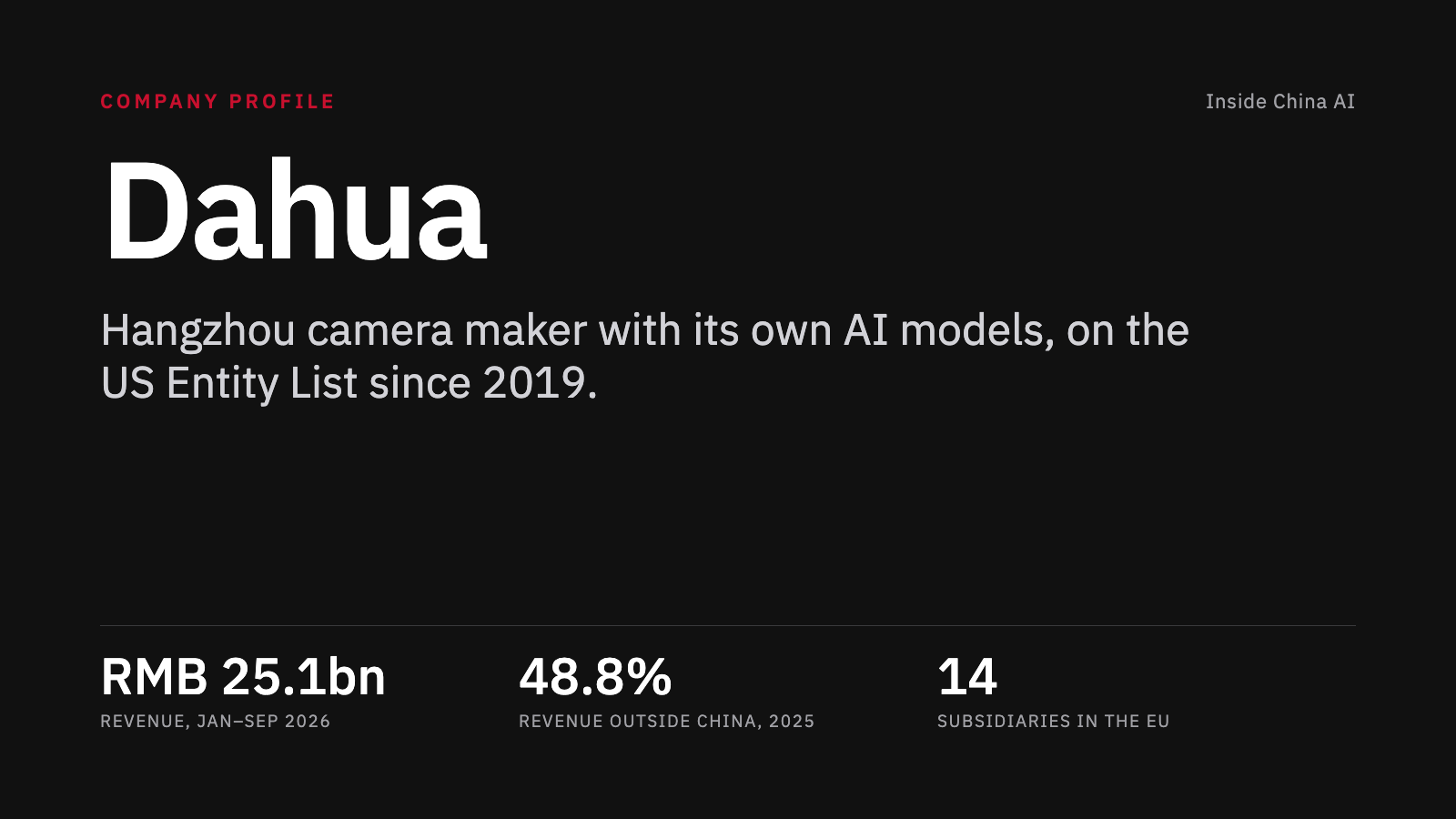
Zhejiang Dahua Technology sells cameras, recorders and software in more than 180 countries and regions, and describes that business as “video-centric AIoT” driven by its own “Xinghan” large models. It has 14 subsidiaries in the European Union. Since October 2019 it has been on the US Entity List, a listing Washington tied to the surveillance of Uighurs in Xinjiang, and it is on two further US lists. For Europe, Dahua tests how far individual governments go: the United Kingdom has replaced Chinese-made surveillance equipment on sensitive government sites, Lithuania is phasing out Chinese cameras, Amsterdam intends to replace its own, and the Czech cyber agency has warned against them, while most EU countries have no restriction.
Origins and backing
Dahua became a joint-stock company in June 2002, restructured from Hangzhou Dahua Information Technology by five individuals: Fu Liquan, Chen Ailing, Zhu Jiangming, Liu Yunzhen and Chen Jianfeng. It listed in Shenzhen on 20 May 2008 (2025 annual report). Fu Liquan still controls it: on 30 September 2026 he held 31.32 per cent, and Chen Ailing, his wife, a further 2.18 per cent (Q3 2026 report). Fu was re-elected chairman on 7 September 2026, and Zhao Yuning, president since January 2026 and formerly head of overseas marketing, was reappointed (board announcement).
The second-largest shareholder is state-owned. In March 2023 China Mobile Communications Group subscribed for all 293,103,400 new shares in a private placement, paying RMB 5.1 billion; the shares were listed on 14 April 2023 with a 36-month lock-up, leaving China Mobile with 8.81 per cent (listing announcement). Dahua said the issue did not change its controlling shareholder or actual controller (announcement). China Mobile now holds 8.97 per cent, none of it restricted (Q3 2026 report). It is also a customer: sales to China Mobile came to RMB 361 million in 2025, making it Dahua’s fifth-largest customer and a related party (2025 annual report). In October 2026 a Dahua subsidiary, Zhejiang Huaqi Zhihui, bid in a China Mobile tender for “AI super-node” computing equipment; the tenderer’s published list of winning candidates puts its share at about RMB 2.63 billion including tax, which Dahua’s board confirmed on 2 November 2026 (announcement).
What they build
Dahua calls itself “a globally leading provider of video-centric AIoT (Artificial Intelligence of Things) solutions and operational services” (2025 annual report). In practice: cameras, thermal and radar sensors, recorders, video platforms and projects for city governments and companies. An “innovative business” adds machine vision and mobile robots under the HuaRay brand, automotive electronics, fire protection, smart whiteboards and, abroad, EV charging stations; it made up 17.3 per cent of 2025 revenue (2025 annual report).
Dahua’s own model family is called Xinghan (星汉). It was unveiled on 24 October 2023 at Dahua’s annual summit in Shenzhen together with its “Think#2.0” strategy (Dahua via PR Newswire; 36Kr). In its 2025 annual report Dahua says it chose “an industry-specific development path distinct from general-purpose large models”, that Xinghan drives a “MaaS Intelligent Hub”, runs “on-device” in cameras, and that “Dahua V/L/M series large models” power industry agents that search video, analyse alarms and trigger workflows on natural-language instructions (2025 annual report). We found no model card, parameter count, independent benchmark or open weights.
Growth is modest. Revenue reached RMB 32.74 billion in 2025, up 1.75 per cent, with net profit of RMB 3.86 billion; 48.8 per cent of revenue came from outside China (2025 annual report). In the third quarter of 2026 revenue rose 8.7 per cent to RMB 8.40 billion, but net profit fell 50.9 per cent to RMB 520 million: one-off items, chiefly a RMB 286 million loss on entrusted wealth-management investments, cut profit by RMB 233 million, after one-off gains a year earlier. Excluding them, profit was almost flat. For January to September, operating cash flow was negative at RMB 2.17 billion and inventories were 76 per cent higher than at the start of the year, which Dahua attributes to stocking up (Q3 2026 report, Chinese original).
Key numbers
- Listed Shenzhen Stock Exchange (002236) since 20 May 2008 (2025 annual report)
- Ownership Fu Liquan 31.32%, China Mobile Communications Group 8.97%, Zhu Jiangming 4.13%, Chen Ailing 2.18% (30 September 2026, Q3 2026 report)
- Revenue RMB 32.74 billion in 2025 (+1.75%), 48.8% outside China; RMB 25.11 billion in January–September 2026 (+9.58%) (2025 annual report; Q3 2026 report)
- Profit RMB 520 million in Q3 2026 (−50.9%); RMB 2.90 billion in January–September 2026 (−17.9%) (Q3 2026 report)
- R&D RMB 3.08 billion in January–September 2026; 11,594 of 22,131 employees in R&D at end-2025 (Q3 2026 report; 2025 annual report)
- Abroad 75 overseas subsidiaries and branches, one overseas manufacturing centre, two European hub warehouses, the company says (2025 annual report)
The European angle
- Physical presence Yes. Dahua’s 2025 annual report lists wholly owned companies in the Netherlands and Germany (two each, one of them the machine-vision unit HuaRay Technology GmbH), France, Spain, Italy, Poland, Hungary, the Czech Republic, Denmark, Belgium, Romania and Bulgaria, as well as the United Kingdom, Serbia and Turkey (2025 annual report). It also mentions a European R&D sub-centre, location unnamed. In October 2025 Dahua opened a regional showroom in Budapest and said its European operations employ “over 600” people (Dahua via PR Newswire). In 2018 Dahua opened a European supply centre in Zalaegerszeg, Hungary, run by a partner, for warehousing and local assembly (Dahua via a&s); we found no current figures on its output.
- Customers Dahua says the French charging operator MEA Energies uses its D-Volt Ultra fast chargers at its sites (Dahua). The Hungarian outlet Átlátszó reported in August 2023 that the national police’s 2017 contract list includes two contracts with Dahua’s Hungarian subsidiary, for border-guard server migration and the police case-management system (Átlátszó). RFE/RL reported in May 2024 that Dahua and Hikvision equipment was used at 28 or more Romanian military sites, kept offline according to officials (RFE/RL).
- United Kingdom On 24 November 2022 the government told departments to “cease deployment” of surveillance equipment on sensitive sites “where it is produced by companies subject to the National Intelligence Law of the People’s Republic of China”, and not to connect it to core networks (written statement HCWS386). The statement names no company. On 18 November 2025 the government said all sensitive sites originally identified “have now finished their replacement work” (written statement HCWS1065).
- Lithuania A law passed in 2022 bars equipment from “unfriendly countries”, mainly China, Russia and Belarus, in critical public infrastructure; institutions had until 2025 to phase out Chinese equipment (LRT). That it covers Dahua cameras at about 400 institutions we know only from the Czech cyber agency NÚKIB (NÚKIB).
- Netherlands On 5 June 2024 Amsterdam’s IT alderman told the city council that new procurement rules should allow the city to replace its roughly 1,280 Chinese cameras within five years; the council motion behind it named Hikvision and Dahua. The letter imposes “no general restriction” on Chinese-made products (council letter, copy published by IPVM). We found no national camera ban.
- Czech Republic NÚKIB’s analysis of 29 August 2025 names Hikvision and Dahua and judges it “probable (55–70%)” that some Chinese cameras are compromised by Chinese authorities. It is a warning with recommendations, not a ban (NÚKIB).
- US lists Dahua has been on the Entity List, an export-control list, since 9 October 2019. The Commerce Department said the listed entities had been “implicated in human rights violations and abuses in the implementation of China’s campaign of repression, mass arbitrary detention, and high-technology surveillance against Uighurs, Kazakhs, and other members of Muslim minority groups” in Xinjiang (Federal Register). Dahua replied on 8 October 2019 with a “strong protest” against a decision “in lack of any factual basis” (Dahua). In February 2021 the trade publication IPVM and the Los Angeles Times reported that Dahua documents for police face-analytics software described a “real-time warning mode for non-local Uyghurs” (IPVM). Dahua did not respond then; its UK website answers “No” to whether its products identify Uighurs or any other single ethnic group (Dahua, undated). Since 12 March 2021 Dahua’s video-surveillance equipment has been on the FCC Covered List when used for public safety, government facilities, critical infrastructure and national security (FCC); an FCC notice of 26 June 2026, in force since 16 July 2026, bars further imports and marketing of such equipment authorised before the FCC’s 2022 rules, with a temporary exception for critical-infrastructure surveillance; equipment already installed may still be used (FCC). The Pentagon lists Dahua as a “Chinese military company” under Section 1260H, confirmed in the lists of 7 January 2025 and 10 June 2026; the 2026 notice says “Dahua is indirectly owned by SASAC”, China’s state-asset regulator, without explaining how (Federal Register); the 1260H list is not a sanction. Dahua is not on the Treasury’s Chinese military-industrial complex list; we found no EU sanctions (checked 23 November 2026).
- The AI Act Dahua’s European compliance group met on 20–21 October 2026 to work through the AI Act, the Cyber Resilience Act, the GDPR and NIS2 with Bird & Bird lawyers, the company says (Dahua). Since 2 February 2025 the AI Act has prohibited biometric categorisation that infers race or religion and real-time remote biometric identification by police in public spaces, with narrow exceptions (AI Act, Article 5).
- What a European buyer would actually encounter A supplier with local companies, distributors and service in most EU countries, whose cameras increasingly carry its own AI models — and whose use on sensitive public sites depends on the country, and sometimes the city.
What we could not verify
- Dahua’s revenue in Europe. The company reports only “overseas”.
- Where its European R&D centre and two European hub warehouses are, and whether the Hungarian supply centre still assembles products.
- Where Dahua’s cloud services store European customers’ data, and which Dahua company is responsible for it.
- The Xinghan models: size, versions, benchmarks and whether any run in products sold in Europe.
- The Lithuanian legal act and whether it names Dahua; we know it only from LRT and NÚKIB.
The open question for Europe: will a patchwork of national and municipal rules decide where Dahua’s AI cameras can be used — or will the AI Act?

Comments are closed