Graphic: Inside China AI
DataCanvas: The Beijing AI Compute Provider Filing for a Hong Kong Listing
Company profile · 28 November 2026.
DataCanvas (九章云极) started in 2013 as a Beijing maker of data-science software. Since 2023 it has rebuilt itself as a supplier of AI computing power: it designs and delivers AI data centres for local governments and state-owned companies, and rents out the capacity through its own cloud. On 29 September 2026 it filed to list in Hong Kong. Its draft prospectus names Spain as a target market. For now, though, its European presence consists of trade fairs and stated plans. For European readers the company matters less as a supplier today than as an example of how China’s “neocloud” layer — independent AI cloud providers outside the big platforms — is being built and financed.
Origins and backing
DataCanvas was set up in Beijing on 26 February 2013 by Fang Lei (方磊) and Shang Mingdong (尚明栋), and was converted into a joint-stock company, DataCanvas Co., Ltd. (北京九章云极科技股份有限公司), in February 2026, according to its Application Proof filed with the Hong Kong stock exchange, a draft prospectus that may still change. Fang is chairman and general manager; Shang is vice chairman and deputy general manager. The company says both previously worked at Microsoft’s headquarters, Fang on the incubation of Azure and on Bing’s search architecture. It is based in Beijing’s Haidian district (company website) and had 303 full-time employees at 30 June 2026.
The founders each hold 6.86 per cent before the listing, plus 5.79 per cent through a partnership they control, and have agreed to vote together, with Fang’s view prevailing in case of disagreement (Application Proof). The filing lists fourteen funding rounds since 2015. The most recent, signed on 1 June 2026, brought in about RMB 500 million. In the round before, in November 2025, two Beijing investment funds took part: the Beijing Artificial Intelligence Industry Investment Fund (RMB 37 million) and the Beijing Information Industry Development Investment Fund (RMB 40 million).
The filing is a draft: price range, offer size and valuation are redacted. It says the company expects a market capitalisation above HK$4 billion at the low end of the range. It names China Galaxy International Securities (Hong Kong) as sole sponsor. As of 27 November 2026 we found no report of a listing hearing.
What they build
DataCanvas describes two businesses. The first, “AI Computing Infrastructure Solutions”, is turnkey work on AI data centres: design, hardware procurement and delivery, mostly for local governments, state-owned enterprises and private companies. The second, “AI Computing Cloud Services”, rents out computing capacity through Alaya NeW Cloud, which runs on the company’s own scheduling software, Alaya NeW OS (launched April 2024). The cloud started in September 2024; version 3.0, launched in June 2026, is built around what the company calls a “token factory” for inference (Application Proof).
The company bills capacity in a unit it invented, the “One Degree of Compute” (一度算力, DCU), which ties charges to actual use rather than reserved hardware. Its newest product, Alaya Token, sells access to third-party language models through an API, billed by tokens; the draft prospectus reports about ten contracts but no revenue from it up to 30 June 2026. The company has also listed open models from others on its platform, for example DeepSeek-V4 on its coding service in April 2026 (company news).
DataCanvas also builds models of its own, though they are not its main business. It open-sourced the Alaya-7B series in November 2023, and its Alaya model passed Beijing’s generative-AI service filing in July 2024 (company website). The company says its DART-GUI-7B agent model, trained on its own infrastructure, took first place in the 7B track of the OSWorld benchmark in 2026, under a 30-iteration setting. Its older machine-learning tools — YLearn for causal learning, Hypernets, HyperGBM and DeepTables — are public on GitHub under the Apache 2.0 licence.
The ranking it leads with comes from the industry consultant commissioned for its prospectus, CIC: by 2025 revenue, the company says, it was ninth among AI computing service providers in China and “the only neo AI computing service provider (‘neocloud’) among the top ten”. As of 24 September 2026 it reported more than 29,000 PFLOPS of controllable computing capacity across seven Chinese provinces and more than 150 enterprise customers. We did not find the chips behind that capacity named in the draft prospectus; it says the company’s infrastructure solutions rely in part on computing servers “procured or leased from PRC-based suppliers”.
Key numbers
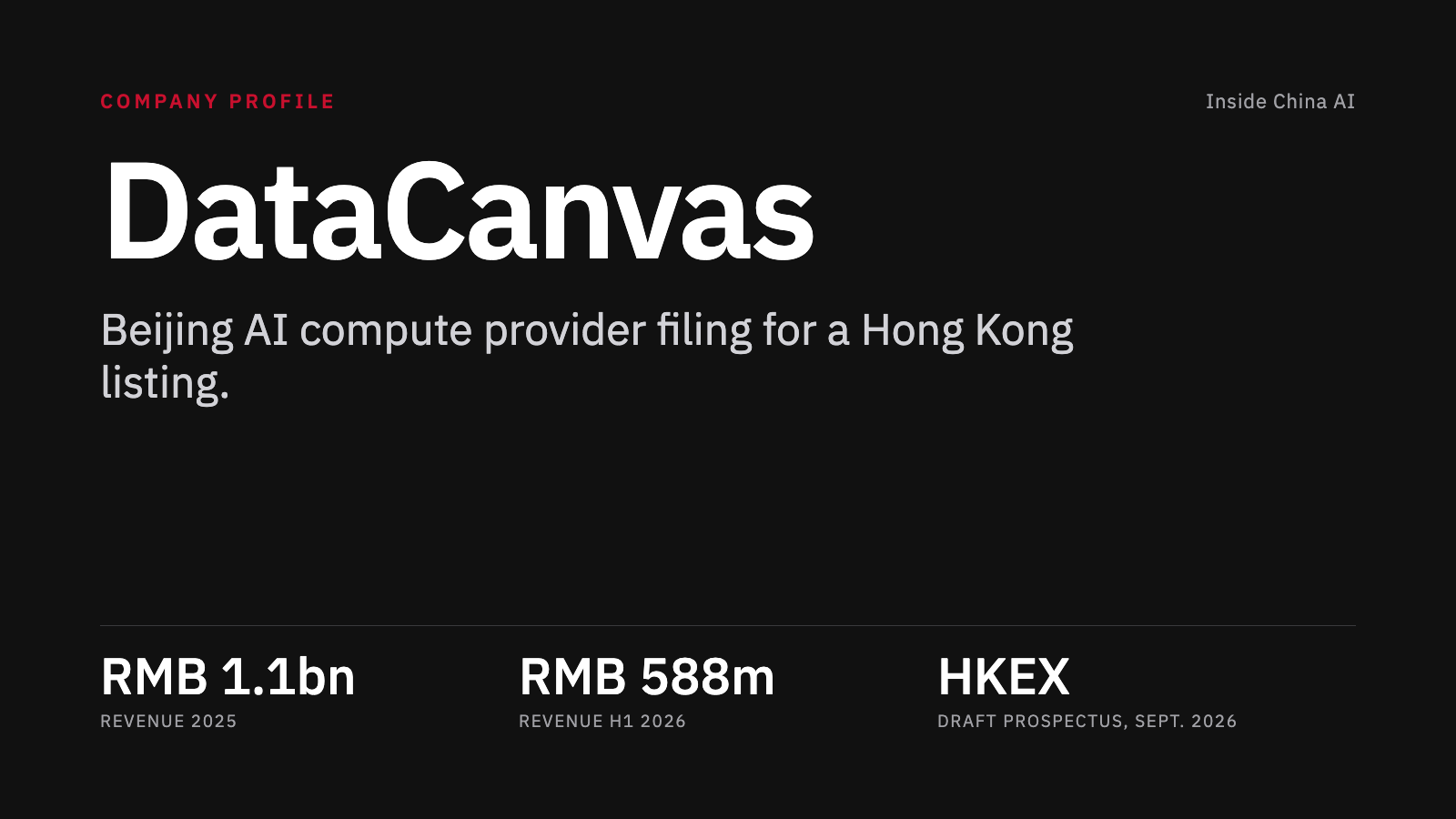
- Revenue RMB 1,098.2 million in 2025 (2024: 395.5 million; 2023: 106.2 million); RMB 588.4 million in H1 2026, against 306.4 million a year earlier (Application Proof)
- Net loss RMB 335.6 million in 2025; RMB 1,094.9 million in H1 2026, of which RMB 1,067.8 million came from fair-value changes in financial liabilities. Adjusted net loss (company measure): RMB 91.3 million in 2025, RMB 14.9 million in H1 2026
- Balance sheet Net liabilities of RMB 2,644.4 million at 30 June 2026
- Cloud Cloud-service revenue RMB 77.6 million in 2025 and 153.8 million in H1 2026; utilisation 79.6 per cent in H1 2026
- Customer concentration Top five customers: 88.0 per cent of revenue in 2025, 80.8 per cent in H1 2026
- Capacity More than 29,000 PFLOPS controllable, seven provinces (24 September 2026, company figure)
- Staff 303 full-time employees (30 June 2026)
The European angle
- Physical presence None found. The draft prospectus lists subsidiaries in mainland China, Hong Kong and Singapore. Its only operating footprint outside China is in Southeast Asia: research collaborations in Singapore and a project with a subsidiary of a telecoms operator in Indonesia that “has commenced yielding initial revenues” (Application Proof).
- Stated plans The draft prospectus says DataCanvas will target “Asia, the Middle East and Europe, including Japan, Saudi Arabia, the United Arab Emirates and Spain”. In a speech on 22 April 2026 Fang said the company was “actively exploring” computing-centre projects in places including Spain and Sweden (company news). In July 2026 it said it was speeding up that exploration in Southeast Asia, the Middle East and Europe (company news). We found no named site, partner or customer in Europe.
- Visibility DataCanvas exhibited at MWC 2026 in Barcelona in March, where Fang spoke at an industry forum (company news), and a representative attended the WBBA broadband conference in Paris in November 2025 (company website). In April 2026 Fang was among the Chinese business leaders who met Spain’s prime minister, Pedro Sánchez, in Beijing; the company says it is expanding its “European industry cooperation network” (company news).
- Lists and export controls A name check on 27 November 2026 found no entry for DataCanvas on the EU financial sanctions list, the US Consolidated Screening List (which includes the Entity List) or the US Defense Department’s 1260H list. The draft prospectus says the company had “limited transactions with a small number of customers designated on the Entity List maintained by the BIS”. According to the filing, it provided them only with “self-developed software for financial data management purposes” and “computing resources”, and the company writes that it believes “our transactions with these customers did not give rise to a violation of the Entity List restrictions under the EAR”. It does not name those customers.
- What a European buyer would actually encounter At present, a Chinese compute provider at trade fairs with a model for building data centres together with local governments and operators — not yet a service on offer in Europe.
What we could not verify
- Any European customer, partner, office or legal entity, or a concrete project behind the plans for Spain and Sweden.
- Whether Alaya NeW Cloud can be used from Europe, and where data would be stored.
- Which chips make up the company’s computing capacity.
- The IPO timetable and valuation, which are redacted in the draft filing.
The open question for Europe: will DataCanvas’s model of building data centres with local partners reach a European country — and on whose chips would it run?

Comments are closed