Graphic: Inside China AI
DiDi: China’s Ride-Hailing Giant Builds Robotaxis for the World — Starting in the Gulf, Not Europe
Company profile · 21 November 2026.
DiDi runs a ride-hailing platform in China and other markets and a robotaxi unit of its own: since 31 August 2026 its R2 robotaxi, built with the carmaker GAC Aion, has carried passengers without a safety driver in parts of Beijing and Guangzhou. The company says the car is designed for global deployment, and it has named its first foreign market: the United Arab Emirates. For Europe, DiDi is a case study rather than a market participant. It operates in no European country, its shares moved from the New York Stock Exchange to the over-the-counter market in 2022 and in 2022 China’s internet regulator fined it RMB 8.026 billion for data violations. Its main European link is a robotaxi safety partnership with the French supplier Valeo.
Origins and backing
DiDi began in Beijing in 2012, when Xiaoju Technology launched the DiDi Dache taxi-hailing app (DiDi). It merged with its rival Kuaidi Dache in February 2015 and bought Uber’s China business in August 2016 (DiDi). Founder Cheng Wei is chairman and chief executive of the holding company, DiDi Global Inc. Co-founder Jean Liu gave up the titles of president and board director in May 2024 (Bloomberg) and is now “Permanent Partner” and Chief People Officer, according to the company’s website (DiDi).
The company’s recent history is shaped by its brief time on Wall Street. DiDi listed in New York in 2021 at $14.00 per American depositary share (Heng Ren Partners). In July 2021 China’s cybersecurity review office opened a review of the company (CAC). On 3 December 2021 DiDi’s board decided to delist from the New York Stock Exchange and to pursue a listing on the main board of the Hong Kong exchange (SEC filing). Shareholders approved the delisting on 23 May 2022, with 781 million votes for and 30 million against (SEC filing); the company said it would file the delisting form (Form 25) with the SEC on or after 2 June 2022 (SEC filing). Since June 2022 its shares have traded over the counter in the United States under the symbol DIDIY (Heng Ren Partners).
The Hong Kong listing announced in 2021 has not happened. On 26 October 2026 Heng Ren Partners, a Boston fund that owns DiDi shares and campaigns for a Hong Kong relisting, said that to its knowledge DiDi had announced no plan or timetable since 2021 and had held no shareholders’ meeting since 2022; it put the share price close to $3.00; the shares closed at $3.03 on 20 November 2026 (Stock Analysis). The same fund names SoftBank (about 21.5 per cent), Uber (12.8 per cent) and Tencent (7.1 per cent) as the largest shareholders (Heng Ren Partners). The shareholders’ own most recent SEC filings show the same order: SoftBank’s Vision Fund held 20.5 per cent of DiDi’s Class A shares at the end of 2021 (SEC filing), Tencent 7.3 per cent at the end of 2023 (SEC filing) and Uber 11.8 per cent in May 2024 (SEC filing). Founder Cheng Wei holds 6.9 per cent of the economic interest but, through ten-vote Class B shares, 43.2 per cent of the voting power, according to his filing of 1 May 2026 (SEC filing). DiDi still files annual reports with the SEC; the latest, for 2025, was filed on 13 April 2026 (SEC).
What they build
Ride-hailing and local services. DiDi’s core is mobility: ride-hailing, designated drivers, car-pooling (“Hitch”), deliveries and electric-car charging in China, and ride-hailing in 14 countries in Latin America, Asia-Pacific and Africa, with food delivery in its key markets Brazil (under the brand 99) and Mexico (China News Service). Its international list on its own website runs from Argentina to Peru and includes Japan, Australia, New Zealand and Egypt — but no European country (DiDi).
AI in the ride-hailing app. DiDi’s main consumer AI product is “Xiaodi” (小滴), an assistant that turns a spoken or typed request — one example the company gives translates as “I’m not feeling well and a bit carsick, get me a car quickly” — into service tags that the dispatch system matches against available cars. It went into public beta in September 2025; version 1.0 launched in March 2026 with more than 90 tags (Xinhua, from China.com.cn). DiDi says Xiaodi now uses a multi-agent architecture and has raised satisfaction in its core scenarios by nearly ten percentage points (China News Service). The company has not said which language models the assistant runs on. Behind it sits DiDi AI Labs, which the company says works on natural-language processing, speech interaction, computer vision, a smart map engine, platform efficiency and the driver and passenger experience (DiDi).
Robotaxis. DiDi set up its autonomous-driving unit in 2016 and made it an independent company, DiDi Autonomous Driving, in August 2019 (DiDi). It is led by DiDi co-founder Zhang Bo. GAC, the Guangzhou state-owned carmaker, invested in 2023, and its electric-car unit GAC Aion formed a 50-50 joint venture with DiDi’s unit (Yicai), set up in April 2024 according to DiDi. In October 2025 the unit raised RMB 2 billion (about $281 million) in a Series D round from three Beijing investment funds, GAC and DiDi itself (Yicai). No valuation was published.
The joint venture’s first product is the R2, delivered on 23 January 2026 in Guangzhou. DiDi says it carries 33 sensors and a central computer with more than 2,000 TOPS, costs 74 per cent less than the previous generation and meets five-star safety ratings under both C-NCAP and Euro NCAP (DiDi). Euro NCAP’s published results list no R2; they show a five-star rating from 2025 for the GAC Aion V (Euro NCAP), the production car on which the R2 is based (electrive). Since 31 August 2026 the R2 has offered fully driverless service trials, bookable in the DiDi app, in demonstration areas of Beijing and Guangzhou; it has also been tested on public roads in Shenzhen and other cities (DiDi). On 13 April 2026 Zhang Bo named the UAE as the unit’s first international market, with testing and pilots planned “for later this year”; in November 2025 it had joined Abu Dhabi’s autonomous-vehicle cluster SAVI and signed a partnership with the Abu Dhabi Investment Office (DiDi).
Key numbers
- Founded 2012, Beijing; founder, chairman and CEO Cheng Wei
- Listing NYSE from 2021 to June 2022; since then over the counter (DIDIY). Hong Kong listing announced December 2021, not carried out as of November 2026
- Transactions 5.05 billion on the core platform in Q2 2026 (+13.2%), of which 3.65 billion in China and 1.40 billion abroad, the company says (China News Service)
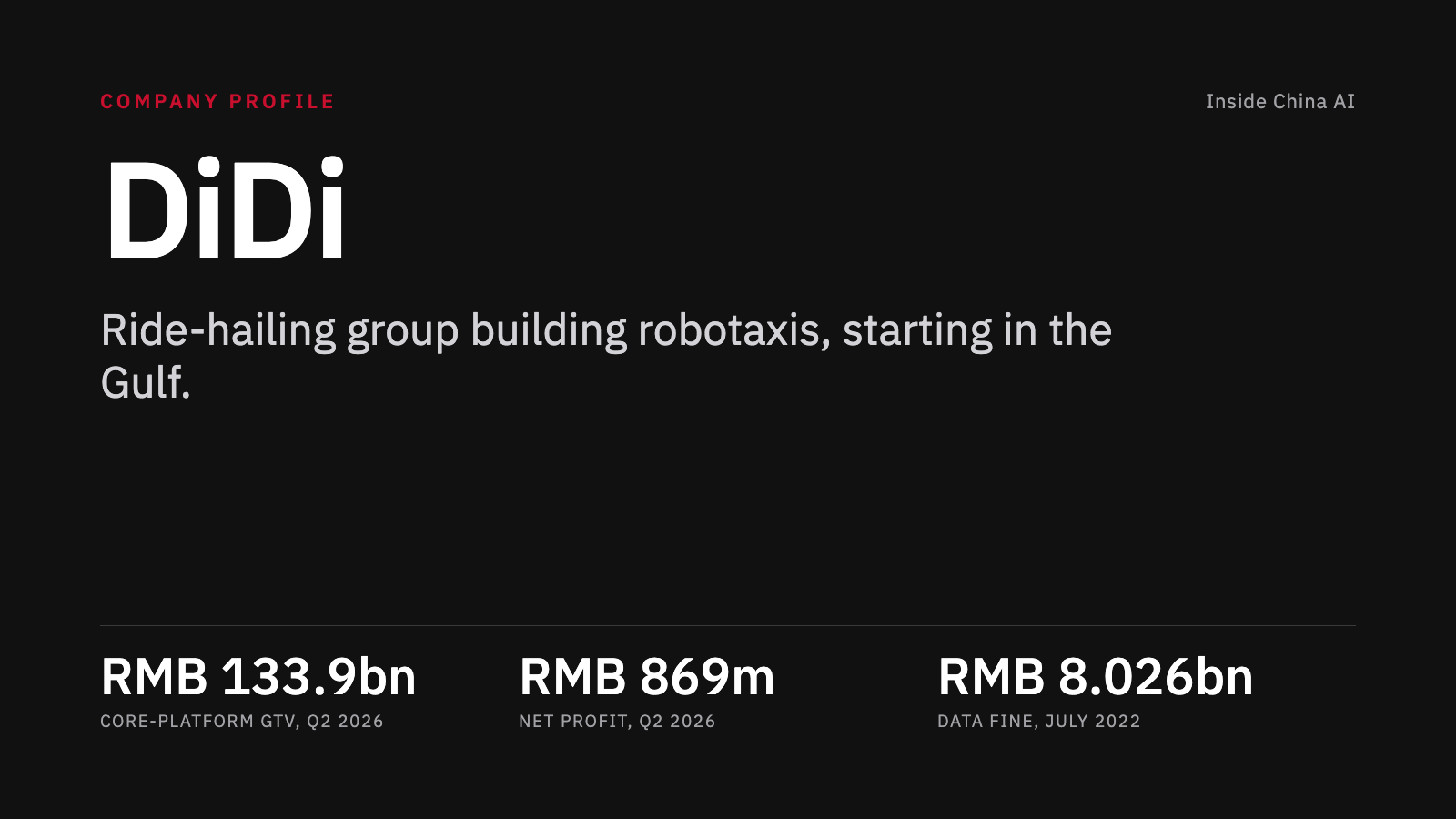
- Gross transaction value RMB 133.9 billion on the core platform in Q2 2026 (+22.2%); international GTV +61%
- Net profit RMB 869 million in Q2 2026, results published 13 August 2026 (Caixin); third-quarter results not yet published on 21 November 2026
- Robotaxi funding RMB 2 billion Series D for DiDi Autonomous Driving, October 2025
- Data fine RMB 8.026 billion, imposed by the Cyberspace Administration of China on 21 July 2022
The European angle
- Physical presence None found. DiDi lists no European market, entity or office, and its robotaxi unit’s announced expansion begins in the UAE. In February 2022 DiDi announced it would leave Russia and Kazakhstan on 4 March 2022, having run a service in Russia for about eighteen months (Yicai); on 26 February 2022 it said it would stay in Russia after all (Reuters). Russia is not on DiDi’s current list of markets. DiDi invested in the Estonian ride-hailing company Taxify, now Bolt, in 2017 (TechCrunch); Estonia’s business register, checked on 21 November 2026, lists no DiDi company among Bolt’s shareholders (e-Business Register).
- European partner On 29 May 2023 Valeo and DiDi Autonomous Driving signed a strategic cooperation and investment agreement: Valeo “intends to invest”, and a joint team is developing an “Automated Safety Pilot”, a second set of hardware and software that can take over the robotaxi if the main system fails, to be deployed first in DiDi’s robotaxis (Valeo). No amount was disclosed, and we found no later report that the investment was completed.
- Regulatory record China’s Cyberspace Administration fined DiDi RMB 8.026 billion on 21 July 2022 under the Cybersecurity Law, the Data Security Law and the Personal Information Protection Law, and fined Cheng Wei and Jean Liu RMB 1 million each (CAC). The regulator listed 16 violations, among them the illegal collection of 11.96 million screenshots from users’ photo albums and the excessive collection of 107 million passenger face-recognition records, and said DiDi had processed 64.7 billion items of personal information illegally since June 2015. It also said the review had found data processing that “seriously affected national security”, details of which it did not publish (CAC). DiDi was allowed to register new users again in January 2023 (Caixin).
- Lists DiDi is not on the US Entity List, the Pentagon’s 1260H list or the EU’s consolidated financial sanctions list, according to our check of the published lists on 15 November 2026.
- What a European buyer would actually encounter Today, nothing directly: no app, no service and no robotaxi in Europe. Indirectly, Valeo’s work on a robotaxi safety system with DiDi, and an R2 that DiDi markets as built for global deployment and as rated under the European safety programme.
What we could not verify
- Revenue and DiDi’s own results release. DiDi’s investor-relations site blocked our access; the operating figures above come from China News Service’s account of the company’s release.
- Hong Kong listing. Whether DiDi has filed or set a timetable; we found no filing.
- Current shareholder stakes. The shareholders’ latest SEC filings date from 2021 to 2024; we could not read the shareholder table of DiDi’s 2025 annual report in full.
- Valeo’s investment — whether it closed, and how far the joint safety system has come.
- A Euro NCAP rating for the R2 itself; Euro NCAP lists only the Aion V on which it is based.
- Whether robotaxi testing in the UAE has begun, and which AI models power the Xiaodi assistant.
- When DiDi’s service in Russia ended.
The open question for Europe: when DiDi takes its robotaxi beyond China and the Gulf, will it come as a platform operator — or through partners such as Valeo?

Comments are closed