Graphic: Inside China AI
Dify: The Agent-Building Platform With a Menlo Park Headquarters and an Engineering Team in Suzhou
Company profile · 28 November 2026.
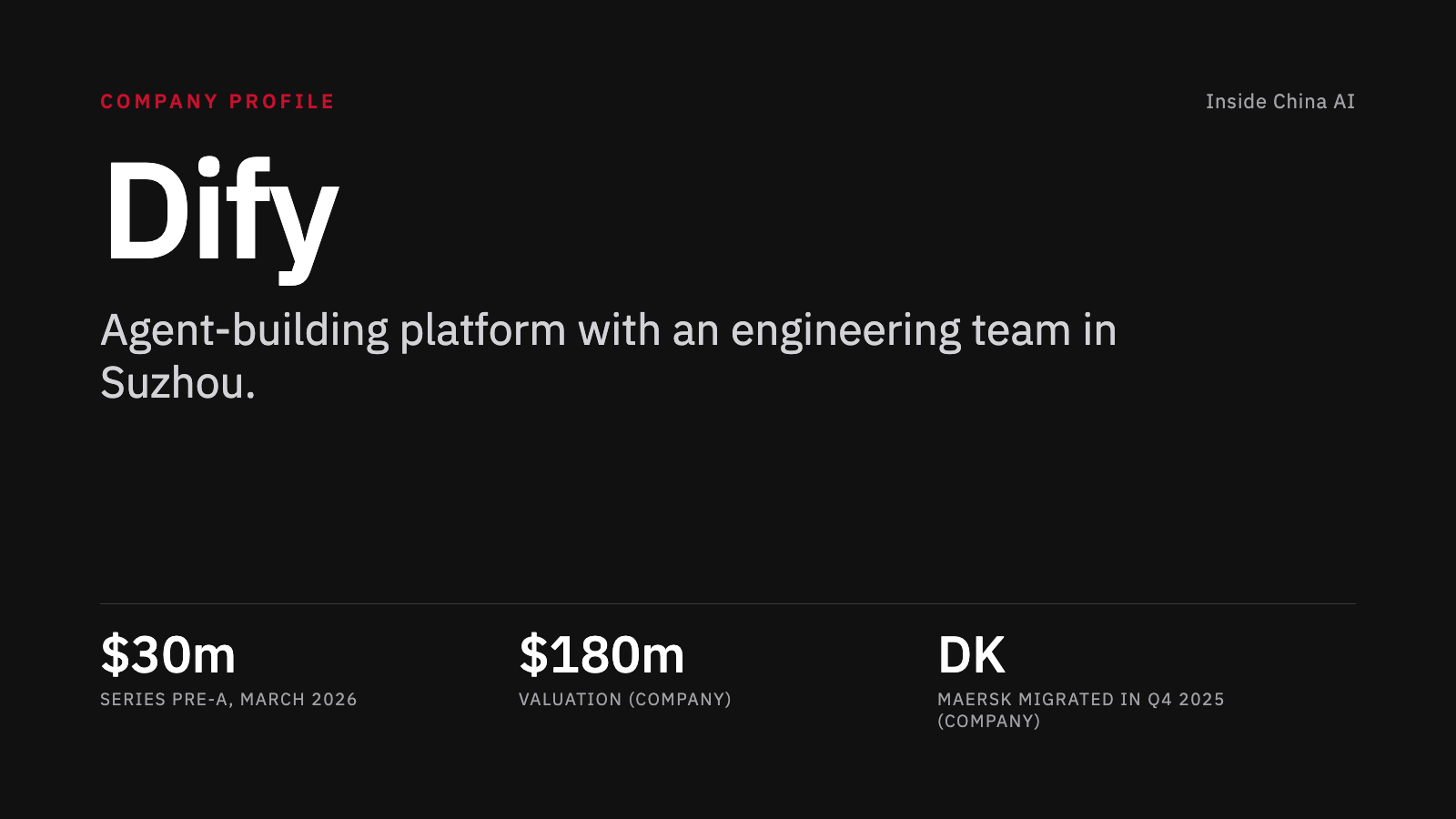
Dify is an open-source platform on which companies build, run and manage AI agents and automated workflows. It does not train its own large language models; it sits between the models a customer chooses and that customer’s own data and systems. The company behind it, LangGenius, Inc., is a Delaware corporation headquartered in Menlo Park, California, and it has an engineering office in Suzhou, China. For Europe, Dify matters as infrastructure: according to a Dify case study, the Danish shipping group Maersk completed a full migration to Dify Enterprise in the fourth quarter of 2025, and Dify says a German municipality runs Dify on its own servers. Dify has no European subsidiary or office; it reaches the continent through a manager responsible for the EU, event partners and open-source downloads.
Origins and backing
Founder and chief executive Luyu Zhang writes that Dify was founded in March 2023 (Dify); the hosted product went live on 9 May 2023 (Dify). In that launch post the company described itself as “built by Ex-Tencent CODING DevOps team members”, former staff of the Tencent developer platform CODING, which the team says it had made “a one-stop DevOps platform with millions of developers in China”. Zhang was still founder and chief executive in October 2026 (Dify).
The contracting company is LangGenius, Inc. Its terms of service say: “LangGenius, Inc. is a Delaware corporation”, that it runs the service from an office in California, and that disputes go to courts in San Francisco under Delaware law (terms of service). Dify lists four offices: Menlo Park as headquarters for product, design, engineering and R&D; Tokyo, home of the Japanese company LangGenius K.K., for R&D and the Asian enterprise business; Suzhou for engineering; and Shanghai for sales in the Asia-Pacific region (Dify). The five open roles shown on that page on 27 November 2026 (list last published 6 November 2026) were located in China, one of them in “China / JP”.
On 9 March 2026 Dify announced a $30 million “Series Pre-A” round led by HSG, with GL Ventures, Alt-Alpha Capital, 5Y Capital, Mizuho Leaguer Investment and NYX Ventures; 5Y Capital had invested before (Dify). The company gives its valuation as $180 million (Dify; Business Wire release via VentureBeat). Dify does not publish revenue.
What they build
Dify is a visual builder for AI applications. Teams draw a workflow, connect knowledge bases and tools, choose “proprietary or open-source models from multiple providers”, and then monitor the agents in production: execution logs, model costs, access rights and audit logs (Dify). It comes in three editions (Dify):
- Dify Cloud, hosted by the company;
- Dify Enterprise, which customers run in their own cloud account or on their own servers, including, the company says, in air-gapped environments without internet access;
- Community Edition, the source code on GitHub, installed with Docker.
The source code is not under a plain open-source licence. Dify uses “a modified version of the Apache License 2.0”. Anyone who wants to use the code to operate a multi-tenant service, with separate workspaces for several customers, needs written permission from Dify, and the logo and copyright notice in the user interface may not be removed. Contributors also agree that the company “can adjust the open-source agreement to be more strict or relaxed as deemed necessary” (licence). Dify’s homepage calls this an “Apache-2.0-derivative license”.
The project is one of the most popular on GitHub: 162,024 stars and more than 25,000 forks on 27 November 2026, with version 1.20.0 released on 18 November (GitHub). In March 2026 the company said Dify runs on more than 1.4 million machines and serves developers in over 175 countries and regions, and that 280 enterprises use it (Dify). On 27 October 2026 Dify announced that the research firm Gartner had placed it as a “Niche Player” in its 2026 Magic Quadrant for AI agent management platforms (Dify). On 13 March 2026 Dify said it had completed SOC 2 Type II and ISO 27001:2022 audits for the second consecutive year (Dify) and has been sold on AWS Marketplace since 2024 (Dify).
Key numbers
- Founded March 2023, by Luyu Zhang (CEO), according to the company
- Legal entity LangGenius, Inc., Delaware corporation; headquarters Menlo Park, California; Japanese company LangGenius K.K. in Tokyo; offices in Suzhou and Shanghai
- Funding $30 million Series Pre-A, March 2026, led by HSG; valuation $180 million, according to the company
- Product Agent and workflow platform; no own foundation model; modified Apache 2.0 licence
- Reach 162,024 GitHub stars (27 November 2026); 280 enterprises and more than 1.4 million machines, according to the company (March 2026)
- Named customers Maersk, ETS, Anker Innovations, Novartis, according to the company’s release of 9 March 2026 (Business Wire release via VentureBeat)
The European angle
- Customers Dify’s most detailed European case is Maersk. According to a case study on Dify’s website, the Danish group replaced its in-house AI platform with Dify Enterprise, ran around 90 production applications with 25,000 active users by late 2025, and completed a full migration to Dify Enterprise v3 in the fourth quarter of 2025; Dify cites a Maersk internal assessment from November 2025 as the source (Dify). In its funding announcement of 9 March 2026 Dify also named the Swiss pharmaceutical group Novartis among its customers (Business Wire release via VentureBeat); its about page still lists Novartis on 27 November 2026 (Dify).
- Germany In a blog post of 9 January 2026 Dify describes the municipality of Laer in Münsterland, which it says runs a citizen-service bot called “Laera” on Dify and Ollama “fully locally, without any connection to external services or APIs”, and Switchup, a German service that manages electricity and mobile contracts for households, which it says uses Dify to sort and route customer emails (Dify). We found no account of either project outside Dify’s own publications.
- Presence No European company or office. Dify’s own staff include a “General Manager EU”. In the final weeks of 2025 the team held meetups in London and Berlin, closed-door enterprise sessions in Oslo and Lisbon, and an event in Paris, “alongside partners like Artefact, AWS, Camel AI, Claranet, NeuroSYS, and VIER” (Dify). What those partnerships cover, for example resale, Dify does not say.
- Data In its privacy policy LangGenius states: “our website servers are located in the United States, and our affiliates, partners, third parties, and service providers operate in the United States, European Economic Area, and China.” It lists the United States, Australia, Canada, China, the EEA and the UK as possible processing locations, names standard contractual clauses as its main safeguard for transfers from Europe, and names an EU representative in Ireland (privacy policy). We found no EU hosting region for Dify Cloud on Dify’s website, pricing page or documentation (27 November 2026); the documentation points small customers who “care about data residency” to Dify Premium, a version they deploy in their own AWS account (Dify docs). Self-hosting the Community Edition or Dify Enterprise keeps data on the customer’s own infrastructure.
- Lists Neither Dify nor LangGenius appears on the EU’s consolidated financial sanctions list, the US Consolidated Screening List (including the Entity List) or the Pentagon’s 1260H list, according to our name check on 27 November 2026.
- What a European buyer would actually encounter A US contracting party under Delaware law, software that can be run entirely in-house, and a licence that permits commercial use but reserves multi-tenant services to agreements with Dify.
What we could not verify
- Ownership. Who holds LangGenius, Inc., and which legal entity employs the teams in Suzhou and Shanghai; Dify does not name a Chinese company on its own pages.
- Revenue and headcount, which Dify does not publish.
- The German projects in Laer and at Switchup, described only by Dify.
- The role of the European partners Dify names, and whether any of them resell Dify Enterprise.
- Gartner’s assessment, which is behind a paywall; we rely on Dify’s summary.
The open question for Europe: will Dify, whose biggest European customers already run it in-house, set up a European company or a European cloud region of its own?

Comments are closed