Graphic: Inside China AI
Envision: The Shanghai Wind-Turbine Maker Building AI Weather and Energy Models, With Battery Plants in Britain and France
Company profile · 26 November 2026.
Envision is one of the world’s largest wind-turbine makers, and it now describes itself as an AI company for the energy system: it has built its own weather model, Tianji, and an “energy foundation model”, Dubhe, and has put both into its turbines and storage products. For Europe the group matters on two levels. Through the battery maker AESC, which Envision controls, it produces battery cells in Sunderland and Douai for Nissan and Renault. Through Envision Energy it sells turbines and grid batteries to European developers. Its AI products have so far been shown in China and the Gulf, not in Europe.
Origins and backing
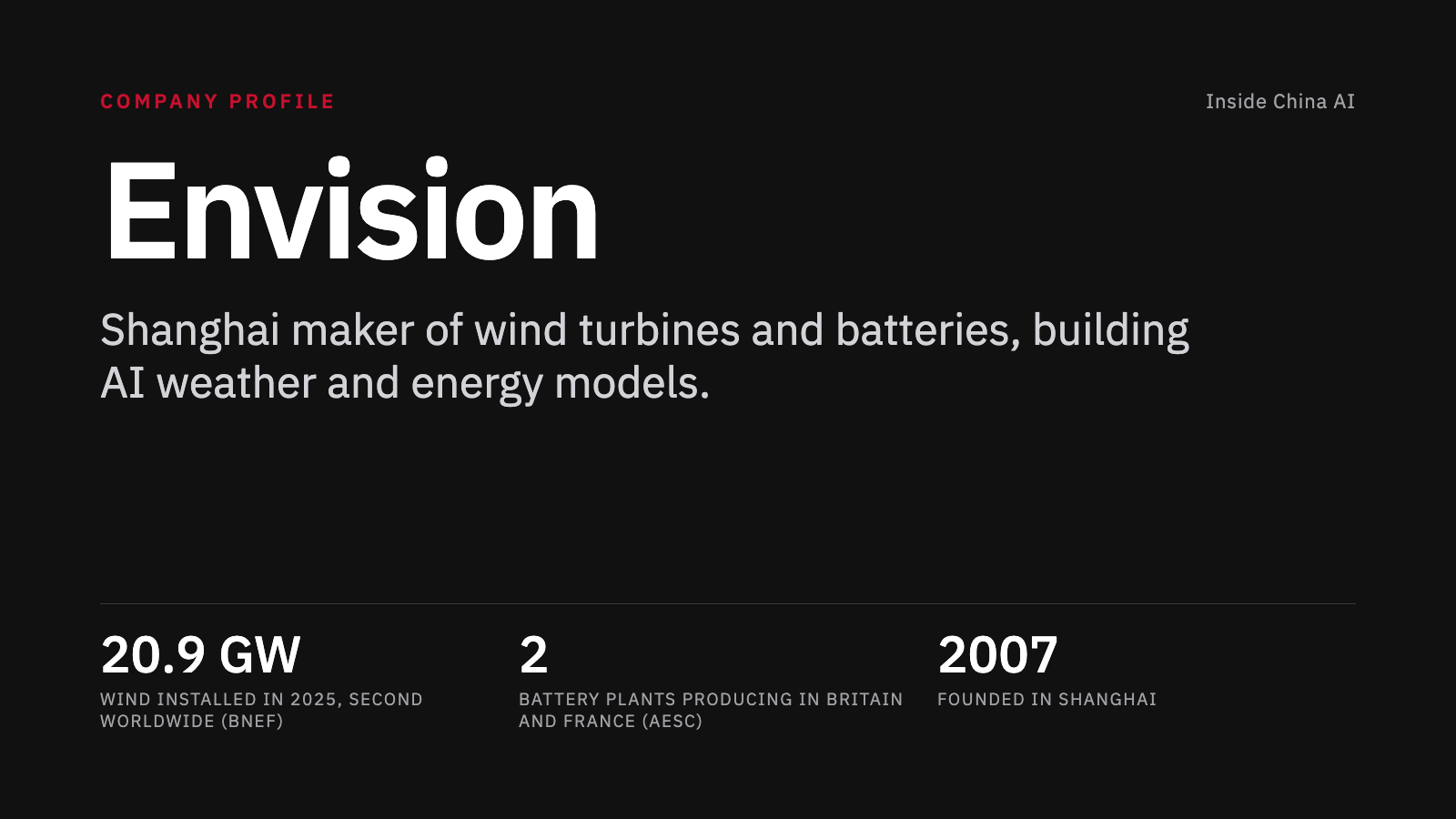
Envision (远景科技集团) was founded in 2007 by Zhang Lei, according to The Paper. Its headquarters are in Huangpu District, Shanghai, with a second base in Jiangyin, Jiangsu, according to the group’s contact page. The group website calls Zhang “Founder and CEO” (Envision); Chinese coverage of January 2026 calls him chairman of the group (Sina Finance). In March 2026 the company changed its vision to “To Create A New Prosperity For Civilization”, the company says.
Envision is privately held and does not publish accounts. The latest figures we found are old: The Paper reported in April 2024 that the investment firm Primavera put $600 million into Envision Energy and the battery business in October 2021, and that the three Envision companies were together valued at more than RMB 150 billion in 2023. Its battery subsidiary AESC goes back to Nissan’s battery business, whose sale to Envision Nissan agreed in August 2018 and completed on 29 March 2019 (Nissan); Nissan kept a minority stake. AESC is “Japan-headquartered” and “controlled by China’s Envision Group”; Bloomberg reported on 16 April 2026 that AESC was considering a Hong Kong IPO of up to $2 billion (The Next Web). On 17 November 2026 Bloomberg reported that Envision is considering adding parts of its data-centre business to the planned Hong Kong listing, as soon as 2027; Envision declined to comment (Energy Connects). We found no filed listing application.
What they build
The core business is wind power. Envision installed 20.9 GW of wind turbines in 2025, second only to Goldwind, and “almost a quarter” of that outside mainland China, according to BloombergNEF. It also sells battery storage systems, builds and runs energy parks in China, and through AESC makes battery cells for cars.
The AI work sits on top of this hardware. Envision has two models of its own:
- Tianji (远景天机) is a weather model that the company calls “self-developed” and uses to predict renewable generation and extreme weather (Envision). At a meteorology-AI symposium in Xiong’an in November 2026, Tianji’s chief scientist Zhang Yuchen said it combines physical laws with data-driven methods and forecasts up to 45 days ahead at 5-kilometre and 10-minute resolution (NetEase, 25 November 2026). Envision says Tianji came first overall in the latest round of the AI Weather Quest run by the European Centre for Medium-Range Weather Forecasts, for the 19–25 day window (PR Newswire, 30 October 2026). We have not checked this against ECMWF’s own results.
- Dubhe (远景天枢) is what the company calls “the world’s first energy foundation model”, meant to coordinate generation, storage, grid and demand as one system (Envision). It was launched on 13 January 2026 at Abu Dhabi Sustainability Week, on the day Envision signed a strategic agreement with the UAE’s Masdar (Sina Finance).
On 14 October 2026, at the Beijing wind fair, Envision relaunched its turbine platforms as “AI wind-storage units” built on Tianji, Dubhe and its EnOS operating system. The company says they raise lifetime project returns by more than 20 per cent and generation by 6–8 per cent (Securities Daily via Sina Finance). A monitoring system called Galileo has been used on more than 20,000 turbines since 2020, the company says (PR Newswire). Envision also sells computing power: its Galaxy Campus in Ulanqab, Inner Mongolia, provides renewable-powered computing capacity “for companies including Tencent and ByteDance“, according to Envision; Bloomberg reported that the first such data centre began initial operations in August 2026 (Energy Connects). Neither Tencent nor ByteDance has confirmed this, as far as we found. We found no open weights for either model.
Key numbers
- Founded 2007 by Zhang Lei; headquarters Shanghai, second base Jiangyin
- Ownership private; no current revenue, profit or valuation published; Hong Kong listing of AESC under consideration (Bloomberg, April and November 2026), no application filed
- Wind 20.9 GW installed in 2025, second worldwide (BloombergNEF, 9 March 2026)
- AI Tianji weather model, Dubhe energy model (launched 13 January 2026), EnOS operating system, Galileo turbine monitoring
- Batteries in Europe AESC Sunderland: 15.8 GWh plant producing since December 2025; AESC Douai: 10 GWh, producing since June 2025
- Lists not on the US Section 1260H list of 10 June 2026
The European angle
- Battery production AESC has made cells in Sunderland since 2012. A new plant there with an initial 15.8 GWh a year, financed with UK government support (GOV.UK), opened and started production in December 2025, according to AESC; its cells go into the third-generation Nissan Leaf, which is built next door (ecomento). In August 2026 AESC delayed a third production line there after lower-than-expected Nissan demand and stalled supply talks with Jaguar Land Rover, according to a Guardian report cited by S&P Global AutoTechInsight. In Douai, northern France, AESC began cell production in June 2025 with a capacity of 10 GWh a year and supplies Renault (Evertiq), whose neighbouring plant builds the electric R5. In January 2026 the plant expected to reach its first gigawatt-hour of output in mid-2026 (AFP via L’info durable), and in July 2026 Envision said the French plant “has been operational since June 2025” (pv magazine).
- Spain AESC’s plant in Navalmoral de la Mata, Extremadura, is delayed. According to the regional government, the first cells are now expected in December 2028, with a capacity of 12 GWh (Vozpópuli, 11 June 2026); at the groundbreaking in July 2024, 30 GWh a year at full output had been announced (Híbridos y Eléctricos).
- Offices Envision lists offices in Silkeborg (Denmark), Hamburg, Paris, Madrid and London (Envision), and says it has subsidiaries in Denmark, Germany, the UK and France (Envision).
- Wind Envision is supplying 21 turbines of 6.25 MW for the 131.25 MW first phase of the Štip wind farm in North Macedonia, which reached financial close in September 2026 (Renewable Energy Magazine); the EBRD is lending up to €42 million to the project (EBRD). The same turbine model obtained Spanish grid-code certification in September 2026, the company says (PR Newswire). At WindEnergy Hamburg the same month it presented a 16.7 MW offshore turbine with a “Europe-specific” rotor, still in validation. We found no Envision turbine factory in Europe.
- Grid storage Envision supplies a 193 MW / 386 MWh battery system at Neuilly-en-Thelle in France for Kallista Energy, under construction since July 2026 (pv magazine), and storage projects with Pulse Clean Energy in Wolverhampton and with ju:niz Energy in Baindt and Schöningen in Germany (Enerdata, 13 July 2026).
- Regulation Envision does not appear on the US Defense Department’s Section 1260H list published on 10 June 2026 (Federal Register). On 9 April 2024 the European Commission announced an inquiry under the Foreign Subsidies Regulation into Chinese wind-turbine suppliers for wind parks in Spain, Greece, France, Romania and Bulgaria (Noerr). The Commission did not name the companies concerned. The only in-depth investigation opened since, on 3 February 2026, concerns Goldwind; we found no formal proceeding against Envision (Borderlex).
- What a European customer would actually encounter Battery cells in European-built Nissan and Renault cars, grid batteries and, outside the EU so far, wind turbines. The AI models Envision promotes at home are not part of any European offer we could find.
What we could not verify
- Envision’s finances: current revenue, profit, valuation and shareholders.
- AESC’s ownership split and its 2026 output in Sunderland and Douai.
- Who owns EnOS outside China: Envision Digital renamed itself Univers in 2023 and still sells EnOS; we found no current statement of its link to Envision Group.
- Tianji’s competition result in ECMWF’s own published rankings.
- Whether Envision turbines run in the EU, and Envision’s role at the 40 MW Entre Tille et Venelle wind farm in Burgundy, which the company calls “one of Envision’s early projects in Europe”.
- The status of the Commission’s wind-turbine inquiry as far as Envision is concerned.
The open question for Europe: will Envision bring Tianji and Dubhe to the turbines and batteries it sells here, and on whose data and servers would they run?

Comments are closed