Graphic: Inside China AI
Estun: A Nanjing Robot Maker With Factories in Germany and a New Plant in Poland
Company profile · 23 November 2026.
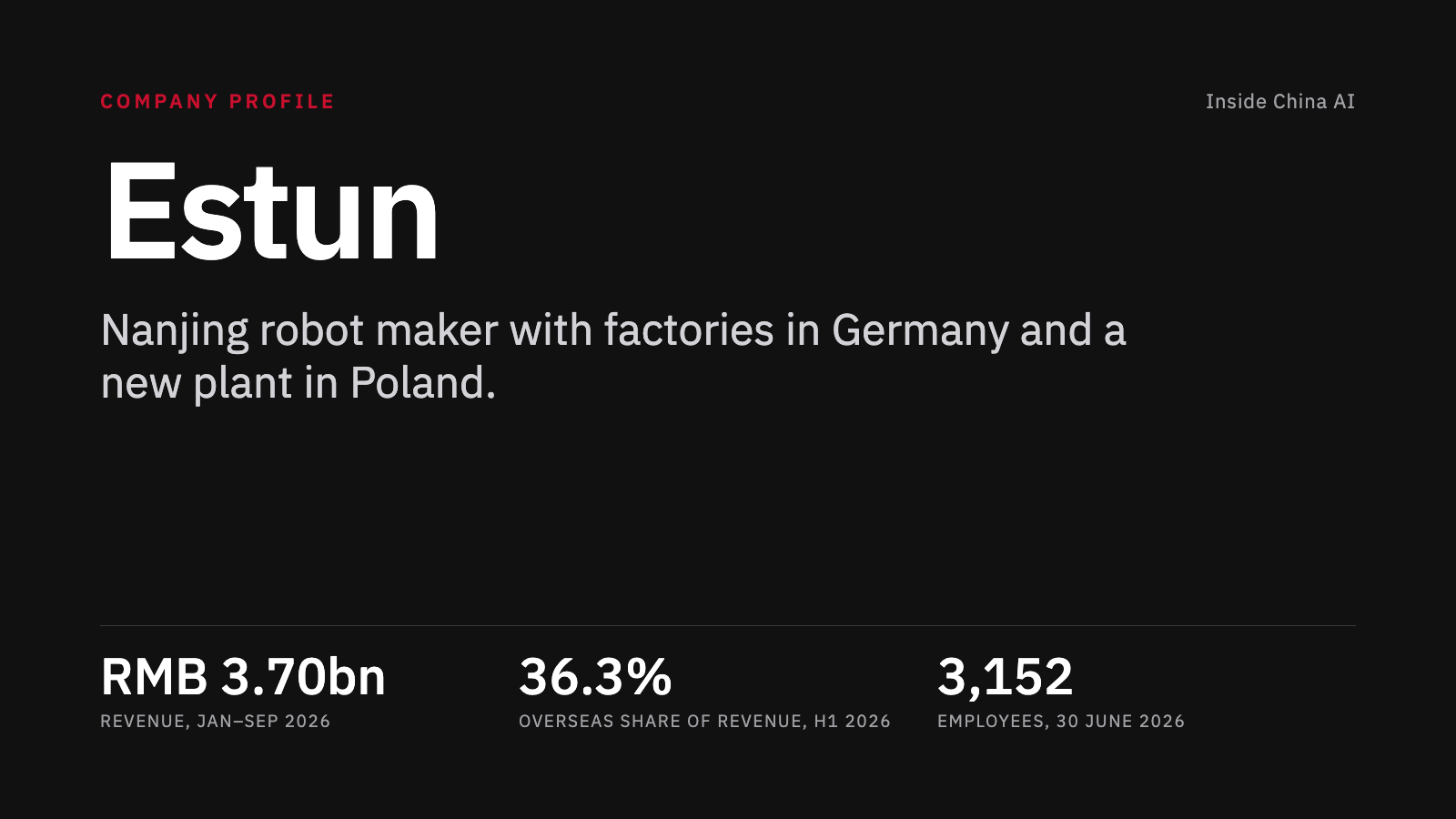
Estun Automation makes industrial robots, servo drives and motion controllers in Nanjing, and is now putting AI into them: vision-guided picking, AI welding and grinding, and a dual-arm humanoid platform. Estun does not need to come to Europe: it already owns a German welding-robot maker in Haiger, an assembly-line builder in Kronach and a motion-control firm in England, and in 2026 it opened its own plant in Poland. For European manufacturers that makes Estun both a supplier with local service and a Chinese owner of European engineering firms. Its numbers are mixed: revenue fell 12.43 per cent in the third quarter of 2026, while sales outside China grew by a quarter in the first half (Q3 report; interim report).
Origins and backing
Nanjing Estun Automation (南京埃斯顿自动化) was founded in 1993 and listed in Shenzhen (002747) in 2015, the company says (Estun). On 9 March 2026 it added a Hong Kong listing (02715), selling 96.78 million H shares at HK$15.36 each (interim report).
Estun is controlled by its chairman, Wu Bo. On 30 September 2026 he held 11.46 per cent directly and, together with the parties acting in concert with him, the controlling shareholder Nanjing Paiweisite and Wu Kan, 37.90 per cent; Paiweisite had pledged 13.5 million of its shares (Q3 report). Wu Kan is Wu Bo’s son; the new board elected on 9 July 2026 named him vice chairman and general manager (board announcement). Several deals involved the controlling family. In 2019 the German welding specialist Cloos was bought through a vehicle in which Estun held 49 per cent and the controlling shareholder 51 per cent (Estun announcement). In 2026 two Estun subsidiaries agreed to buy all of the cobot maker Codroid for a total of RMB 487.1 million. Codroid had been a company controlled by Wu Bo, and one of the sellers was Paiweisite, so Estun treated the purchase as a related-party transaction (announcement; interim report); the shares were transferred by 30 September 2026 (Q3 report).
State money sits further down the group. In October and November 2026 Estun signed contracts to buy out the National Manufacturing Transformation and Upgrading Fund and two other state-linked funds from its production-line subsidiary in Jiangsu, which will raise its stake from 50.15 to 95.01 per cent (announcement; progress report).
What they build
Most of the business is hardware. Industrial robots and manufacturing systems brought in 82.96 per cent of revenue in the first half of 2026, and automation components such as servo systems and motion controllers the rest (interim report). Estun says it offers 95 robot models with payloads from 3 to 1,200 kilograms (Estun). Citing data from the consultancy MIR Databank, it says its industrial robots have ranked first in China’s market for seven consecutive quarters (Estun, 27 October 2026).
The AI sits on top of this hardware. Estun calls its iER series, launched at the start of 2026, a “new-generation intelligent industrial robot platform” that moves AI capability into the controller. The company says an AI grinding “agent” plans the work itself, cutting programming preparation time by at least 50 per cent, and that an AI welding system recognises seams and raises yield by 10 to 25 per cent (Estun, 12 October 2026). These are the company’s own figures. In August 2026 it presented EIRS, an “industrial embodied-intelligence” software platform that combines vision, robot control and process knowledge, with a training platform and support for third-party AI algorithms (Estun). Its product list also includes AI vision packages for bin picking, truck loading, depalletising and inspection; a vision subsidiary, Eclid, and a minority stake in Euclid Labs in Italy sit behind them (interim report). Estun does not name its own AI foundation model.
Humanoids are at an early stage. The website lists a “dual-arm humanoid robot platform HR-B5-UB”, but the product page shows images only (Estun). A wheeled dual-arm robot called Lingzhi, with 18 axes and seven degrees of freedom per arm, appeared at a state-broadcaster event in Nanjing in October 2026 (Estun). For “physical AI”, Estun has signed a partnership with the Hong Kong University of Science and Technology and the simulation company Feidu: the university develops world models, Estun supplies robots and real production lines (Estun, 19 November 2026). Estun’s interim report for the first half of 2026 does not mention humanoids.
Key numbers
- Listing Shenzhen 002747 since 2015; Hong Kong 02715 since 9 March 2026 (96.78 million H shares at HK$15.36)
- Q3 2026 Revenue RMB 1,101.5 million (−12.43%); net profit attributable RMB 18.7 million (+21.54%), restated for the Codroid merger (Q3 report)
- January–September 2026 Revenue RMB 3,699.1 million (−2.96%); net profit attributable RMB 170.8 million, of which RMB 54.7 million non-recurring, mainly a fair-value gain on a stake swapped into shares of Nanjing Chemical Fibre
- Overseas RMB 936 million in H1 2026, up 25.06 per cent, 36.33 per cent of revenue (interim report)
- Staff and R&D 3,152 employees at 30 June 2026; R&D spending RMB 250 million in H1 2026, 9.70 per cent of revenue
- AI iER robots with AI process agents, EIRS embodied-intelligence software, AI vision packages; HR-B5-UB dual-arm humanoid platform (company listing, no specifications)
- Europe Cloos (Haiger, Germany), M.A.i. (Kronach, Germany), Trio Motion (Tewkesbury, UK), plant in Wrocław, Poland
The European angle
- Production in Germany Yes. Carl Cloos Schweißtechnik in Haiger, founded in 1919, makes welding robots and welding systems. Estun’s vehicle agreed to pay €196.07 million for all of it (Estun announcement) and completed the deal on 31 October 2019 (closing notice); today it is a wholly owned subsidiary. Estun classifies Cloos as a manufacturing company and lists it as a German asset run for “production, R&D and sales”, with revenue of RMB 543.2 million and a net loss of RMB 15.3 million in the first half of 2026 (interim report). Cloos calls Haiger its main “research and production site” and completed a new production hall there in 2025 (Cloos). M.A.i. in Kronach, which builds automated assembly and test lines, has been fully owned since 2023: Estun paid about €8.87 million for a first 50.011 per cent in 2017 and €21.4 million for the rest (2017; 2023). Estun also classifies M.A.i. as a manufacturer; it reported revenue of RMB 260.1 million in the first half of 2026 (interim report).
- Poland Estun’s “warehousing and manufacturing base” in Poland went into operation in the first half of 2026 (interim report). A partner release places the robot factory in Wrocław (ENCY and Estun, 5 October 2026). In January 2026 Estun gave its capacity as “up to 15,000 robots per year” (Zona Franca de Barcelona). That is a capacity, not output; Estun has not published how many robots the plant builds. Separately, Cloos has a Polish subsidiary, Cloos Welding Products, which Estun lists as a manufacturing company (interim report).
- Other companies Trio Motion Technology in Tewkesbury, England, which makes motion controllers, was bought for £15.5 million in 2017 (Estun announcement). Estun also has Trio Motion Technology Italy, sales companies in Germany (ESTUN Robotics Deutschland) and Hungary, and a Swiss sales company, ESTUN Robotics Europe AG, which lost RMB 25.9 million in the first half of 2026 (interim report). It runs R&D centres in Germany and the UK (interim report), says it has branches in Germany, France, Italy, Spain, Poland, the Czech Republic and Turkey (Estun), and opened an Iberian office in Barcelona in January 2026 (Zona Franca de Barcelona).
- Customers Estun says it is on the supplier lists of several leading European auto-parts and general-industry customers, without naming them (interim report). The one named case is a winery in Asselheim, Germany, where its Codroid cobots stack wine cases (Estun). Software partnerships with ENCY and RoboDK were announced in October and November 2026 (Robotics & Automation News).
- Lists Estun is not on the US Entity List, the Treasury CMIC list or other lists in the US Consolidated Screening List (version downloaded 23 November 2026), nor on the Pentagon’s Section 1260H list.
- What a European buyer would actually encounter A Chinese robot group that sells in Europe partly through German and British brands it owns, now adding robots from its own Polish plant and AI software developed in China.
What we could not verify
- Output in Europe: how many robots the Polish plant builds, and unit output at Cloos and M.A.i.; only revenue and a capacity figure are public.
- The humanoid: specifications, sales or deployments of the HR-B5-UB platform.
- The AI models: whether Estun’s AI agents run on its own models or on third-party models.
- European customers by name, beyond one case study.
- The ranking: the MIR Databank data behind Estun’s claim to lead China’s industrial robot market.
The open question for Europe: will Estun’s AI-equipped robots and humanoids be built in Wrocław and Haiger, or only shipped there from Nanjing?

Comments are closed