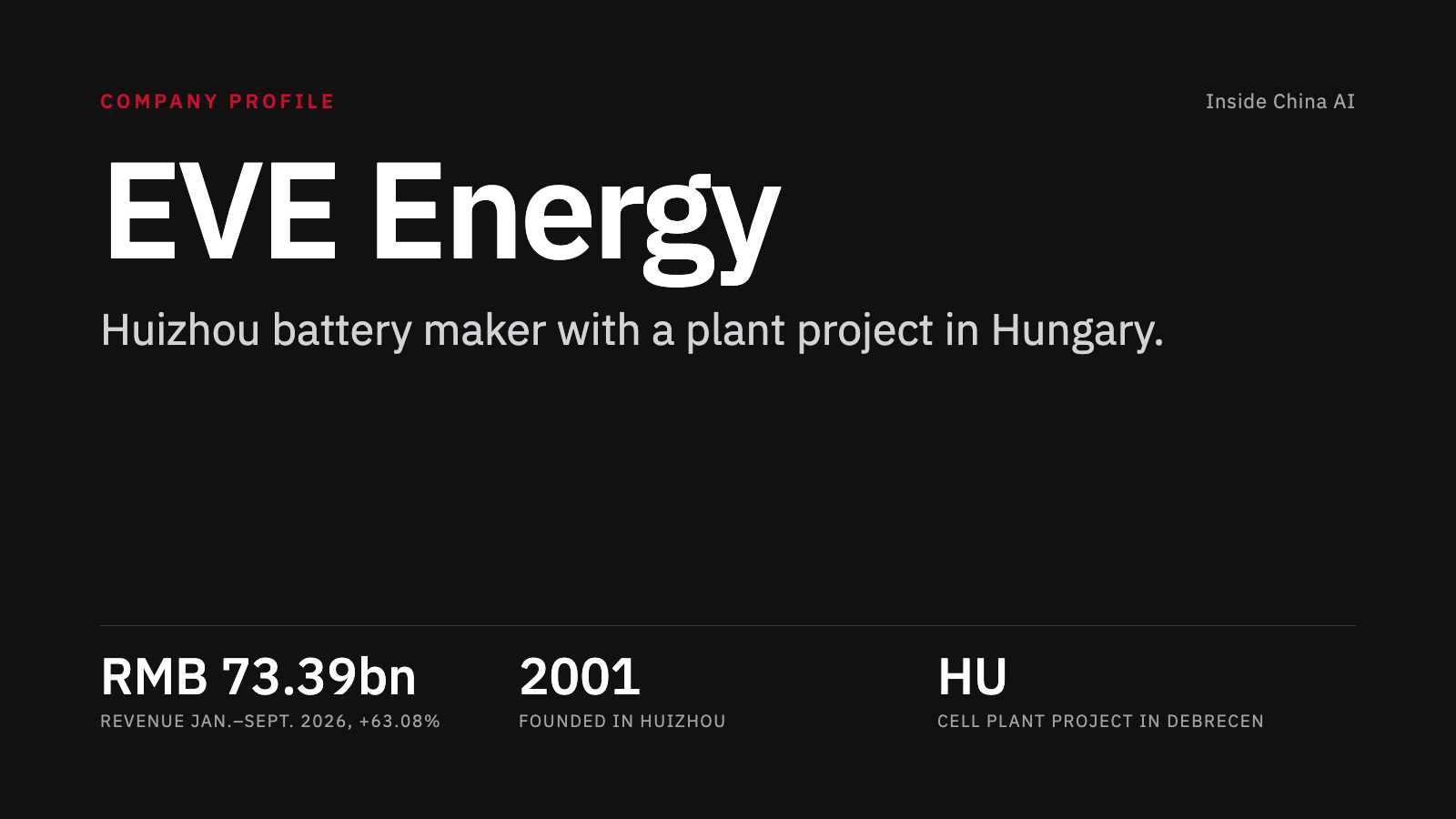
Graphic: Inside China AI
EVE Energy: Huizhou Battery Maker With a Plant Project in Hungary
Company profile · 28 November 2026.
EVE Energy does not sell AI models. It makes lithium batteries for cars, trucks, power grids, power tools and AI data centres, and it says it uses AI in its factories and to monitor batteries on the road. For Europe the company matters because of one customer and one site: EVE says it supplies cells for BMW’s new generation of electric cars, and it is building a plant for large cylindrical cells in Debrecen, Hungary. Since June 2026 it has also been on the US Department of Defense’s Section 1260H list of “Chinese military companies”. The list is not a sanction.
Origins and backing
EVE Energy Co., Ltd. (惠州亿纬锂能股份有限公司) was established in 2001 in Huizhou, Guangdong, and listed on the ChiNext board of the Shenzhen Stock Exchange in 2009 (300014), according to the company’s profile. The company says it has more than 30,000 staff worldwide. Liu Jincheng is chairman, according to the same page and the 2026 interim report, and is named as legal representative in the third-quarter report of 24 October 2026.
On 30 September 2026 EVE’s largest shareholder, Tibet EVE Holdings (西藏亿纬控股), which has since been renamed Guangdong EVE Holdings (广东亿纬控股), held 29.92 per cent of the shares and is listed as a domestic non-state legal person. According to the Q3 report, Liu Jincheng and Luo Jinhong each own 50 per cent of that holding company; they also hold 2.73 and 2.97 per cent of EVE directly. The interim report names the two as EVE’s actual controllers. EVE is preparing a second listing in Hong Kong: on 23 October 2026 its board revised rules that will take effect once the planned H shares are listed on the Hong Kong main board (SZSE announcement), and shareholders approved the revised draft articles on 9 November 2026 (SZSE announcement). We found no listing date.
What they build
EVE’s products are hardware: consumer batteries, cylindrical cells, power batteries for passenger cars and commercial vehicles, and energy-storage cells and systems. In the first half of 2026, power batteries brought in RMB 17.28 billion, energy storage RMB 15.09 billion, consumer batteries RMB 6.41 billion and battery materials RMB 6.87 billion, according to the 2026 interim report. Citing SNE Research, EVE says it ranked second worldwide in energy-storage battery shipments in that period. The company also says it has applied for more than 17,000 patents worldwide (SZSE announcement, 24 July 2026).
AI enters in three places, all described by the company itself. In manufacturing, the interim report describes “IoT+AI+Andon” workshops, a digital-twin factory, and a “production all-factor large model” (生产全要素大模型) that EVE says it has built over several years to simulate processes for new products and predict yields. The report says the Ministry of Industry and Information Technology put an EVE smart factory on its first list of “excellence-level” smart factories. On 18 January 2026 EVE said that one of its plants had been admitted to the Global Lighthouse Network of the World Economic Forum and McKinsey as the first lighthouse factory for cylindrical batteries. In that release, EVE says physical simulation combined with AI saves 75 per cent of R&D trials, that AI visual inspection checks each cell in 0.3 seconds, and that first-pass yield exceeds 97 per cent (EVE via PR Newswire).
In the product, EVE says its “AI smart battery” for commercial vehicles combines a self-developed in-vehicle battery chip with a cloud-based “battery large model” for self-diagnosis, fault warnings and range estimates, and is supplied in volume to leading commercial-vehicle makers, which it does not name (interim report). And AI is a market: EVE offers cylindrical backup-battery (BBU) cells for server racks, UPS cells and storage systems for AI data centres, as well as batteries for robots. We found no published AI model from EVE, and the company does not say what its “large models” are built on.
Key numbers
- Listing Shenzhen ChiNext (300014) since 2009; Hong Kong listing planned
- Revenue RMB 27.70 billion in Q3 2026, up 64.56 per cent; RMB 73.39 billion in January–September, up 63.08 per cent (Q3 report, unaudited)
- Net profit RMB 1.94 billion attributable to shareholders in Q3 2026, up 60.18 per cent; RMB 5.24 billion in January–September, up 86.11 per cent
- R&D costs RMB 2.80 billion in January–September 2026, against RMB 1.87 billion a year earlier
- Overseas revenue RMB 11.33 billion of revenue in the first half of 2026, up 62.61 per cent (interim report)
- AI AI in manufacturing and a cloud battery model for commercial vehicles, the company says; no AI model of its own published
- Europe EVE Germany GmbH (trading); EVE Power Hungary Kft. building a cylindrical-cell plant in Debrecen; customer BMW
The European angle
- Companies EVE’s interim report lists two wholly owned European subsidiaries: EVE Germany GmbH, a trading company it acquired, and EVE Power Hungary Kft., a manufacturing company it set up (interim report).
- Hungary On 8 June 2023 EVE’s board approved an investment of up to RMB 9.97 billion (about €1.31 billion at the time) in a plant for large cylindrical passenger-car cells in Debrecen, to be built in phases over four years (SZSE announcement). At the time, the plant was reported to have a planned capacity of 28 GWh a year and to start operating in 2026 (electrive, 10 May 2023; electrive, 30 November 2023). On 8 April 2025 EVE said its Hungarian subsidiary had received a building permit for the battery plant from the city of Debrecen (SZSE announcement). In its interim report, published on 20 August 2026, EVE says it is “actively advancing” construction of the Hungarian plant. On 3 July 2026 the University of Debrecen, which signed a partnership with EVE Power Hungary, described the company as “currently building” its first European production facility (University of Debrecen). On 9 November 2026 electrive wrote that EVE “has built a cell factory” near BMW’s new plant in Debrecen (electrive). We found no company figure for production or output there.
- Customers On 9 September 2022 BMW said it had awarded “contracts in the two-digit billion-euro range” for battery cell factories to CATL and EVE Energy, and that both would build gigafactories in China and Europe (BMW Group). In its 2026 interim report EVE says it has become the first-launch battery supplier for BMW’s new-generation models and that its 46-series large cylindrical cells entered volume delivery in the first half of 2026. EVE does not say which plant makes them. According to the same interim report, EVE has signed a strategic cooperation agreement with Stark Future, which it calls a leading European maker of off-road motorcycles, and Stark’s Varg EX electric motorcycles use EVE’s tabless cylindrical cells. We found no second source for this.
- Sales EVE’s website names several European countries among its distribution markets but no distributors, and runs a European web shop, evemall.eu (EVE).
- US lists The US Department of Defense added EVE Energy to its Section 1260H list in the update published in the Federal Register on 10 June 2026. The notice states that “EVE Energy is directly and indirectly affiliated with SASAC” and that it “is a military-civil fusion contributor to the Chinese defense industrial base because it knowingly received assistance from the Government of China … through its selection as a ‘Single Champion’” (Federal Register, 10 June 2026). The list is not a sanction. We found no statement from EVE on the listing. EVE is not on the US Consolidated Screening List, which includes the Entity List and the Treasury’s Chinese military-industrial complex list (trade.gov, list as downloaded on 24 November 2026), on the forced-labour (UFLPA) entity list (Federal Register, 29 October 2026), or on the EU’s financial sanctions list.
- Patent dispute On 21 July 2026 LG Energy Solution and its Arizona subsidiary sued EVE for patent infringement in the US District Court for the Eastern District of Texas and filed a complaint with the US International Trade Commission. EVE said on 24 July 2026 that it does not infringe the patents and will defend itself (SZSE announcement). The ITC opened investigation 337-TA-1518 into “certain secondary cylindrical batteries”; the complainants seek a limited exclusion order and cease and desist orders (Federal Register, 24 August 2026). Both proceedings are in the United States. We found no decision.
- What a European buyer would actually encounter An industrial supplier rather than a brand: cylindrical cells in BMW’s new electric cars and, according to EVE, in Stark Future’s electric off-road motorcycles, and, once Debrecen produces, cells made in Hungary. As EVE describes it, its AI work stays inside its own factories and its battery cloud.
What we could not verify
- Whether Debrecen has started production, in trial or series, and how much it makes; the company has published no figure.
- Which EVE plant supplies BMW’s new-generation cells, in China or in Hungary.
- What EVE’s “large models” are: whether the production model and the cloud battery model are EVE’s own, and on which base models they run.
- EVE’s response to the 1260H listing; we found no statement or petition.
- When the Hong Kong listing will take place.
The open question for Europe: when Debrecen produces at scale, will EVE’s AI-run factory systems and battery cloud come with it, and where will that data be stored?

Comments are closed