Graphic: Inside China AI
Galaxea AI: A Beijing Robot Maker Whose AI Models Are Free for Research, Not for Commercial Use
Company profile · 22 November 2026.
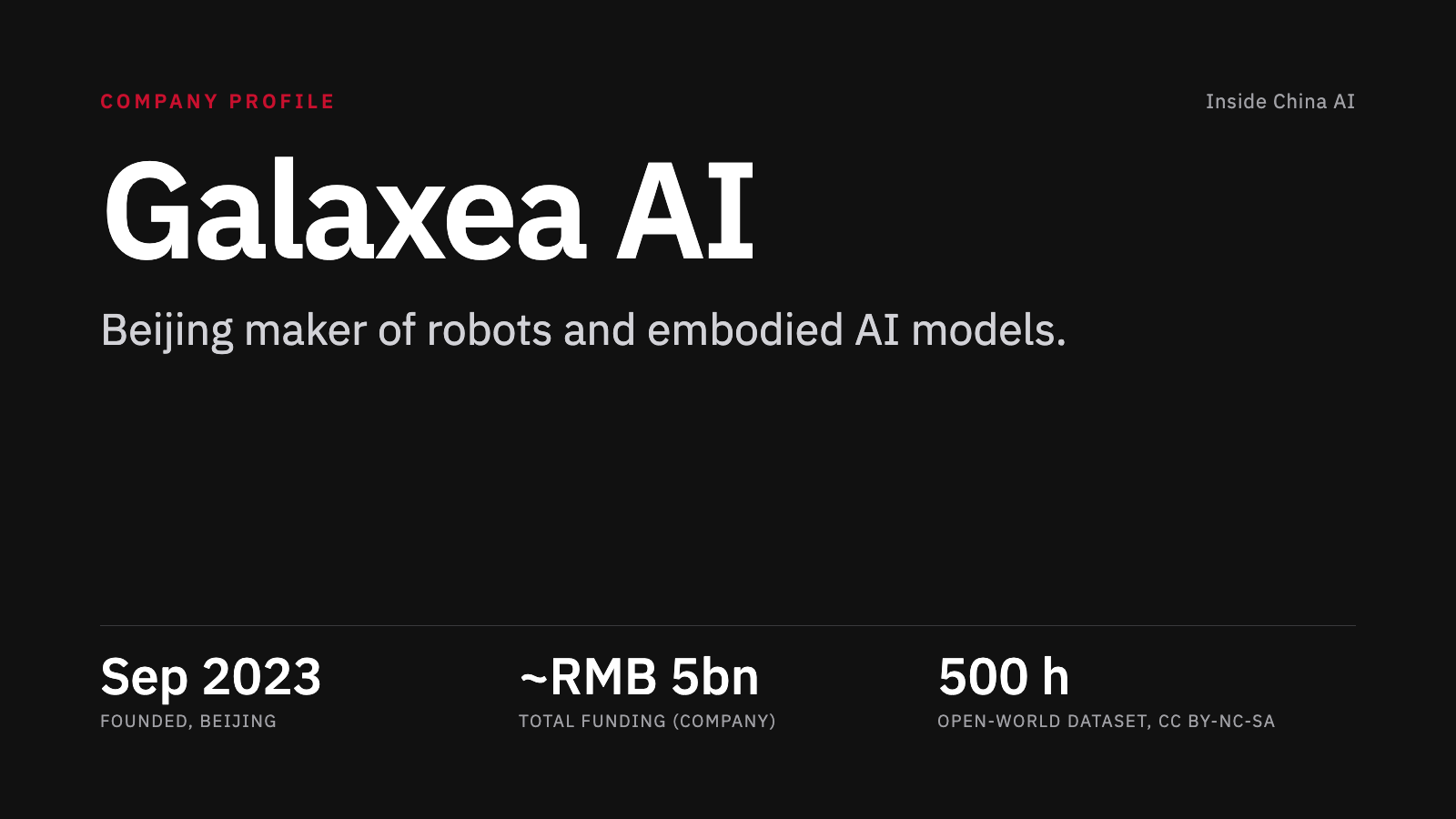
Galaxea AI (星海图) builds both halves of a robot: the hardware, led by its wheeled dual-arm R1 series, and the “brain”, a family of vision-language-action models called G0. Founded in Beijing in September 2023, it says it has raised nearly RMB 5 billion in total, and Chinese media reported a valuation above 20 billion yuan after its April 2026 round. Its models and its 500-hour robot dataset are public, but under licences that rule out commercial use without a separate agreement. For Europe, Galaxea is so far a web shop: its Hong Kong store ships robot arms and developer kits to Germany, France, Italy, Spain and the UK, but we found no European company, distributor, customer or research partner.
Origins and backing
Galaxea’s legal entity, 星海图(北京)人工智能科技股份有限公司, is a joint-stock company that says it was founded in September 2023 (Galaxea); its store gives an address in the Zhongguancun (Yizhuang) International Robot Industry Park in Beijing (Galaxea Dynamics). Two of the founders come from self-driving cars. Chief executive Jiyang Gao worked as a tech lead at Waymo and later as an executive director at the Chinese autonomous-driving company Momenta, according to a personal page that still describes the Momenta role as current and predates Galaxea (Jiyang Gao). Chief scientist Hang Zhao is an assistant professor at Tsinghua University’s Institute for Interdisciplinary Information Sciences and was a research scientist at Waymo from 2019 to 2020 (Hang Zhao). Tianwei Li is co-founder and chief operating officer (Galaxea). A fourth co-founder, Huazhe Xu, is no longer on the leadership page; Caixin reported in February 2026 that Galaxea had confirmed his departure (Caixin).
Funding came in quick succession. A pre-A round of more than RMB 200 million in November 2024 was led by Hillhouse’s GL Ventures and Ant Group (PEdaily). By July 2025 total funding had reached nearly RMB 1.5 billion, the company says (Galaxea). In February 2026 Galaxea raised RMB 1 billion in a Series B at a valuation of 10 billion yuan; Jinding Capital and BAIC Group’s industrial investment arm came in, while existing backers including Cathay Capital, Meituan Dragonball and Capital Today increased their stakes (Caixin). In April 2026 it added nearly RMB 2 billion, which the company calls a Series B+. Caixin reported that the round pushed the valuation “above 20 billion yuan” and that nearly 20 investors took part, among them Lens Technology, Galaxea’s hardware partner, and state-backed funds (Caixin); QbitAI reported the same threshold (QbitAI). Galaxea itself has published no valuation. Galaxea’s own timeline now says it completed “Series B and Series C financing” in 2026, with total funding of nearly RMB 5 billion (Galaxea). It gives no date, amount or investors for a Series C; Caixin had put total funding at nearly 3 billion yuan after the Series B, so the B+ alone brings the total close to the company’s figure. The company does not publish revenue, and we found no listing application.
What they build
The models are what set Galaxea apart from many Chinese robot makers. G0, presented in August 2025, splits the work in two: a vision-language model plans the task, and a vision-language-action model carries out the movements (arXiv). It was released with the Galaxea Open-World Dataset, which the company describes as 500 hours of robot data covering more than 150 tasks in 50 real homes and workplaces, all recorded on one type of robot (arXiv). The dataset was downloaded 35,106 times in the 30 days to 22 November 2026, according to Hugging Face (Hugging Face). G0.5, presented in June 2026, drops the split: a single model writes out its reasoning and its actions in one sequence. It is built on Alibaba’s open Qwen3.5 2B model and pretrained on data from 14 different robots (GitHub). In its paper Galaxea reports that G0.5 beats the models it compared against in real-world fine-tuning and benchmark tests (arXiv); these are the company’s own results.
“Open” has limits here. The G0 weights and the dataset are licensed under CC BY-NC-SA 4.0, which excludes commercial use (Hugging Face). The GalaxeaVLA code repository started under Apache 2.0; everything committed from 4 January 2026 carries Galaxea’s own non-commercial community licences, since 16 June 2026 the G0.5 licence, under which “commercial use … requires a separate commercial license” (GitHub). A European company can test G0.5 freely, but has to negotiate with Galaxea before putting it into a product.
The hardware is aimed first at laboratories. The R1, launched in October 2024, is a wheeled robot with two arms; the company says the first units went to Fei-Fei Li’s team at Stanford and to the US start-up Physical Intelligence (Galaxea). Its store lists the current R1 Lite at $39,999 and the R1 Pro at $69,999, but only on request, not for direct purchase (Galaxea Dynamics). The range also includes robot arms, the LEMO two-arm desktop kit for developers, open for orders since 14 October 2026 at a launch price of RMB 49,999 (Galaxea), the KENGO two-legged robot and NEXO, a new wheeled two-arm robot with 30 degrees of freedom presented at the World Robot Conference in Beijing in August 2026 (press release).
The company is now pushing into paid work. On 22 August 2026 it signed a three-year strategic agreement with JD.com covering robot sales, joint development and after-sales service, and showed a robotic “dark store” for online orders in which, the company says, G0.5 picks from more than 10,000 products (Galaxea). As of 23 September 2026, four R1 Pro robots had been carrying contaminated surgical instruments and doing ward rounds at Kunshan First People’s Hospital for nearly a month, together with the local partner Kunshu Xingqi, the company says (Galaxea). Galaxea says it serves “nearly 100” clients, naming Stanford University, Physical Intelligence and Huawei (press release).
Key numbers
- Founded September 2023, Beijing; founder and CEO Jiyang Gao
- Funding Nearly RMB 5 billion in total, the company says; Series B of RMB 1 billion (February 2026) and B+ of nearly RMB 2 billion (April 2026); a Series C is mentioned without details
- Valuation Above 20 billion yuan after the April 2026 round, as reported by Caixin and QbitAI; no company figure
- Models G0 (August 2025), G0 Plus (2026), G0.5 (June 2026); weights public under non-commercial licences
- Data Galaxea Open-World Dataset: 500 hours, more than 150 tasks, 50 scenes (CC BY-NC-SA 4.0)
- Robots R1 Lite from $39,999, R1 Pro $69,999 (store list prices, on request); LEMO, KENGO, NEXO
- Revenue and deliveries Not published
The European angle
- Physical presence None found: no European company, office, warehouse or service centre.
- Sales channel Galaxea’s international store is run by GALAXEA HK LIMITED in Hong Kong and ships to Germany, Italy, France, the United Kingdom and Spain, with delivery times of 38 to 53 business days (Galaxea Dynamics). Arms, LEMO kits and accessories can be ordered directly; the R1 robots only on request. We found no authorised European distributor.
- Customers and research We found no named European customer or research institution using Galaxea robots or models. The clients Galaxea names are in the United States and China.
- Money Cathay Capital is among the existing investors that increased their stakes in February 2026 (Caixin).
- Data The store’s privacy policy names the Hong Kong company as controller and says order data is stored by Shopify in the United States (privacy policy); it names no EU representative.
- Regulatory exposure Galaxea is not on the US Entity List, the Treasury’s Chinese military-industrial complex (CMIC) list or the Pentagon’s 1260H list, according to our check on 22 November 2026 of the US consolidated screening list and of the 1260H list. We found no CE declaration on the store pages; its terms leave machinery-safety compliance to the buyer (legal notice).
- What a European buyer would actually encounter A research-grade robot and developer kits ordered from Hong Kong, paired with capable models that are free to study but need a licence deal to sell.
What we could not verify
- The Series C: when it closed, how much it raised, from whom, at what valuation, and whether it is a separate round at all.
- Revenue, units delivered and headcount; reports of “thousand-unit orders” from Chinese carmakers and logistics companies name no customers.
- Galaxea’s claim that G0 is the most-downloaded open-source embodied-AI project, and its leaderboard rankings.
- CE marking, EU warranty and service for robots shipped to Europe.
- Any European customer, research partner or distributor.
The open question for Europe: will Galaxea offer commercial licences and local support that let European companies build on its models — or will they stay a research tool?

Comments are closed