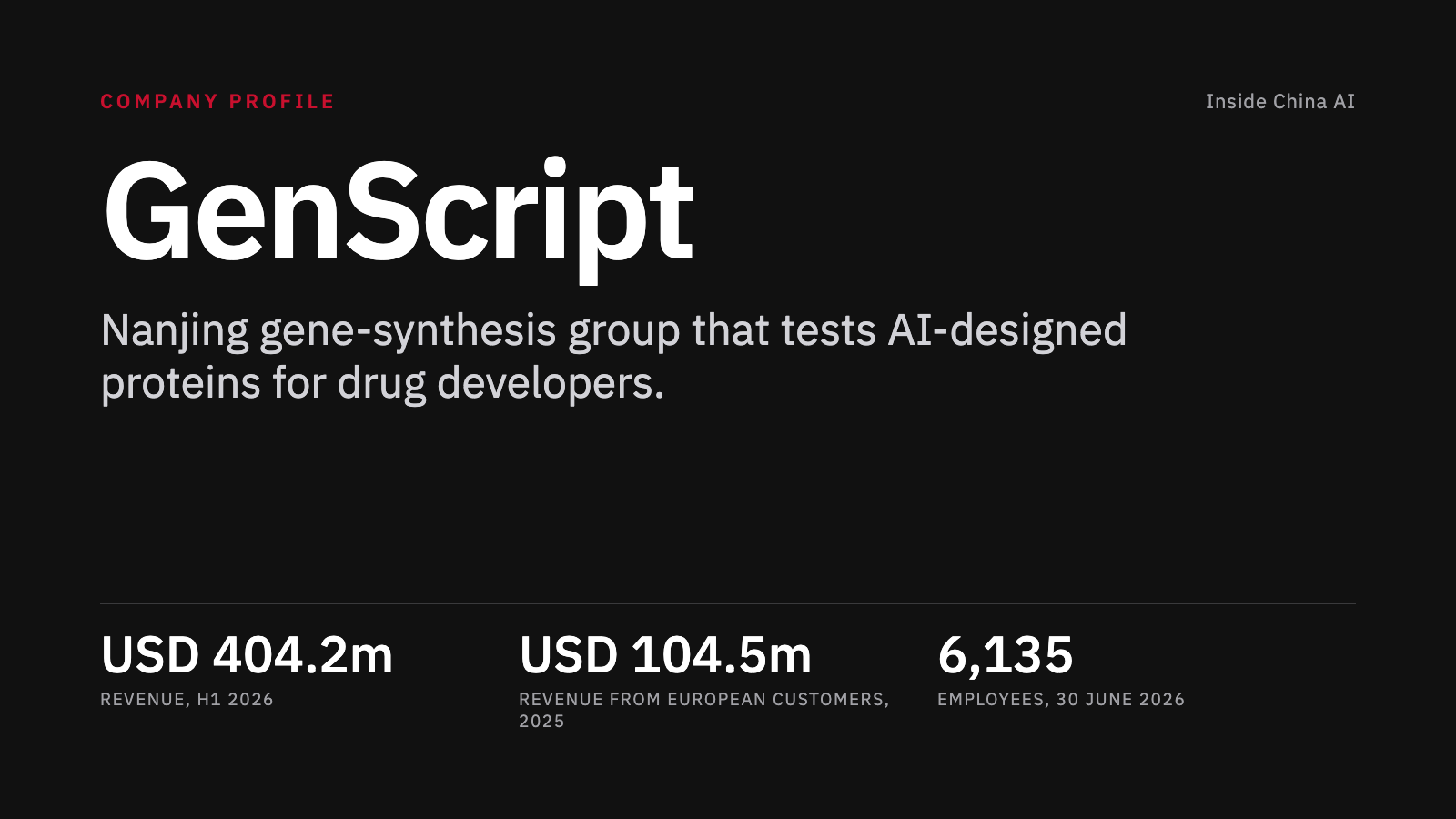
Graphic: Inside China AI
GenScript: The Gene-Synthesis Group That Tests AI-Designed Proteins for Drug Developers
Company profile · 23 November 2026.
GenScript is not an AI developer. It makes DNA, proteins and antibodies to order for laboratories, and it has turned that into a service for a new kind of customer: companies that design proteins with AI and need someone to build and test them. The company says this AI drug-discovery business doubled in the first half of 2026, and in September it raised about HK$2.3 billion, mostly to expand the automated labs behind it. Its main operations are in China; in Europe it has sales companies and, since March 2026, an mRNA lab in Delft. European customers paid it USD 104.5 million in 2025. For Europe’s biotech firms the questions are practical: where the work is done, which group company they are dealing with, and how US scrutiny of Chinese biotech suppliers develops.
Origins and backing
GenScript was founded in New Jersey in 2002 (GenScript press release, 18 August 2026). The listed parent, Genscript Biotech Corporation, is incorporated in the Cayman Islands and has traded on the Main Board of the Hong Kong stock exchange (1548) since 30 December 2015. Most of its long-term assets are in mainland China: USD 493.6 million of USD 647.2 million at the end of 2025, against USD 127.0 million in the US (Annual Report 2025).
The founders still control the group. GS Corp, a Delaware company owned by co-founders Frank Zhang and Sally Wang, other early shareholders and family trusts, held 36.55 per cent of the shares on 30 June 2026; funds managed by Hillhouse held 7.92 per cent (Interim Report 2026). Frank Zhang, chief executive until August 2020, is an executive director (Annual Report 2025). On 16 September 2026 the board listed Robin Meng as chairman and Sally Wang as president (HKEX list of directors); Sherry Shao is rotating chief executive (press release, 18 August 2026).
The group has three operating arms and one large holding:
- GenScript Life Science Group makes DNA, RNA and peptides, produces proteins and develops reagent antibodies. It brought in 78.0 per cent of revenue in the first half of 2026 (H1 2026 results).
- ProBio develops and manufactures biologics and cell and gene therapies for clients. On 4 September 2026 GenScript announced plans to list ProBio separately in Hong Kong; the exchange’s Listing Committee had confirmed on 14 August that it may proceed. GenScript says it will keep control of ProBio (HKEX announcement).
- Bestzyme makes industrial enzymes. GenScript owns 83.42 per cent of its Nanjing company (Annual Report 2025).
- Legend Biotech, the cell-therapy company behind the myeloma drug Carvykti, is no longer a subsidiary. After Legend ended a proxy-voting arrangement for its US depositary shares, GenScript, with 47.56 per cent, lost its majority of votes and deconsolidated Legend with effect from 18 October 2024 (HKEX announcement). On 30 June 2026 it held 45.03 per cent, carried at about USD 2.9 billion, or 60.9 per cent of GenScript’s total assets (H1 2026 results).
What they build
The AI link is in the laboratory, not in software. AI protein designers produce thousands of candidate sequences; each has to be turned into DNA, expressed as a protein and measured. GenScript sells that step. Its AI drug-discovery page offers to express customers’ AI-designed sequences in cell-free systems or its TurboCHO mammalian cells and return binding and developability data, in as little as four days, the company says. The customers confirm part of this. Latent Labs, a London-based AI firm, writes that the mini-binder proteins for its Latent-X model, about 100 designs for each of five targets, “were produced by GenScript Biotechnology Co., Ltd. (Nanjing, China)” (Latent Labs, July 2025). EvolutionaryScale’s ESM3 paper says GenScript synthesised and measured its AI-designed fluorescent protein, esmGFP, “as part of an independent replicate” (EvolutionaryScale preprint); the figure of 178 variants comes from GenScript’s own page (GenScript). We found no AI model of GenScript’s own.
In its half-year filing, GenScript attributes the 28.8 per cent revenue growth of the Life Science Group to demand for integrated “gene-to-protein” services, “driven by structural growth in AI-driven drug discovery”, and to closer ties with “AI-native customers” (H1 2026 results). Only its press release says the AI-enabled drug-discovery business “doubled year over year”; gene-to-protein services made up about 66 per cent of segment revenue (press release, 18 August 2026). The company gives no revenue figure for the AI business.
On 15 September 2026 GenScript completed a placing of 77.1 million new shares at HK$30.50 each, raising HK$2,327.1 million net (HKEX announcement). It plans to spend about 70 per cent on capacity for its AI drug-discovery platform, “including automated high-throughput wet-lab facilities”, and about 20 per cent on related research, digital workflows and business development (placing announcement). The half-year filing places the group’s expansion of manufacturing and discovery infrastructure “across our sites in the U.S. and Chinese Mainland” (H1 2026 results).
Bestzyme, the company says, uses a “proprietary AI-powered protein engineering engine” for enzymes (Annual Report 2025) but gives no name or performance figure.
Key numbers
- Revenue USD 404.2 million in the first half of 2026, up 27.3 per cent on the company’s “underlying” basis, which excludes a one-off licence deal; on the reported basis, revenue was USD 518.8 million a year earlier (H1 2026 results, unaudited). GenScript does not publish quarterly results.
- By segment Life Science Group USD 319.0 million, ProBio USD 61.1 million, Bestzyme USD 30.4 million in the first half of 2026 (H1 2026 results)
- Profit A net loss of USD 129.3 million in the first half of 2026. The core business earned USD 25.6 million; Legend cost USD 154.9 million, mostly in non-cash accounting charges. The company’s adjusted net profit was USD 62.5 million (H1 2026 results)
- Full year 2025 Revenue of USD 959.5 million, inflated by about USD 283.8 million from a single customer, mainly payments to ProBio from LaNova under an antibody licence; a net loss of USD 532.4 million after a USD 398.1 million impairment of the Legend stake (2025 annual results; Annual Report 2025)
- Customers by region In 2025, USD 476.1 million came from customers in mainland China (2024: USD 176.9 million), USD 293.0 million from the US and USD 104.5 million from Europe, up from USD 80.9 million in 2024 (Annual Report 2025)
- People 6,135 employees on 30 June 2026, 10.3 per cent of them in research and development (H1 2026 results)
The European angle
- Companies GenScript Biotech (Netherlands) B.V., set up on 6 December 2017, and Probio Technology (Netherlands) B.V., set up on 26 August 2021, are wholly owned and listed for the “sale of life science research products and services” (Annual Report 2025). The company’s Europe page gives the Dutch office in Rijswijk and a UK company, GenScript Biotech (UK) Limited, in Oxford (GenScript). The annual report also names a Spanish company, Genscript Biotech (Spain), S.L., without describing its activity.
- An mRNA lab in Delft On 12 March 2026 GenScript announced “the official opening of its first European mRNA production site” in Delft, offering gene synthesis, vector engineering and mRNA production (GenScript). It gives no capacity or output, and the Hong Kong filings do not mention the site. We found no European site for the AI drug-discovery service; assets outside the US and mainland China came to USD 26.6 million at the end of 2025 (Annual Report 2025).
- Customers European customers paid USD 104.5 million in 2025, about 11 per cent of revenue (our calculation from the Annual Report 2025). Latent Labs in London names GenScript’s Nanjing company as its protein supplier (see above). On GenScript’s own pages, a scientific director of London-based ViiV Healthcare praises its TurboCHO expression system (GenScript), and a researcher at Spain’s CIEMAT welcomes the Delft site (GenScript).
- Legend in Belgium Legend makes Carvykti with Johnson & Johnson in Ghent (Fierce Pharma, 12 March 2025). As an associate, it does not count towards GenScript’s own presence.
- Lists Our checks on 23 November 2026 found no GenScript, Legend, ProBio or Bestzyme entry on the US Consolidated Screening List (including the Entity List), the Treasury’s Chinese Military-Industrial Complex list or the Defense Department’s Section 1260H list. The EU’s consolidated sanctions list showed no match on 15 November 2026.
- BIOSECURE The US BIOSECURE Act became law on 18 December 2025 as Section 851 of the 2026 defence authorisation act. It names no companies but bars federal agencies from contracts and grants involving “biotechnology companies of concern”: biotechnology firms on the 1260H list, and others on a list the Office of Management and Budget must publish within one year, by 18 December 2026 (Public Law 119-60, Sec. 851). GenScript is not on the 1260H list, and by 23 November 2026 that second list had not been published. US lawmakers have raised questions, not findings: on 30 May 2024 the chair and ranking member of the House Select Committee on the Chinese Communist Party asked the FBI and the Director of National Intelligence for a briefing on GenScript, Bestzyme, Legend and ProBio “for their ties to the Chinese Communist Party (CCP)”, as their letter puts it (committee letter), and asked again in July 2025. GenScript said: “While our name was included in the context of these broader conversations, there have been no actions, allegations or findings directly related to our company” (Reuters, 8 July 2025).
- What a European partner would actually encounter A Hong Kong-listed group with offices in Rijswijk and Oxford and an mRNA lab in Delft, whose AI-related protein production and testing are done outside Europe, mainly in China and the US.
What we could not verify
- How large the AI drug-discovery business is. The company gives no revenue figure.
- Where European orders are processed in general. Only Latent Labs’ paper names a site, in Nanjing.
- What the Delft lab produces, and how much, and what the British and Spanish companies do.
- European customers beyond those named by GenScript and Latent Labs.
- The ProBio listing: timing, size and valuation are not set.
- Whether the Office of Management and Budget will name GenScript or any group company when it publishes its list, due by 18 December 2026.
The open question for Europe: as AI drug design sends more protein work to automated labs in China and the US, what will European customers want to know about where their sequences go?

Comments are closed