Graphic: Inside China AI
GigaDevice: A Beijing Memory and Microcontroller Designer Profits From AI Demand and Widens Its European Sales Network
Company profile · 28 November 2026.
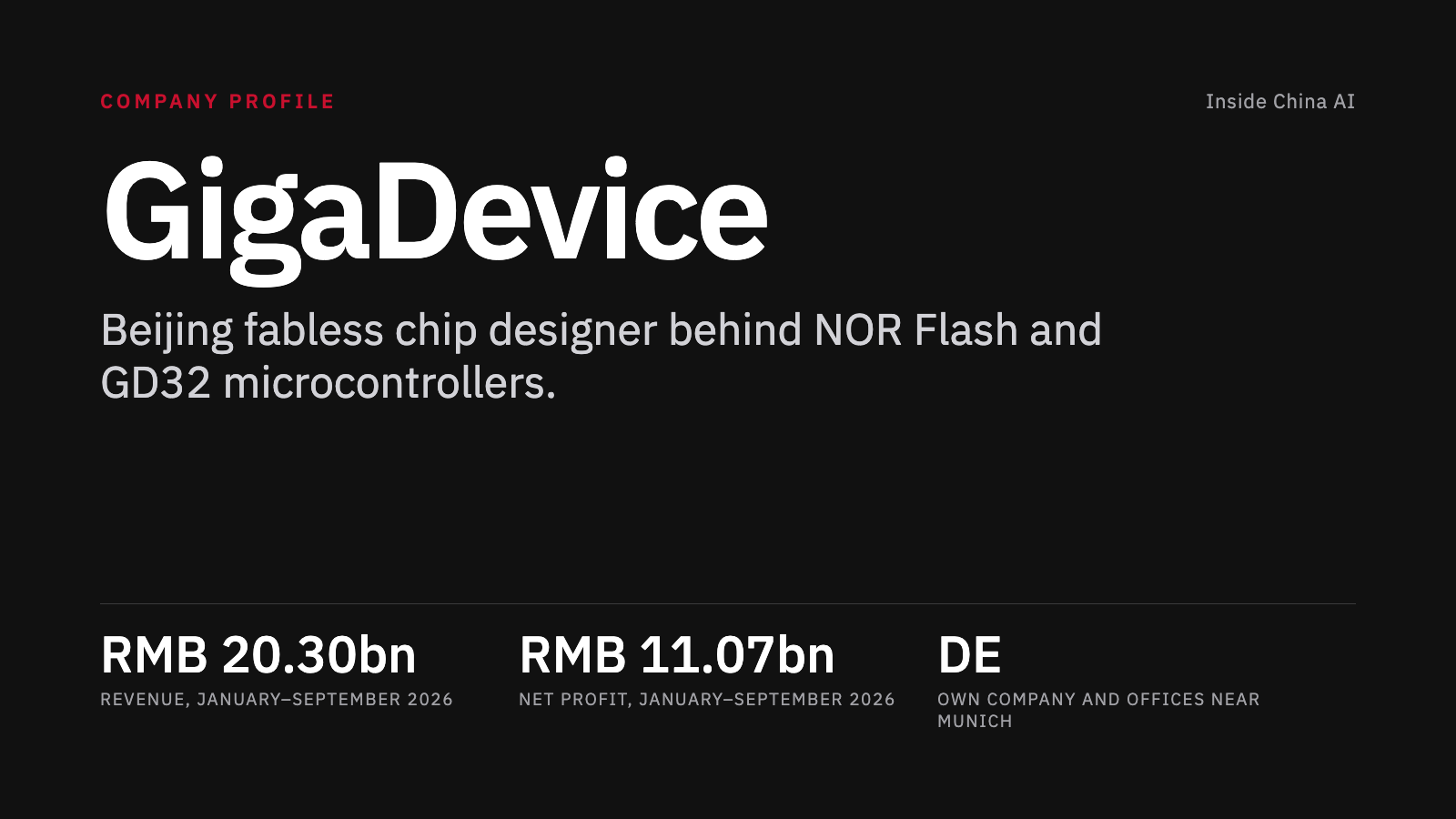
GigaDevice designs the small chips that sit in almost every electronic device: NOR Flash memory that stores firmware, niche DRAM and the 32-bit GD32 microcontrollers. It does not build AI models or AI accelerators. But the AI build-out has lifted its business: in the first nine months of 2026 its revenue rose 197 per cent to RMB 20.3 billion and its net profit attributable to shareholders 922 per cent, which the company attributes mainly to tight supply of memory chips, a shortage it links to demand “across the entire AI value chain”. For Europe, GigaDevice is already a supplier: it has its own companies in Germany and the UK, sells through European distributors such as Rutronik and Melchioni, and is pitching its microcontrollers to European makers of industrial machines, robots and car electronics.
Origins and backing
GigaDevice Semiconductor (兆易创新) was founded in April 2005 and is a fabless chip designer: it develops the chips and has them made by outside foundries (company profile). Its registered office and headquarters are in Haidian, Beijing. In June 2025 it set up an international headquarters in Singapore to coordinate its business outside China (2025 annual results).
The company’s A shares trade in Shanghai (603986). On 13 January 2026 it added a Hong Kong listing (3986), selling 28.9 million H shares at HK$162 for gross proceeds of HK$4.68 billion (HKEX allotment results). On 7 February 2026 the underwriters fully exercised the over-allotment option for a further 4.34 million H shares at the same price (HKEX announcement). The shareholding is widely spread. Apart from the Hong Kong clearing nominees, the largest holder is chairman Zhu Yiming with 4.92 per cent at 30 September 2026, acting in concert with InfoGrid Limited, which holds 1.85 per cent (third-quarter report). The company’s filings describe Zhu as its de facto controller. He Wei is general manager.
One holding matters more than any other. GigaDevice has a minority stake of about 1.80 per cent in CXMT (ChangXin Memory Technologies), a DRAM maker based in Hefei that the filing calls “a leading IC manufacturing company”. CXMT is neither GigaDevice’s parent nor one of its shareholders. Zhu Yiming chairs both companies, so GigaDevice reports CXMT as a related party. On 30 June 2026 the stake was worth RMB 10.06 billion, or 23.7 per cent of GigaDevice’s total assets. In the first half of 2026 GigaDevice bought RMB 1.99 billion of “raw materials, etc.” from CXMT and its subsidiaries, up from RMB 433 million a year earlier (interim results).
What they build
GigaDevice has four product lines. The first is specialty memory: NOR Flash, SLC NAND Flash and niche DRAM (DDR3L, DDR4, LPDDR4X). The others are GD32 microcontrollers, sensors such as fingerprint and touch chips, and analog chips. The analog line grew with the 2024 purchase of Suzhou XySemi, which makes battery-protection chips. The company says it held about 19.4 per cent of the SPI NOR Flash market in 2025, second worldwide. It ranked seventh among makers of 32-bit general-purpose microcontrollers, with about 1.7 per cent. Both figures come from Omdia data cited in its interim results.
The AI connection runs mainly through memory. GigaDevice says AI demand for NOR Flash ranges “from hyperscale data centers to edge devices”. It also says niche DRAM ran short after “major overseas manufacturers have withdrawn from the niche DRAM market”, so both volumes and prices rose in the first half of 2026. A controlling subsidiary, CreMemory Technology, builds customised memory for AI phones, AI PCs and robots, the company says.
On the microcontroller side, AI means small models running on the chip itself. GigaDevice’s filings list “AI MCU” and higher-computing-power MCUs as products under development (interim results). In September 2026, at Embedded World North America, the company showed face recognition on its 600 MHz GD32H7 chip, with what it says is 97.9 per cent mAP and an inference time of 77 milliseconds. It also showed an “embodied AI” robotics demo with vision, SLAM and sensor fusion (GigaDevice). On 10 November 2026 in Munich it launched a new GD32H7 family that includes the GD32H77R, a chip for servo control in robot joints, “custom-designed for collaborative robots, humanoid robots and high-precision servo equipment”. The company says the family’s security functions are designed to help customers address the cybersecurity requirements of the EU Cyber Resilience Act (GigaDevice).
Cars are a growing market. By mid-2026 GigaDevice had shipped more than 450 million automotive-grade Flash chips and more than 10 million automotive microcontrollers, the company says. In December 2025 it announced that TÜV Rheinland had certified it under the ISO/SAE 21434 automotive cybersecurity standard (GigaDevice).
Key numbers
- Listing Shanghai (603986) and Hong Kong (3986) since 13 January 2026; HK$4.68 billion gross proceeds from the Hong Kong offering before the over-allotment option
- Revenue RMB 20.30 billion in January–September 2026 (+197%); RMB 8.73 billion in the third quarter (+226%) (third-quarter report)
- Net profit RMB 11.07 billion attributable to shareholders in January–September 2026 (+922%), including RMB 1.63 billion of non-recurring items, mainly fair-value gains on investments
- Total assets RMB 87.65 billion at 30 September 2026, against RMB 21.40 billion at the end of 2025
- 2025 revenue RMB 9.20 billion; 90.8 per cent sold through distributors (annual results)
- Staff 2,458 full-time employees at 30 June 2026, about 97 per cent of them in China
- AI No own AI models; memory for AI servers and devices, GD32 microcontrollers that run small on-device models, “AI MCU” in development
The European angle
- Own companies GigaDevice Semiconductor Germany GmbH (sales, semiconductor R&D, marketing) and GigaDevice Semiconductor Europe Ltd. in the UK (sales) are wholly owned subsidiaries (interim results). The company lists offices in Munich and in Höhenkirchen-Siegertsbrunn near Munich, and in Wokingham, Berkshire (GigaDevice). Dr. Reiner Jumpertz leads the region as vice president and general manager EMEA.
- Distribution In November 2025 GigaDevice signed Milan-based Melchioni Electronics as distributor for France, Italy, Spain and Portugal (GigaDevice). In February 2026 it added SEMITRON for Germany, Austria and Switzerland (GigaDevice). On 31 August 2026 it announced a franchise agreement with Rutronik of Ispringen, Germany. The deal covers EMEA and Southeast Asia and GigaDevice’s “complete portfolio of microcontrollers, sensors, and power management ICs” (Rutronik).
- Target markets GigaDevice exhibited at Embedded World in Nuremberg in March 2026 and at electronica in Munich in November 2026. There Jumpertz called Europe “an important market for GigaDevice, with strong demand for innovation across industrial automation and automotive electronics” (GigaDevice).
- How much it sells here Not disclosed. In 2025, 22.8 per cent of revenue went to customers registered outside mainland China and Hong Kong, mainly in Taiwan, Japan, South Korea and Singapore. The company does not show a figure for Europe (annual results).
- Lists GigaDevice is on none of the lists we checked on 27 November 2026: the EU’s consolidated financial sanctions list, the US Consolidated Screening List (including the Entity List) and the Pentagon’s Section 1260H list of “Chinese military companies”, which is not a sanctions list.
- What a European buyer would actually encounter Microcontrollers and memory chips from a Chinese supplier, bought through familiar European distributors and supported by a German team. Some AI runs on the chips, but GigaDevice offers no AI service of its own.
What we could not verify
- How much GigaDevice sells in Europe, and which European manufacturers use its chips. We found no named European customer.
- How many people GigaDevice employs in Europe.
- Whether an “AI MCU” of the kind named in the company’s filings is already on sale.
The open question for Europe: as tight memory supply lifts GigaDevice’s earnings, will its European push move from distributors and trade fairs to named customers in European industry?

Comments are closed