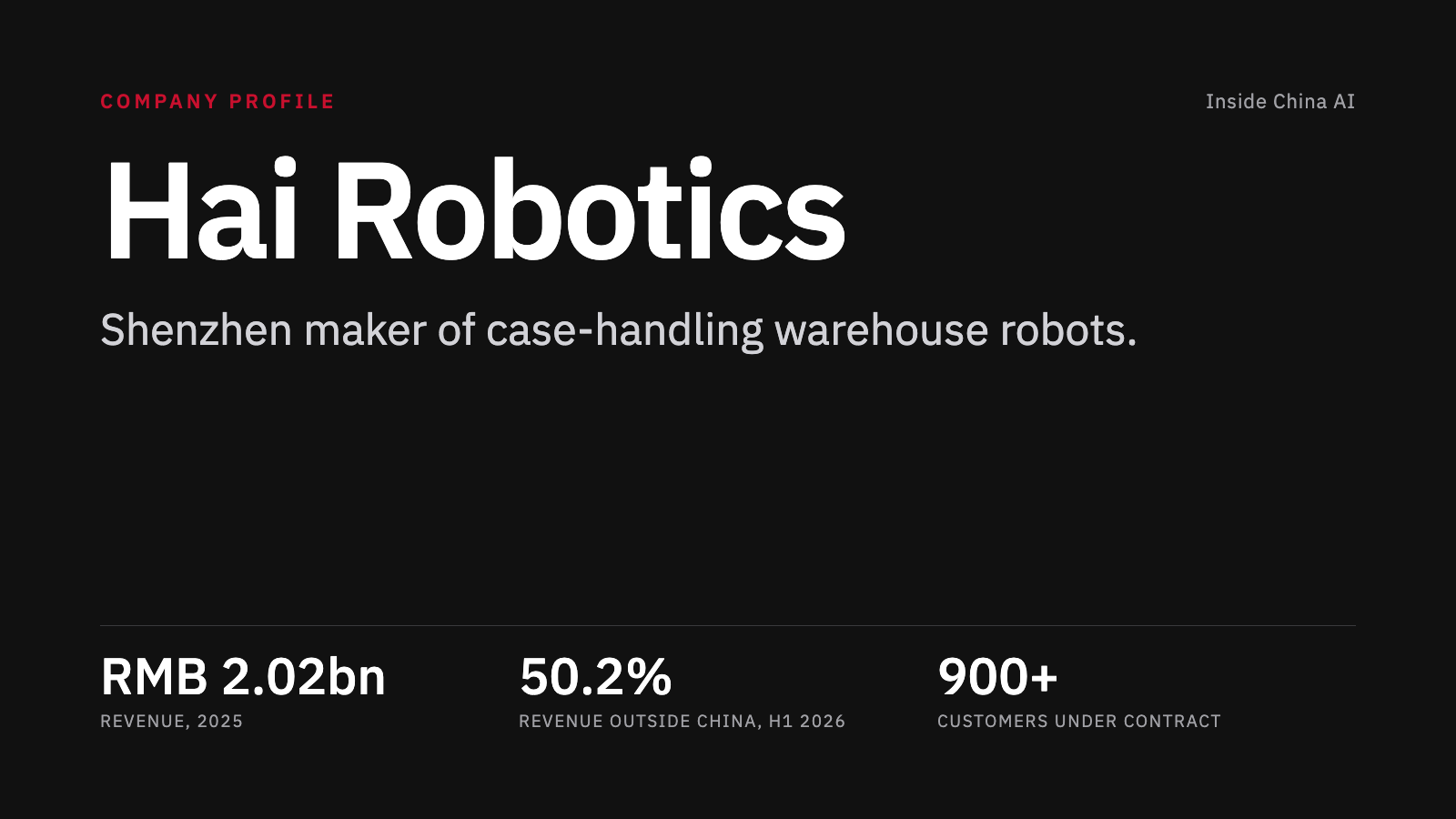
Graphic: Inside China AI
Hai Robotics: Case-Handling Robots From Milton Keynes to Ostrava, and a Second Bid to List in Hong Kong
Company profile · 22 November 2026.
Hai Robotics (海柔创新) builds robots that climb warehouse racks, pull out individual cartons and bring them to a picking station. The Shenzhen company says it invented this kind of robot, and European retailers and system integrators are among its biggest buyers: a Polish apparel group, a Dutch and a German systems integrator have each ranked among its five largest customers, and its case studies name sites in Britain, Spain, the Czech Republic, Poland, Italy, the Netherlands and Romania. Its European subsidiary sits in Hoofddorp near Amsterdam. Half of its revenue now comes from outside its home market, but the company still loses money, carries more than RMB 5 billion of redemption liabilities to its investors, and filed for a Hong Kong listing for the second time on 13 September 2026, after its first application lapsed. For readers following AI: the filing describes its technology as fleet-scheduling, routing and robot-control software and presents no AI model of its own.
Origins and backing
The company was set up on 1 December 2016 in Dongguan as Dongguan Hairou Intelligent Technology. At the start Chen Yuqi held 52.2 per cent, his co-founders Xu Shengdong and Fang Bing 18.9 per cent each, and the Dongguan Songshan Lake International Robotics Research Institute 10 per cent (Application Proof, September 2026, p. 95). Since November 2025 it has been a joint stock company, Hai Robotics Innovation Group Co., Ltd., registered in Shenzhen. Chen has been chief executive since the founding and chairman since June 2018. Xu is chief technology officer and Fang chief operating officer; both are executive directors (Application Proof, pp. 188–189).
The founders keep control through weighted voting rights, which the company adopted in August 2021. Chen, Xu and Fang act in concert under an agreement of January 2018, and together with the partnership Hairou Weizheng, whose general partner is Chen, they are the controlling shareholders. After a listing each Class A share would carry ten votes and each Class B share one (Application Proof, pp. 4–5). The financial backers named in the filing are 5Y Capital, Capital Today, HongShan and General Atlantic. General Atlantic invested USD 150 million in a pre-IPO round agreed on 14 November 2025, at USD 2.63 a share (Application Proof, p. 102). Funds from the Hubei city of Ezhou are also among the shareholders (Application Proof, p. 104). The filing gives no company valuation.
That money came with strings. Some pre-IPO investors were granted redemption rights, which the company books as liabilities of about RMB 5,253.7 million at 30 June 2026. They are to be reclassified as equity on listing (Application Proof, p. 168); if no listing is completed within 18 months of the first submission, the investors’ redemption rights revive (Application Proof, p. 106). Until then they push the balance sheet into the red: net liabilities stood at RMB 4,371.0 million at the end of June 2026 (Application Proof, p. 8). Hai Robotics first applied to list in Hong Kong on 13 February 2026; the exchange’s application list shows that filing as lapsed and the new one of 13 September 2026 as active (HKEX, checked 22 November 2026). Goldman Sachs and CITIC Securities are the joint sponsors (China Fund News). We found no listing hearing by 22 November 2026.
What they build
The core product is the automated case-handling mobile robot, or ACR: a robot that drives between the racks, raises its handling unit to the required shelf level and takes out cartons or totes, carrying several at once to a workstation. Hai Robotics sells these as HaiPick systems: System 1 from 2017, System 2 from 2022, System 3 from 2023 and HaiPick Climb, a robot that climbs the rack itself, from 2025. Citing CIC, a consultant it commissioned for the listing, the company says it was “the world’s largest ACR solution provider in 2025, with a market share of over 30%” (Application Proof, p. 1).
The software is the HaiQ platform. The company says it uses “proprietary algorithms, modular scheduling and multirobot pathfinding” and can coordinate “up to 6,000 robots of different types at a single site” (Application Proof, pp. 124–125). On the hardware side it names motion control, visual recognition and SLAM navigation. Hai Robotics does not present an AI model of its own. Its filing also states that it does not “engage in any covered activities in … artificial intelligence systems” under the US outbound investment rules (Application Proof, p. 185). That is a legal test under US law, not a description of its technology.
The company spent RMB 385.3 million on research in 2025, 19.1 per cent of revenue. By 30 June 2026 it had filed 2,495 patent applications (Application Proof, p. 4), and 566 of its staff, nearly 35.8 per cent, worked in research and development (Application Proof, p. 125). Its robots are built in two leased plants in Dongguan and Yancheng (Application Proof, p. 169).
Key numbers
- Revenue RMB 2,016.9 million in 2025 (2024: 1,360.4 million); RMB 1,118.1 million in the first half of 2026, against 656.9 million a year earlier (Application Proof, p. 147)
- Loss RMB 827.5 million in 2025 (2024: 1,255.7 million); RMB 430.9 million in the first half of 2026. Adjusted net loss, a company measure that excludes interest on redemption liabilities among other items: RMB 207.9 million in the first half of 2026 (Application Proof, pp. 6–7)
- Gross margin 34.4% in the first half of 2026 (2023: 16.0%); 40.1% outside mainland China, 30.1% at home (Application Proof, pp. 10–11)
- Outside China 50.2% of revenue in the first half of 2026 (2023: 24.2%), allocated by where the account team sits; no figure for Europe (Application Proof, p. 147)
- Orders Order intake RMB 2,352.7 million in the first half of 2026; backlog RMB 4,154 million at 30 June 2026 (Application Proof, pp. 10, 163)
- Customers More than 900 under contract; the five largest accounted for 50.3% of revenue in the first half of 2026 (Application Proof, p. 3)
- Balance sheet Redemption liabilities about RMB 5,253.7 million; net liabilities RMB 4,371.0 million, both at 30 June 2026 (Application Proof, pp. 8, 168)
The European angle
- Companies and sites Hai Robotics Europe B.V. was set up in the Netherlands on 13 September 2021 to sell warehouse automation; HAI Robotics U.K. Limited followed in 2022. Both are wholly owned (Application Proof, pp. 94–95, 116). The company leases two properties in the Netherlands with about 1,413 square metres of office, warehouse and showroom space and keeps a spare-parts warehouse there (Application Proof, pp. 171, 181). Its European office is in Hoofddorp, and the UK office in Northampton (Hai Robotics). In April 2026 it opened an EMEA Innovation Center in Hoofddorp, where customers can see HaiPick systems running (Hai Robotics). It has no production in Europe; the filing mentions only a general plan to “strengthen local supply chain and manufacturing capabilities” outside China (Application Proof, p. 128).
- Weight in the business The filing’s anonymised customer tables show how much Europe matters. In 2025 “a leading apparel manufacturer and retailer, based in Poland” was the second-largest customer, with RMB 198.0 million or 9.8 per cent of revenue. In the first half of 2026 a Netherlands-based logistics-automation integrator ranked second with 11.5 per cent, and a Europe-based IT solutions provider fifth with 4.1 per cent. In 2024 a German intralogistics integrator was among the five largest customers (Application Proof, pp. 154–156). The company also lists an e-commerce order as “the largest project undertaken by the Company in Europe”, and another for a logistics centre in Poland (Application Proof, p. 143). The filing does not name these customers, and we do not identify them.
- Named customers According to the company’s case studies, its systems run at John Lewis’s Fenny Lock distribution centre in Milton Keynes, installed through the integrator Logistex (Hai Robotics); at Desigual’s distribution centre in Viladecans and Scalpers’ logistics hub in Guillena, Spain (Hai Robotics, Hai Robotics); at Malfini’s logistics centre in Ostrava, Czech Republic (Hai Robotics); at the electronics distributor TME’s logistics centre in Rzgów, Poland (Hai Robotics); at Transmec in Italy (Hai Robotics); and at New Wave Textiles in Utrecht (Hai Robotics). The largest by storage locations is LPP Logistics’ fulfilment centre near Bucharest, Romania, which serves online customers in five South-East European countries and has more than 625,000 automated storage locations (Hai Robotics). The trade publication Warehouse News reported the project on 9 August 2026.
- Pipeline On 8 September 2026 the company said an unnamed “leading European fashion retailer” had chosen it for an e-commerce centre with more than 1,500 HaiPick Climb robots, which it calls the “world’s largest deployment of rack-climbing warehouse robots” (Hai Robotics). It did not say where the site is.
- Data The website’s privacy policy, last updated on 25 April 2022, says personal data “may be collected, transferred to and stored by us in China” and names no European entity or representative (Hai Robotics). That covers the website only. We found no statement on where HaiQ data from European warehouses is processed.
- Lists We found no entry for Hai Robotics on the US Entity List or the other lists in the US Consolidated Screening List, on the Pentagon’s Section 1260H list of “Chinese military companies”, or on the Treasury’s NS-CMIC list (our check on 22 November 2026, partly via the OpenSanctions mirrors). Its sanctions lawyers confirm in the filing that it is not on the relevant US restricted-party lists (Application Proof, p. 185).
- Risks on record The filing discloses a workplace accident at a customer’s project site in Shanghai between 2023 and June 2026 that killed one person and injured another; a subsidiary was fined RMB 600,000. The company gives no date and says it has since tightened safety controls (Application Proof, p. 42). It says it has been loss-making since its founding and expects a further net loss for 2026 (Application Proof, p. 11).
What we could not verify
- Who the anonymised European top customers are, and where the 1,500-robot project for a European fashion retailer will be built.
- Europe’s share of revenue: the filing only separates mainland China from the rest of the world.
- The company’s valuation and the total it has raised. Both appear in press reports but not in the filing.
- Where operating data from European installations is stored and processed.
The open question for Europe: if Hai Robotics lists and builds the local manufacturing it promises, will its European business still run on systems engineered and supported from Shenzhen?

Comments are closed