Graphic: Inside China AI
Hesai: The Lidar Maker on the Pentagon’s List Builds for Robots and Courts European Carmakers
Company profile · 21 November 2026.
Hesai, listed in New York and Hong Kong, makes the laser sensors that let cars and robots see in three dimensions. It shipped almost 730,000 of them in the third quarter of 2026, has been profitable for six quarters in a row, and now calls itself a “Physical AI infrastructure company”. Europe meets it through a German subsidiary, a Swiss development unit and supply deals that, the company says, include European carmakers. In the United States the Pentagon lists Hesai as a “Chinese military company”. In August 2026 a federal appeals court ruled that the Pentagon had denied Hesai due process, but it left the designation in place.
Origins and backing
Hesai (禾赛科技) began operating in Shanghai in October 2014 (annual report on Form 20-F). Its three co-founders still run it: Yifan “David” Li is chief executive and, since September 2025, chairman; Kai Sun is chief scientist; and Shaoqing Xiang is chief technology officer (annual report 2025). Li still held both roles when the company reported its third-quarter results on 10 November 2026 (Q3 2026 results).
The holding company, Hesai Group, is incorporated in the Cayman Islands, and its head office is in Shanghai’s Changning district. Its American depositary shares have traded on Nasdaq (HSAI) since 9 February 2023. On 16 September 2025 it added a dual primary listing in Hong Kong (2525), where the offering brought in net proceeds of HK$4.65 billion (annual report 2025). The founders control the company through shares with ten votes each. According to the 20-F, they held about 17.4 per cent of the share capital but 67.6 per cent of the votes on 31 March 2026 (Form 20-F). Hesai had cash reserves of RMB 6.98 billion on 30 September 2026 (Q3 2026 results). On 18 November 2026 it announced that it may buy back up to US$100 million of its shares over twelve months (HKEX announcement).
What they build
Hesai’s main product is lidar, a sensor that measures distance with laser pulses. It sells long-range and short-range units for driver assistance in cars (the AT, ET and FT series) and other lines for robotaxis, delivery vehicles, lawn mowers and humanoid robots. The company says it designs its own chips and has assembled its sensors in its own factories “from day one”, today in Shanghai and Hangzhou (annual report 2025). In January 2026 it said it would double annual capacity from 2 million to more than 4 million units during the year (Hesai).
In 2026 Hesai began presenting itself as an AI company: its third-quarter release calls it “a Physical AI infrastructure company” and reports “our sixth consecutive quarter of GAAP profitability” (Q3 2026 results). A new segment, “Strategic Growth Initiatives”, groups joint modules for robots and Kosmo, which the company calls a “3D world data engine”; it brought in RMB 90.5 million in the third quarter of 2026, while lidar for robots is still reported in the lidar segment. Kosmo, launched on 14 October 2026, consists of a spatial camera and a cloud platform that turn real places into “AI-ready 3D assets” for robot training and film production. Hesai names Pixar’s RenderMan, the robotics companies Galbot and Dexmal and Alibaba’s map service Amap as partners (Q3 2026 results). Its software processes sensor data and filters noise. We found no AI model of its own.
Most of its car customers are Chinese. The company says it has design wins with 40 car brands for more than 160 models, “including all top ten OEMs in China” (annual report 2025). In the third quarter of 2026 it reported new wins with Cadillac, Geely, Great Wall Motor, Leapmotor, Wuling and an unnamed European carmaker, and design wins with seven carmakers, including Chery, for possible export models (Q3 2026 results). Robotaxi customers named in the annual report include Pony.ai, WeRide, Baidu Apollo Go and DiDi.
The new robot business has a governance angle. The “anchor customer” for Hesai’s robot joint modules is Sharpa, which Hesai calls “a global frontrunner in AI robotics” (Q3 2026 results). According to the annual report, Sharpa was co-founded by Hesai’s three co-founders, who have sat on its board since January 2026. Hesai bought about 10 per cent of Sharpa in April 2025 for US$13.9 million, sold the stake in August 2025 for US$38.4 million, and sold Sharpa know-how for RMB 37.0 million (annual report 2025). In a filing of 31 July 2026 Hesai said the co-founders “together indirectly held majority voting rights in Sharpa”, which makes Sharpa a connected person under Hong Kong listing rules. Hesai had sold Sharpa products worth about RMB 42 million between 25 March and 30 June 2026 and asked shareholders to raise the cap for 2026 from RMB 100 million to RMB 300 million; the co-founders abstained from the board vote (HKEX announcement).
Key numbers
- Listing Nasdaq (HSAI) since 9 February 2023, Hong Kong (2525) since 16 September 2025; incorporated in the Cayman Islands, headquarters in Shanghai (annual report 2025)
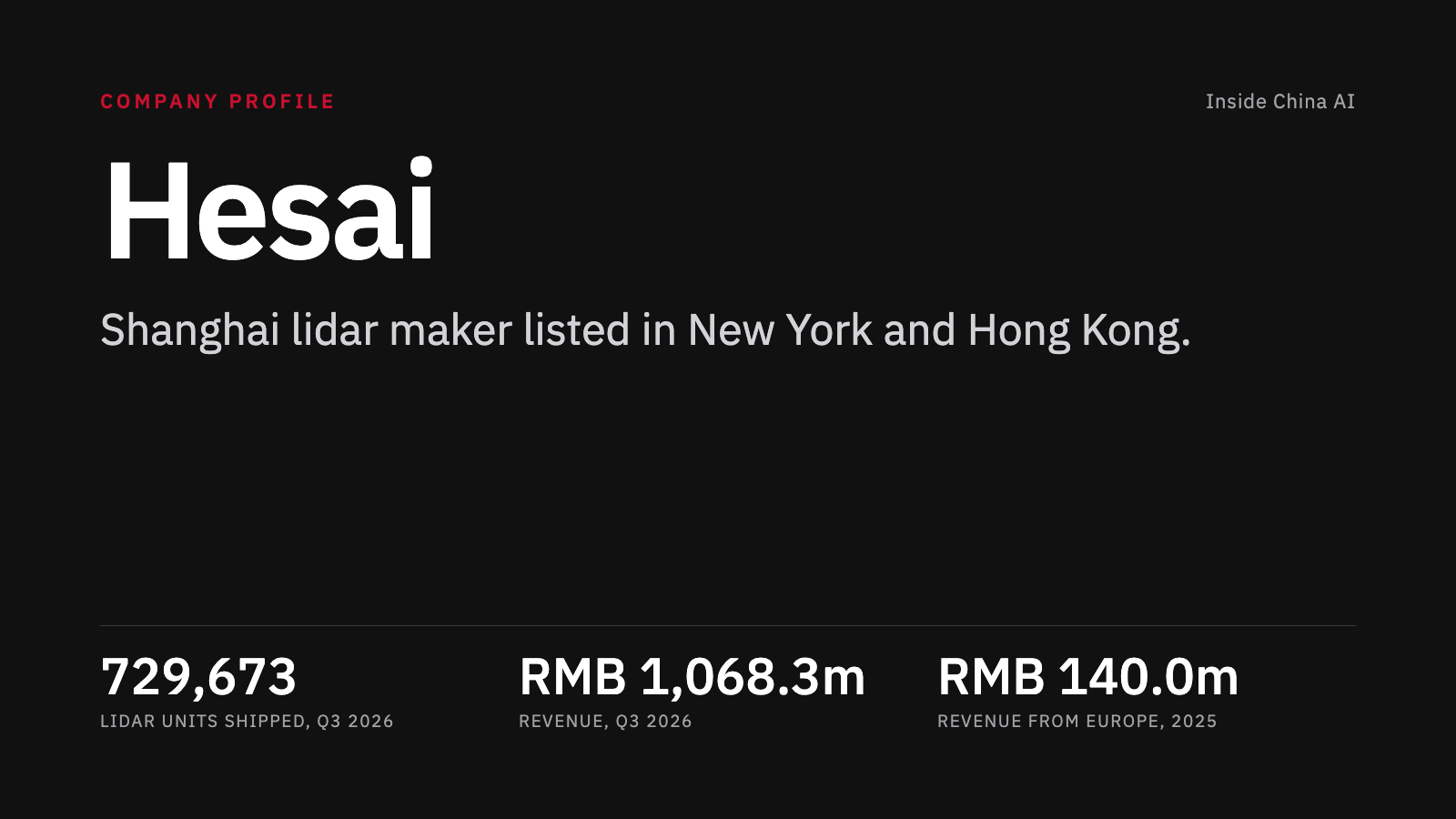
- Lidar shipments 729,673 units in Q3 2026, up 65.3 per cent (638,055 for cars, 91,618 for robotics); 1,829,671 in January–September 2026; 1,620,406 in 2025 (Q3 2026 results; annual report 2025)
- Revenue RMB 1,068.3 million in Q3 2026, up 34.3 per cent, below the RMB 1,100–1,150 million Hesai had forecast in August; RMB 3,027.6 million in 2025 (Q3 2026 results; Q2 2026 results)
- Profit Net income of RMB 80.8 million in Q3 2026, down 68.5 per cent; gross margin 41.0 per cent; net income of RMB 435.9 million in 2025 (Q3 2026 results; annual report 2025)
- Outlook Revenue of RMB 1,100–1,150 million expected for Q4 2026 (Q3 2026 results)
- Europe RMB 140.0 million of 2025 revenue, about 4.6 per cent, down from RMB 161.1 million in 2024 (annual report 2025); RMB 62.2 million in January–June 2026, up from RMB 59.6 million (interim report 2026)
- Staff 1,118 employees at the end of 2025, 28 of them outside mainland China, plus 1,879 contract workers, mainly in its Chinese factories (annual report 2025); 1,249 employees on 30 June 2026 (interim report 2026)
The European angle
- Physical presence Yes, in Germany and Switzerland. Hesai GmbH was incorporated in Germany on 22 April 2022 for “marketing and after-sales service of LiDAR” (annual report 2025), and Hesai opened its European office in Stuttgart on 11 May 2023 (Hesai). In December 2023 Hesai bought Fastree3D, a developer of SPAD sensor technology for lidar based in Ecublens near Lausanne with, in Hesai’s words, “deep roots in EPFL”, which it lists as a subsidiary for “development of LiDAR” (annual report 2025; Hesai; Swiss commercial register). We found no production in Europe. Hesai’s first plant outside China is being built in Bangkok; in January 2026 the company expected operations to begin in early 2027 (Hesai).
- Car customers On 19 May 2026 Hesai said it is “strategic lidar partner and confirmed supplier for Mercedes-Benz models enabling L3 autonomy”, in programmes “in Europe and China”, with production supported by the Thai plant (Q1 2026 results; Hesai). We found no statement from the carmaker on the deal; Reuters had first reported the choice in March 2025, citing an unnamed source (Automotive World). The other European wins Hesai reports are either unnamed or for Chinese joint ventures: an order of more than 1 million units for “more than 10 models across the OEM’s joint venture brands in China” from “another top-tier European automaker” (Hesai), and a “major global design win with Volkswagen” for models of its China joint ventures (Q2 2026 results). In 2023 the company said its sensors were in the Lotus Eletre, then sold in nine European countries (Hesai).
- Other customers Hesai reports robotaxi orders from “other global players across North America, Asia, and Europe” without naming the European ones (annual report 2025).
- Regulatory exposure The US Department of Defense first put Hesai on its Section 1260H list of “Chinese military companies” on 31 January 2024. On 15 October 2024 it rescinded that designation and immediately redesignated the company (Federal Register), and its January 2025 list said Hesai “remains” a Chinese military company (Federal Register). A district court upheld the redesignation on 11 July 2025. On 18 August 2026 the Court of Appeals for the D.C. Circuit reversed that judgment (No. 25-5256) because the Pentagon had not given Hesai notice of the unclassified material it relied on or a chance to respond; it did not decide whether the evidence supported the listing, and it remanded “without vacating the 2024 designation” (D.C. Circuit). Hesai is also on the new list published on 10 June 2026, which says it “is directly affiliated with MIIT and is indirectly affiliated with SASAC of the State Council and the PLA” and cites its status as a state-supported “Little Giant” firm (Federal Register). The list is a US designation, not a sanction; it bars Pentagon contracts. Hesai’s chief executive told CNBC in July 2026 that he did not see “sufficient evidence” for the designation (CNBC). Our checks of the EU’s consolidated financial sanctions list on 15 November 2026 and of the US Consolidated Screening List on 21 November 2026 found no other listing (trade.gov). We found no action by a European authority.
- Security debate In the US, government officials and security experts quoted by CNBC argued that Chinese lidar could be a cyber risk; Hesai says its products are safe, and a firmware bug that stopped its sensors on 29 February 2024 was “fixed within 24 hours” (CNBC). The Idaho National Laboratory, a US Department of Energy lab, is reviewing whether Chinese lidar poses a security risk; no results have been published (TechCrunch).
- What a European buyer would actually encounter A dual-listed Chinese component supplier with a German sales and service subsidiary, an office in Stuttgart and a small development unit in Switzerland. Its sensors come from China, and possibly from Thailand from 2027. The supplier is controlled by its founders and is designated by the Pentagon as a “Chinese military company”, a label it is contesting in court.
What we could not verify
- The names of the other European carmakers that Hesai says have chosen its ET, FT and ETX sensors.
- What happened after the court’s remand: whether the Pentagon has reconsidered the designation, and whether Hesai has challenged the June 2026 listing. The Federal Register shows no new notice on Hesai up to 21 November 2026.
- Whether the Thai plant is already producing. Hesai’s releases, most recently on 10 November 2026, speak of factories “in China and Thailand”, while its January 2026 forecast put the start of operations in early 2027 and its annual report on Form 20-F of April 2026 described the leased site as under renovation.
- Whether Hesai still expects to ship 3 to 3.5 million lidar units in 2026, as it said in its annual report. The figure does not appear in its second- and third-quarter results; it had shipped 1.83 million by the end of September.
- Named European robotaxi customers.
The open question for Europe: will Hesai’s sensors reach cars built for European roads, and will a carmaker say so itself, while the Pentagon still calls their maker a “Chinese military company”?

Comments are closed