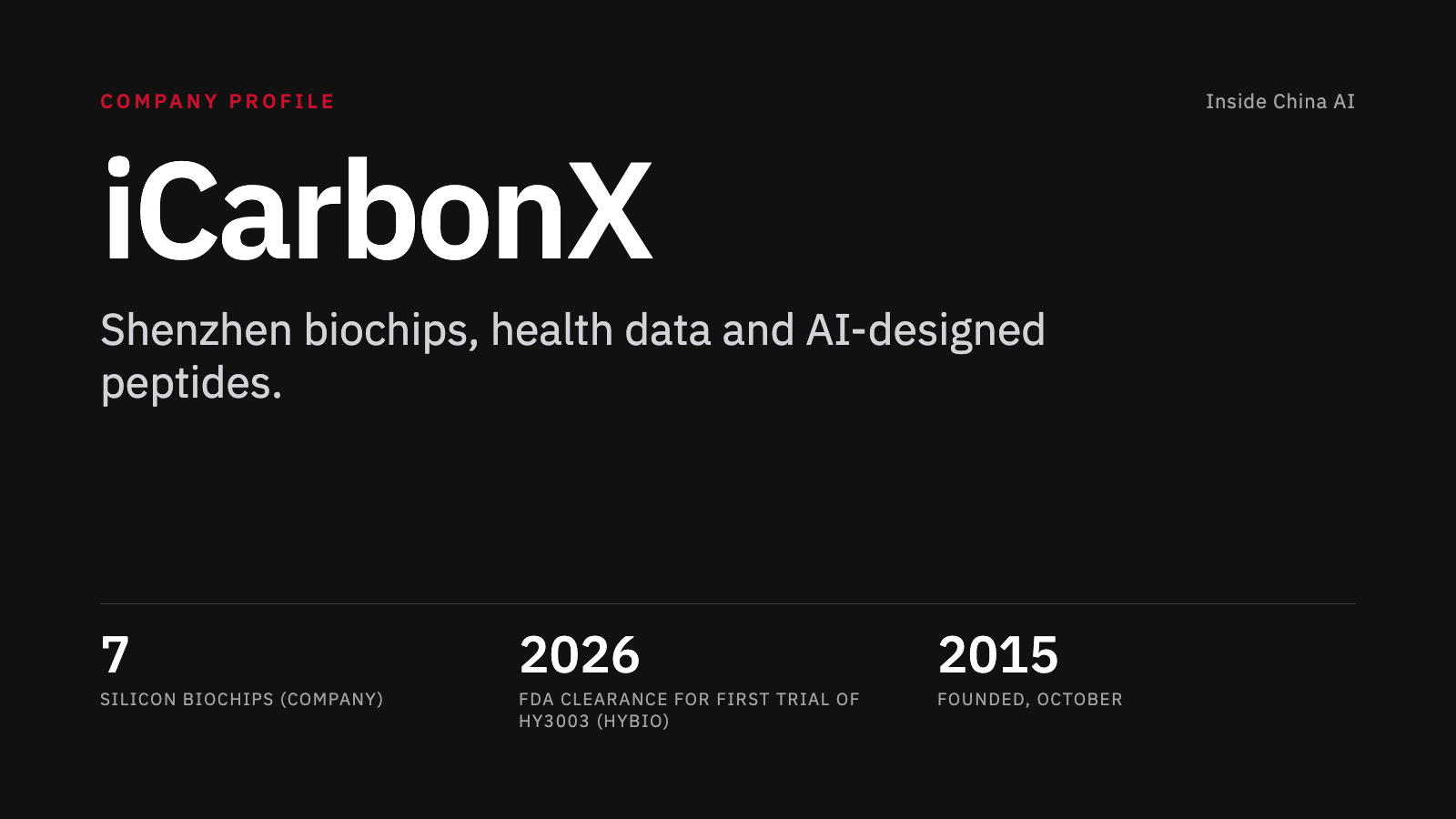
Graphic: Inside China AI
iCarbonX: Silicon Biochips, Health Data and AI-Designed Peptides from Shenzhen
Company profile · 28 November 2026.
iCarbonX (碳云智能) was founded in Shenzhen in 2015 by Wang Jun, the former chief executive of the genomics group BGI, and passed a valuation of $1 billion with a Series A led by Tencent in April 2016. Ten years on, it sells silicon-based biochips and diagnostic tests in China and says its drug unit discovered a weight-loss drug candidate, developed by a Shenzhen-listed partner, that has been cleared for clinical trials in the United States and China. For Europe the company is so far a name rather than a presence: it says some of its diagnostic tests carry CE marking and has named Europe as one possible location for international labs, but we found no European entity, partner or customer.
Origins and backing
iCarbonX was set up in October 2015 and is headquartered in Shenzhen, with further sites in Shenzhen’s Nanshan and Longhua districts, in the Hengqin cooperation zone in Zhuhai and in Guangzhou’s Huangpu district, according to its website. Its founder and chief executive, Wang Jun, co-founded BGI and served as its chief executive for 16 years, according to an interview with Health Tech World in August 2025; the company also lists Wang as a professor at the University of Copenhagen. Li Yingrui is chief scientist and co-founder, Zhao Jie is chief financial officer (iCarbonX).
The company’s early funding drew attention. In April 2016 Tencent led a Series A of more than RMB 1 billion, about $154 million at the time, at a valuation above $1 billion (Global Venturing; iCarbonX). In April 2018, the company says, it closed a Series B of $300 million at a valuation of $3 billion and entered the “IPO guidance process” (iCarbonX); we found no independent report of that valuation, and the company has not listed. The investors iCarbonX now shows on its website are regional funds from Shenzhen, Zhuhai and Guangzhou, including the Zhuhai Development Investment Fund and the Guangzhou Kaitou New-quality Industry Investment Fund; when they invested and how much is not stated (iCarbonX).
What they build
iCarbonX describes itself as a “Digital Life” company that uses “artificial intelligence and silicon-based biochip technologies” for drug discovery and precision diagnostics (iCarbonX). The business rests on three parts.
Biochips. At its tenth-anniversary event in October 2025 the company launched what it calls the CarbonX Seven Chips Series, covering genes, DNA methylation, transcripts, proteins, immune responses, the microbiome and molecular interactions (iCarbonX). The probes are synthesised directly on 8-inch silicon wafers; the company says it has reached pilot-scale production of a diagnostic chip with 160,000 tests and a research chip with 3.3 million (iCarbonX, 29 August 2026). It also sells its own scanners and analysers, such as the ICX MFA 768.
Diagnostics. The chips feed in-vitro diagnostic tests for allergies, autoimmune diseases, infections and tumour markers. On 19 May 2026 the Guangdong provincial drug regulator registered its allergen-specific IgE test kit, which checks up to 30 allergens at once, as a class II diagnostic, the company says; an autoantibody test had been approved earlier (iCarbonX). For consumers it offers a biological-age assessment called iNeverage; on 15 July 2026 it signed a strategic partnership with a Chinese nutrition company built around it (iCarbonX).
AI. The company presents a “Digital Life AI Model Suite” of three systems (iCarbonX). InCightX models disease from multi-omics data; InteraCtX learns from chip-measured protein–ligand binding and combines “deep-learning algorithms with computer docking simulations”; iCeeX models individuals as digital twins from a dataset called DigitalWe and, the company says, integrates “digital-twin technology with large-language-model capabilities”. iCarbonX has published no model weights or benchmarks for these systems; they are described on its website as platforms, not released models.
The clearest test of the approach is a drug candidate. HY3003, a weekly injectable that acts on three receptors (GLP-1, GIP and glucagon) for weight management, was found “through artificial intelligence combined with peptide-chip technology” by the Shenzhen company 深圳碳云智肽药物科技有限公司 and is being developed by the Shenzhen-listed Hybio Pharmaceutical, which runs preclinical work and clinical trials (Hybio filing, 30 July 2026). According to Hybio, the two companies agreed a strategic cooperation in October 2024, signed a joint development agreement in May 2025, and Hybio made a strategic investment in the peptide company in July 2025 (Hybio filing, 11 September 2026). iCarbonX presents the peptide unit and its “silicon peptide chip × AIDD” platform as its own (iCarbonX). The US Food and Drug Administration accepted the investigational new drug application on 5 October 2026, with Hybio as sponsor (Hybio filing, 9 October 2026), and then allowed a first trial in healthy adults to proceed (Hybio filing, 5 November 2026; iCarbonX, 5 November 2026). China’s National Medical Products Administration approved clinical trials of the injection for adult weight management, Hybio reported on 20 November 2026 (Hybio filing).
Key numbers
- Founded October 2015, Shenzhen, by Wang Jun (CEO)
- Funding Series A of more than RMB 1 billion led by Tencent, April 2016, valuation above $1 billion; Series B of $300 million at a valuation of $3 billion in April 2018, according to the company’s own timeline. No current valuation published. Not listed.
- Investors named today Regional funds from Shenzhen, Zhuhai and Guangzhou (iCarbonX)
- Products Seven silicon biochips, scanners and analysers, diagnostic kits (allergy, autoimmunity), iNeverage age assessment
- Drug pipeline HY3003 with Hybio Pharmaceutical: cleared for a first trial by the US FDA (Hybio, 5 November 2026) and for clinical trials in China (Hybio, 20 November 2026)
- Revenue, headcount Not published
The European angle
- Physical presence None found. We found no European company, office, laboratory, distributor or named customer.
- Products The company says that “several” of its chip-based fluorescence diagnostic products hold CE certification as well as Chinese approval, covering allergy, autoantibody, infectious-disease and tumour-marker tests (iCarbonX, 29 August 2026). It does not name the products or the dates; we have not checked them against the EU’s medical-device database.
- Stated plans In August 2025 Wang Jun said iCarbonX was planning international labs: “Hong Kong is one option, along with Europe, the Middle East, Singapore, and Australia”, adding that the company was “still assessing where to begin” (Health Tech World). In September 2026 the company said it would open its peptide-chip and AI drug-design platform to drug makers and research institutes in China and abroad (iCarbonX).
- Lists iCarbonX is not on the EU’s consolidated financial sanctions list, the US Consolidated Screening List (which includes the Entity List) or the Pentagon’s 1260H list, according to our name check of 27 November 2026.
- What a European partner would encounter A diagnostics and drug-discovery company whose biochips and AI platforms are offered for co-development, with a first candidate cleared for clinical trials in the US and China through a Chinese partner, but with no European base yet.
What we could not verify
- Ownership today. The legal entity, the current shareholder structure and whether Tencent is still a shareholder are not published.
- The $3 billion valuation of 2018, which rests on the company’s own timeline, and any current valuation.
- Revenue and headcount.
- Which products carry CE marking, and under which EU regulation.
- Who owns the peptide company 深圳碳云智肽药物科技有限公司: iCarbonX presents it as its own, but the shareholding is not published.
- The nature of the AI systems: whether InCightX, InteraCtX and iCeeX are trained models or software platforms.
The open question for Europe: will iCarbonX bring its biochip tests and AI drug-design platform here through a lab of its own, or through European partners?

Comments are closed