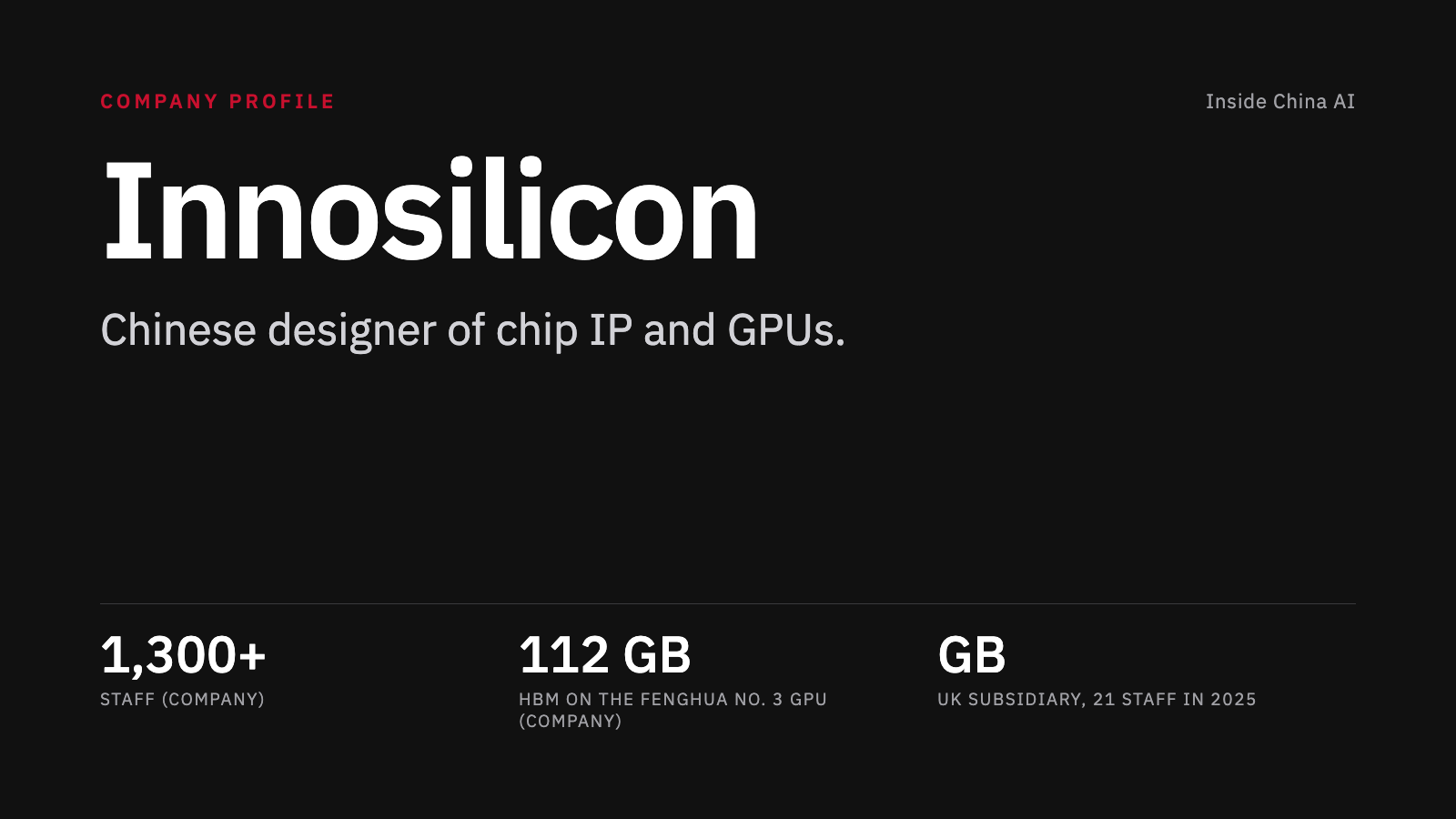
Graphic: Inside China AI
Innosilicon: The Chip-IP Supplier Building China’s Own GPUs
Company profile · 28 November 2026.
Innosilicon (芯动科技) sells the plumbing of AI chips: the memory and interconnect blocks (HBM, GDDR, LPDDR, PCIe, UCIe, UALink) that other chip designers license instead of building them themselves. It also designs custom chips for clients and, since 2021, its own Fenghua (风华) graphics processors, the latest of which is pitched at running large language models. For Europe the company matters in two ways: as a supplier of interface IP that sits inside other companies’ silicon, and as a firm that has a small but real subsidiary in the United Kingdom.
Origins and backing
Innosilicon says it has a “proven track record since 2007” in interface IP and chip design services; its website copyright line starts in 2006 (Innosilicon). The company lists three “global headquarters”, in Beijing, Wuhan and Zhuhai (Innosilicon contact page), and research centres in nine Chinese cities (Innosilicon). Its English site says it has more than 1,300 employees; in January 2026 it described “a research and development team of more than a thousand” (Innosilicon, 21 January 2026). The company’s own releases name Gordon Ao as chief executive, in November 2019 and again in July 2024 (Innosilicon, 5 November 2019; Innosilicon, 4 July 2024).
Innosilicon is not listed on a stock exchange and publishes no revenue, funding rounds or valuation. The clearest ownership statement comes from the accounts of its British subsidiary for 2025, filed at Companies House in September 2026: the ultimate parent is Innosilicon Technology (Beijing) Co., Ltd.; “Mr. Hai Ao owns 44.6%” of it, “which is less than a majority stake”, and “there is no one ultimate controlling party” (Companies House).
What they build
Interface IP and custom chips. Most of the business is licensing circuit blocks and designing chips to order. The catalogue covers HBM3E/4, GDDR7/6X/6, LPDDR6/5X and DDR5 memory interfaces, PCIe and CXL, UCIe chiplet links, high-speed SerDes and display interfaces (Innosilicon). The company says it works across the major foundries, naming TSMC, Samsung, SMIC, GlobalFoundries, UMC, Intel and Huali, at nodes from 55 nm to 3 nm, and that it has served more than 300 customers and enabled more than 10 billion chips in mass production (Innosilicon).
The AI link is memory and interconnect bandwidth, which limit how fast large models run. In January 2026 Innosilicon said it had “signed and delivered” LPDDR6 interface IP running at 14.4 Gbps per pin to an unnamed “leading industry client”, and it claims to be “the world’s only IP company that has developed and mass-produced GDDR6/6X and GDDR7” (Innosilicon, 21 January 2026). In February it announced PCIe Gen5 switch chips with 104 and 120 lanes, designated GX9104 and GX9120, for AI servers (Innosilicon, 6 February 2026). On 4 June 2026 it launched a set of IP for UALink, the open standard for linking AI accelerators inside a server cluster; the company says its 224G version “has successfully completed tape-out” and that it “plans to initiate global licensing within the year” (Innosilicon, 4 June 2026). An Innosilicon entity in Beijing is listed as a member of the UALink Consortium (UALink Consortium).
Fenghua GPUs. The first Fenghua chip was built on licensed technology from the British GPU designer Imagination Technologies. Imagination announced the licence in October 2020 and confirmed in December 2021 that its BXT-32-1024 GPU architecture was “implemented in Fantasy One”, the English name of Fenghua No. 1, adding that Innosilicon held “an architecture license from Imagination” (Imagination, 13 October 2020; Imagination, 3 December 2021). Fenghua No. 2, a low-power GPU for desktops and notebooks, followed in August 2022 (IT之家, 4 August 2022).
Fenghua No. 3 was launched in Zhuhai on 22 September 2025. The company describes it as a “full-function” GPU that combines an open-source RISC-V processor core, the Nanhu V3 from the Beijing Institute of Open Source Chip, with a CUDA-compatible graphics core. It says each card carries more than 112 GB of high-bandwidth memory, that a server with eight cards can run DeepSeek‘s 671-billion-parameter models, and that the chip works with PyTorch, Triton and CUDA code as well as DirectX 12 and Vulkan (Innosilicon, 26 September 2025). These are the company’s figures; we found no independent benchmark. At the launch, the company says, “nearly ten” partners signed agreements, some of them for cluster purchases; it did not name them. Lowyat.NET noted on 24 September 2025 that Innosilicon had not said when the first Fenghua 3 products would be released (Lowyat.NET). The GPUs are marketed under the brand 风华创智, whose site lists all three chips and a data-centre card, the GR308S MAX (风华创智).
Innosilicon does not develop its own AI models. Fenghua 3 is promoted as hardware for models from others, such as DeepSeek, Qwen and GLM.
Key numbers
- Founded Track record since 2007, according to the company; headquarters listed in Beijing, Wuhan and Zhuhai
- Ownership Private; ultimate parent Innosilicon Technology (Beijing) Co., Ltd., in which Hai Ao holds 44.6%, with no single controlling party (UK subsidiary accounts for 2025, Companies House)
- Staff More than 1,300, the company says (Innosilicon)
- Customers More than 300, and more than 10 billion chips enabled, the company says (Innosilicon)
- Revenue, funding, valuation Not published
- GPUs Fenghua No. 1 (2021, Imagination BXT architecture), No. 2 (2022), No. 3 (launched 22 September 2025, 112 GB+ HBM, RISC-V plus CUDA-compatible core, company figures)
- AI-related IP HBM3E/4, GDDR7, LPDDR6 (14.4 Gbps), UCIe, PCIe5/6, UALink 112G/224G
The European angle
- Own company in the UK Innosilicon Technology UK Limited was incorporated in England and Wales on 18 October 2021 and is active. It is registered for engineering-related scientific and technical consulting, its immediate parent is Innosilicon Microelectronics (Zhuhai), and it had an average of 21 employees in 2025, after 22 in 2024 (Companies House). Innosilicon lists London among its offices (Innosilicon) but publishes no UK address or details of the team’s work.
- A British technology partner The first Fenghua GPU rests on an architecture licence from Imagination Technologies, announced from London in 2020 and 2021 (Imagination). Here Innosilicon is the licensee, not the seller.
- Trade events The company says it presented at TSMC’s technology symposium in Amsterdam on 14 May 2024 (Innosilicon) and lists the Samsung Foundry Forum in Munich on 24 October 2024 among its past events (Innosilicon). Both were foundry-partner events.
- Customers in Europe We found none named. Because interface IP is licensed into other companies’ chips, European exposure would show up indirectly, through the products of its licensees, which Innosilicon does not disclose.
- Regulatory exposure Innosilicon was not found on the EU consolidated financial sanctions list, the US Consolidated Screening List (which includes the Entity List) or the Pentagon’s 1260H list, according to our name check of the published lists on 27 November 2026.
- What a European buyer would encounter An IP vendor that sells to chip designers worldwide, and a GPU line aimed at the Chinese market. For European chip designers looking at its memory or UALink IP, the counterparty is a Chinese group whose UK arm is a small engineering company.
What we could not verify
- Revenue, funding rounds, investors and valuation. None are published; we found no listing application.
- Customers. The “leading industry client” for LPDDR6 IP and the partners who signed at the Fenghua 3 launch are not named; we found no customer confirmed by a source outside the company.
- Fenghua 3 performance and shipments. All figures come from the company; we found no independent test or volume data.
- What the UK subsidiary does beyond its registered activity of engineering consulting.
- The legal relationship between Innosilicon and the GPU brand 风华创智.
The open question for Europe: will Innosilicon’s AI interconnect IP, starting with UALink, be licensed to European chip designers, and will its British subsidiary become the place where that business is handled?

Comments are closed