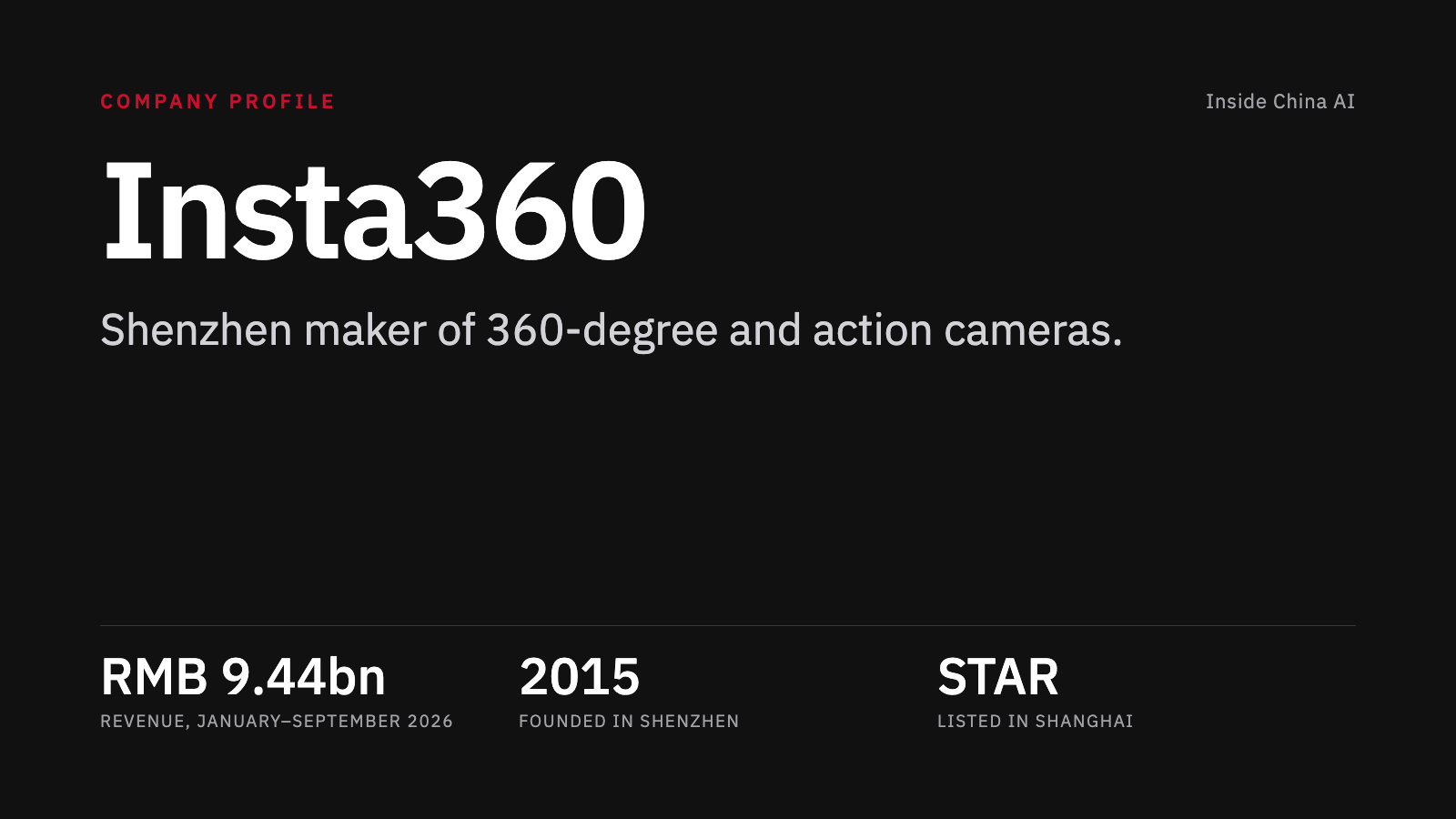
Graphic: Inside China AI
Insta360: The Shenzhen Camera Maker That Earns Most of Its Money Abroad
Company profile · 26 November 2026.
Insta360 builds 360-degree and action cameras whose selling points are increasingly software: AI editing that cuts clips automatically, subject tracking, and a voice assistant on its smallest camera. Almost two thirds of its revenue in the first half of 2026 came from outside mainland China, Europe among its main markets, and it runs its own companies in Germany and the Netherlands. In 2026, a year after its Shanghai listing, revenue has kept growing fast, but the profit attributable to shareholders has almost disappeared, squeezed by memory-chip prices, heavy research spending and a new drone business.
Origins and backing
Insta360 is the brand of Arashi Vision Inc. (影石创新科技股份有限公司), registered in Bao’an District, Shenzhen. It was founded in July 2015 by Liu Jingkang (刘靖康), according to the company’s 2025 annual report; he is chairman and legal representative, according to the company’s interim report for the first half of 2026.
The company listed on the STAR Market of the Shanghai Stock Exchange on 11 June 2025 (stock code 688775), selling 41 million A shares at RMB 47.27 each and raising RMB 1.94 billion before costs, according to the same interim report. Liu remains in control: at 30 September 2026 a Beijing holding company controlled by him held 26.88 per cent, and a partnership acting in concert with it a further 3.65 per cent. The next-largest holders were EARN ACE LIMITED with 11.96 per cent, QM101 LIMITED with 8.44 per cent and Xunlei Network Technologies with 7.84 per cent (Q3 2026 report). On 18 November 2026 the company announced that the China Securities Regulatory Commission had approved the registration of up to RMB 2 billion of sci-tech corporate bonds for professional investors (announcement).
The drone business is housed separately. Insta360’s stake in its Cayman holding, Antigravity Holding Limited, was diluted to 58.20 per cent when the unit took in outside investors, the interim report says; in the first nine months of 2026 subsidiaries received RMB 1.41 billion from minority shareholders (Q3 2026 report). The investors are not named in the reports we read.
What they build
The core products are 360-degree cameras (the X series), action cameras (Ace Pro), the thumb-sized GO cameras, the Luna gimbal cameras, Flow phone gimbals and Link webcams. The professional line consists of VR cameras and AI video-conferencing units. A panoramic drone, the A1, is sold under the separate Antigravity brand. Most products are made by contract manufacturers; Insta360 assembles the professional cameras and conferencing units on its own lines, the company says (interim report).
The AI is in the image pipeline, not in a large model of its own. The interim report lists AI stitching for 360-degree footage based on deep learning, AI low-light enhancement, AI colour grading and underwater colour correction. Its editing software picks highlights automatically – with an average accuracy of 84 per cent, the company says – and a fully automatic mode groups clips from one outing and pushes a finished video to the user. Tracking combines neural networks with person re-identification (ReID) so that subjects are not lost in busy scenes. For 360-degree footage the software looks for points of interest and generates the camera moves itself.
The company says the export rate of its cloud auto-edit feature reached 60 per cent in the second quarter of 2026, that monthly app users rose 67 per cent year on year by June and paying cloud-storage users by more than 124 per cent. In the first half of 2026 it added an AI voice assistant to the GO Ultra thumb camera, connected to Alibaba’s Qwen and Google’s Gemini models, according to the interim report. The Luna Ultra, a gimbal camera with two cameras, went on sale from June 2026 in China, North America, Europe and Asia-Pacific.
Citing IDC, the company says it shipped close to 70 per cent of the more than 500,000 panoramic cameras sold worldwide in the first quarter of 2026, and that cumulative shipments of its panoramic and action cameras passed 10 million by 30 June 2026 (interim report). At that date it employed 2,360 people in research and development, 56 per cent of its workforce.
Key numbers
- Listing Shanghai STAR Market (688775) since 11 June 2025; issue price RMB 47.27
- Revenue RMB 3.92 billion in Q3 2026 (+33.3%); RMB 9.44 billion in January–September 2026 (+42.7%) (Q3 report)
- Profit Net profit attributable to shareholders RMB 17.4 million in Q3 (−93.6%) and RMB 47.8 million in January–September (−94.0%), against RMB 791.7 million a year earlier. Before tax the group made a loss: RMB 119.4 million in Q3 and RMB 209.5 million in January–September. After a tax credit, the group as a whole, including minority interests, lost RMB 166.9 million in the nine months
- Gross margin The company says its gross margin fell; it gives no figure in the Q3 report.
- R&D RMB 1.67 billion in January–September 2026 (+54.3%), 17.8 per cent of revenue
- Inventories RMB 7.15 billion at 30 September 2026, up from RMB 2.92 billion at the end of 2025; operating cash flow −RMB 4.26 billion in the nine months
- Abroad 63.40 per cent of main-business revenue in H1 2026 came from outside mainland China, “mainly” the US, Japan and Europe (interim report)
- Staff 2,360 in R&D at 30 June 2026, 56 per cent of the total
The company gives its own reasons for the profit slump in the Q3 report: more spending on strategic research and market expansion, higher prices for memory components, tougher competition in imaging and a lower gross margin. The panoramic drone, it adds, is still in a phase of “market education” and has weighed on profit. To secure supply it bought ahead: strategic purchases of memory chips came to almost RMB 2 billion in the first half alone, according to the interim report. In the first nine months it booked RMB 123.3 million of write-downs on inventories (announcement of 28 October 2026). Minority shareholders absorbed a loss of RMB 214.8 million in the nine months, which is why the listed parent still reports a small profit while the group made a loss.
The European angle
- Own companies Yes. The interim report lists three European subsidiaries: Insta360 GmbH in Germany (wholly owned, import, export and after-sales service), Arashi Technologie B.V. in the Netherlands (wholly owned, product sales) and Antigravity GmbH in Germany, set up on 20 March 2026 for the drone business, in which Insta360’s indirect stake is 58.20 per cent (interim report). The store’s privacy policy names Insta360 GmbH in Berlin as the contact for users in the EU (privacy policy).
- Sales The company names Media Markt and the British retailer Argos among the chains it has “long-term” relationships with, alongside the Apple Store and others, and says its products are sold in more than 10,000 retail stores (interim report). It runs its own online stores in euros. For the Antigravity A1 drone, the distributor Focus Nordic announced European prices from EUR 1,459.90 and immediate availability on 4 December 2025; it says it is represented in 28 markets in Scandinavia and Central and Eastern Europe (Focus Nordic). Transcontinenta Group describes itself as Insta360’s distributor in the Benelux and Ireland (press release, 12 August 2026).
- Weight of Europe Europe is one of three regions the company names behind its 63.40 per cent share of revenue from abroad, but it does not publish a figure for Europe. Insta360 has exhibited at IFA in Berlin, according to the interim report.
- Data The store’s privacy policy (version 1.0, valid from 29 April 2025) says user data “can be transferred to, processed and stored in Hong Kong” (“Nutzerdaten können nach Hongkong übermittelt, verarbeitet und gespeichert werden”) (privacy policy).
- Lists In our name check of 15 November 2026 Insta360 did not appear on the EU consolidated financial sanctions list, the US Consolidated Screening List or the US Defense Department’s 1260H list.
- The US patent case In an investigation (No. 337-TA-1400) opened on 6 May 2024 on a complaint by GoPro, the US International Trade Commission determined on 26 February 2026 that Insta360 violated US design patent D789,435. It issued a limited exclusion order against imports by Insta360 of cameras that infringe that patent and a cease-and-desist order against its US subsidiary, found no violation for the five utility patents GoPro had asserted, and set the bond for the presidential review period at zero (Federal Register, 3 March 2026). Insta360 says only part of an earlier product generation fell under the design patent, that the ITC found its new design does not infringe and that the earlier models are no longer exported to the US (announcement of 28 February 2026). In its interim report of 28 August 2026 it adds that both sides have appealed and that a parallel suit by GoPro in the federal court for the Central District of California has not yet resumed (interim report). The case concerns imports into the US, not Europe.
- What a European buyer would actually encounter Cameras sold through ordinary electronics retailers and the company’s own euro web stores, with a German company as the EU contact – and AI features that mostly run on the camera or in Insta360’s app.
What we could not verify
- How much Insta360 sells in Europe. The company does not break out European revenue, and the Q3 report gives no share of revenue from abroad.
- How large the European companies are – staff, offices beyond the Berlin address in the privacy policy, and what the Dutch company does in practice.
- Who invested in the drone unit, Antigravity Holding Limited.
- The status of the appeals in the ITC case and of the California lawsuit beyond the company’s own account.
- Where the AI features process data – on the device, in Insta360’s cloud or with the model providers named for the voice assistant.
The open question for Europe: as Insta360’s cameras lean more on cloud editing and third-party language models, where will European users’ footage be processed?

Comments are closed