Graphic: Inside China AI
iSoftStone: A Beijing IT-Services Group Turns to AI Servers, Cloud Partnerships and Token Factories
Company profile · 28 November 2026.
iSoftStone (软通动力) is a Beijing IT-services group with nearly 90,000 employees, the company says, and revenue of RMB 35.1 billion in 2025. Its business has moved from software outsourcing towards AI: servers built on Huawei‘s Ascend chips, an enterprise platform for large models and agents, laptops under the MECHREVO brand and data centres that sell AI inference by the token. In Europe it has a wholly owned subsidiary in Poland, but no named European customer. For European companies, iSoftStone matters mainly as an implementation partner of Huawei Cloud and of Chinese firms expanding abroad.
Origins and backing
iSoftStone was established in Beijing in 2005, according to its company profile. Its own company history lists an expansion into European, American, Japanese and Korean markets and a listing on the New York Stock Exchange in the period 2008–2012, followed by a management buy-out in 2013–2017. The company returned to the stock market in March 2022, this time on the ChiNext board of the Shenzhen Stock Exchange (code 301236), raising net proceeds of RMB 4.34 billion (H1 2026 report). It then bought Tongfang Computer, now its wholly owned subsidiary 软通计算机, and with it the gaming-laptop brand MECHREVO (机械革命), which is run by its subsidiary 智通国际 (H1 2026 report).
The company is controlled by its founder Liu Tianwen (刘天文) (management team), who is chairman and general manager. He held 21.17 per cent of the shares directly on 30 September 2026 (Q3 2026 report); together with the investment partnership 雄安软石智动, which acts in concert with him, he holds 24.96 per cent, the company says. When a new board was elected on 14 September 2026, he was confirmed in both roles (SZSE announcement). According to a company announcement of 28 October 2026, 137.5 million of his 219.1 million directly held shares were pledged (SZSE announcement). The next largest shareholder is CEL Bravo Limited with 5.08 per cent. A private placement approved by the China Securities Regulatory Commission on 24 December 2025 raised net proceeds of RMB 3.31 billion from 15 investors; the new shares were listed on 26 February 2026 (H1 2026 report).
What they build
iSoftStone describes its strategy as integrating software and hardware for full-stack AI, with the “AI factory” (AI 工厂) as its core positioning. It reports three businesses: software and digital technology services; computing products and smart electronics; and digital energy and AI computing services (H1 2026 report). In the first half of 2026 computing products and smart electronics brought in RMB 9.48 billion, up 40.32 per cent and more than half of group revenue.
Its AI offer has four layers, the company says:
- Infrastructure. The Token factory (词元工厂) plan builds data centres that sell AI inference by the token. The first project, the “Beijing No. 1 Token Factory”, was switched on in the first half of 2026. A public computing platform for the Greater Bay Area with a Token factory, built by iSoftStone at the national computing hub in Shaoguan, went live in the same period (H1 2026 report).
- Computing. AI servers under the 软通华方 brand support Huawei’s Ascend 950PR and other Chinese accelerators. iSoftStone also maintains its own operating systems based on open-source projects: 天鹤 OS, a server distribution of openEuler, and 天鸿 AIOS on OpenHarmony for devices.
- Enterprise AI. The Tianxuan (天璇, in English “Merak”) MaaS platform runs large models for companies (product page). On top of it sit Tianxuan AutoAgent for building agents and a data-governance tool. A separate agent cloud platform, 睿动, resells tokens from several model providers. In the first half of 2026 the company reported the first commercial validation of this resale business. We found no evidence that iSoftStone trains its own general-purpose foundation model; Tianxuan is a platform for operating models.
- Devices and robots. MECHREVO laptops are sold as AI PCs; citing GfK among others, iSoftStone says the brand held 18 per cent of China’s gaming-laptop market in the first half of 2026. Under the 天擎 (Tianqing) name it builds robots, including the bipedal Tianhe C1, which was unveiled in Wuxi on 16 January 2025 and runs on the company’s “Nebula” embodied-intelligence platform (iSoftStone).
Much of this sits close to Huawei. The half-year report describes iSoftStone as one of the first strategic partners of Huawei Cloud and a partner for Huawei’s Pangu large models. It also works with Alibaba Cloud, Tencent Cloud and Baidu AI Cloud (H1 2026 report). The 2025 annual report names SAP, for which iSoftStone is a strategic implementation partner, and the Chinese software group Kingdee (2025 annual report summary).
On 27 October 2026 the company disclosed a USD 190.35 million contract for 智通国际 to deliver 309,000 MECHREVO laptops to an undisclosed buyer, which it called a flagship project in Central America (SZSE announcement).
Key numbers
- Listing Shenzhen Stock Exchange, ChiNext (301236), since March 2022; earlier listed in New York
- Control Founder Liu Tianwen, chairman and general manager, 21.17% of shares on 30 September 2026 (Q3 report)
- Revenue 2025 RMB 35.09 billion (+12.05%), net profit attributable to shareholders RMB 206 million; “AI-related” revenue RMB 18.47 billion, 52.6%, by the company’s own definition (annual report summary)
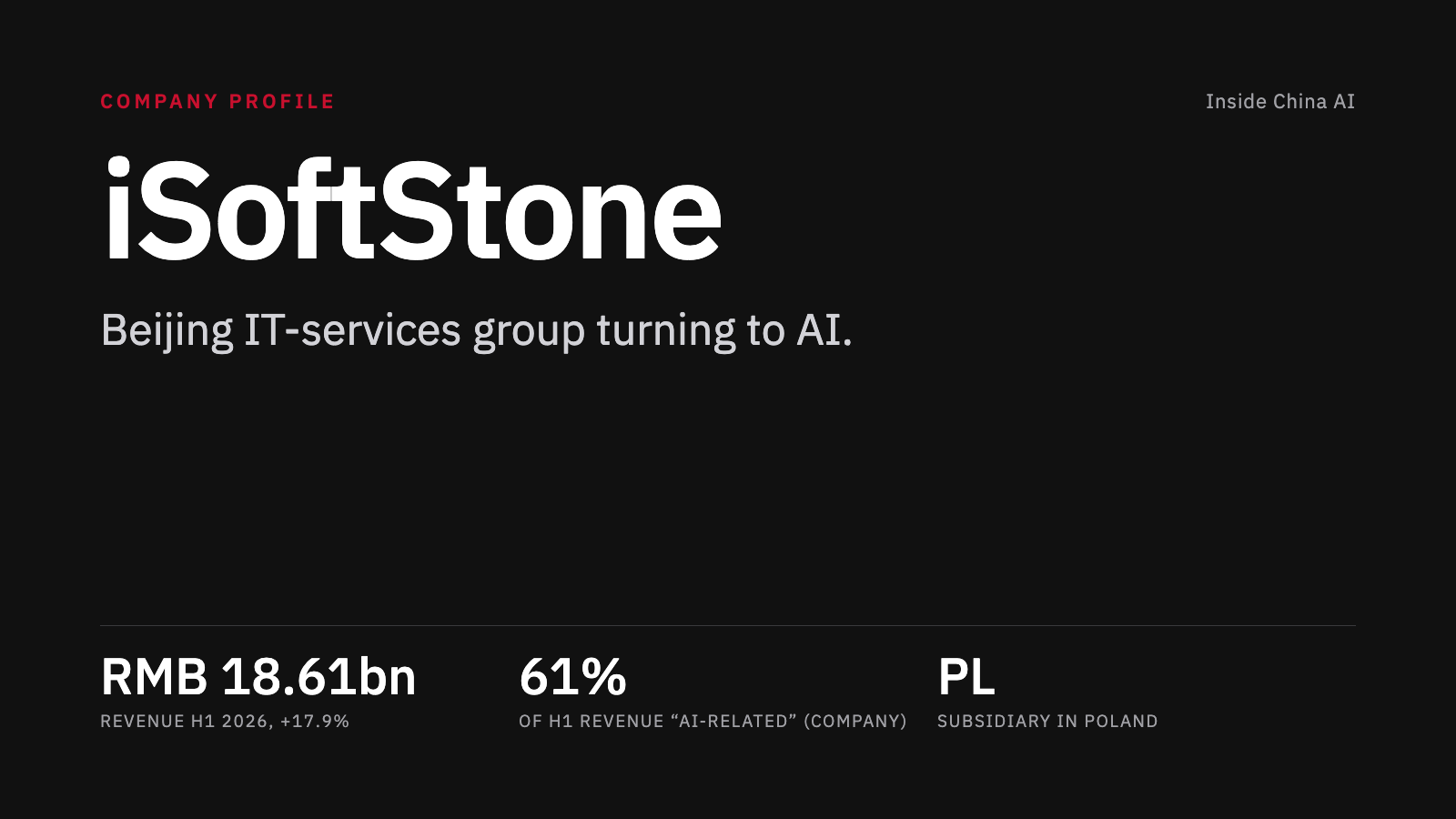
- First half 2026 Revenue RMB 18.61 billion (+17.91%); “AI-related” revenue RMB 11.44 billion, 61.46% (H1 report)
- Third quarter 2026 Revenue RMB 10.76 billion (+12.06%), net profit attributable RMB 149.7 million (−37.99%). January–September: revenue RMB 29.37 billion (+15.70%), net loss attributable RMB 114.9 million, operating cash outflow RMB 3.92 billion (Q3 report)
- Staff Nearly 90,000, the company says (company profile, undated)
- AI products Tianxuan/Merak MaaS platform, Tianxuan AutoAgent, 睿动 agent cloud platform, Ascend-based AI servers, Token factories, MECHREVO AI PCs, Tianqing robots
The company explains the loss for the first nine months of 2026 with write-downs on inventory, larger stocks bought because of swings in component prices and rising AI demand, and higher interest on new bank loans (Q3 2026 report).
The European angle
- Physical presence Yes, small. The half-year report lists ISOFTSTONE TECHNOLOGY POLAND sp. z o.o. as a wholly owned IT-services subsidiary set up by the company, with registered capital of PLN 6,000 (H1 2026 report). The group’s US subsidiary, iSoftStone, Inc., names an office in Warsaw on its locations page. iSoftStone also has a wholly owned subsidiary in Turkey, where, according to the company, its cloud-services business has been fully launched.
- What the company says about Europe In its 2025 annual report, iSoftStone says it advanced projects for Chinese companies going abroad in several regions, Europe among them. The 2026 half-year report says the company has established itself in new regions including Latin America and Europe for the cloud business it runs with a large ICT partner. Neither report names a European country or customer. Its four core international regions are Asia-Pacific, the Middle East, Japan and North America (H1 2026 report), and its English website lists international delivery centres there, none in Europe (company profile).
- Customers and partners in Europe We found no named European customer and no European partnership in company or exchange documents.
- Lists We found no entry for iSoftStone on the EU consolidated financial sanctions list, the US Consolidated Screening List (including the Entity List) or the US Defense Department’s 1260H list (name check, 27 November 2026).
- What a European buyer would actually encounter Today, mostly an implementation partner: for Huawei Cloud projects, for SAP and Kingdee systems, or for Chinese companies setting up in Europe. iSoftStone’s AI servers, Token factories and Tianxuan platform are built for the Chinese market.
What we could not verify
- The size of the Polish subsidiary: staff, revenue and whether it serves European clients or mainly Chinese companies abroad.
- Any named customer in Europe, and which European countries the cloud business covers.
- Overseas revenue: the regional breakdown in the half-year report shows only regions within China.
- Whether Tianxuan includes models of its own or only runs those of other providers.
The open question for Europe: will iSoftStone’s Polish base remain a small foothold, or become a delivery point for the Huawei-centred AI stack it sells at home?

Comments are closed