Graphic: Inside China AI
Keya Medical: Chinese AI for Coronary CT Scans, CE-Marked Since 2018
Company profile · 28 November 2026.
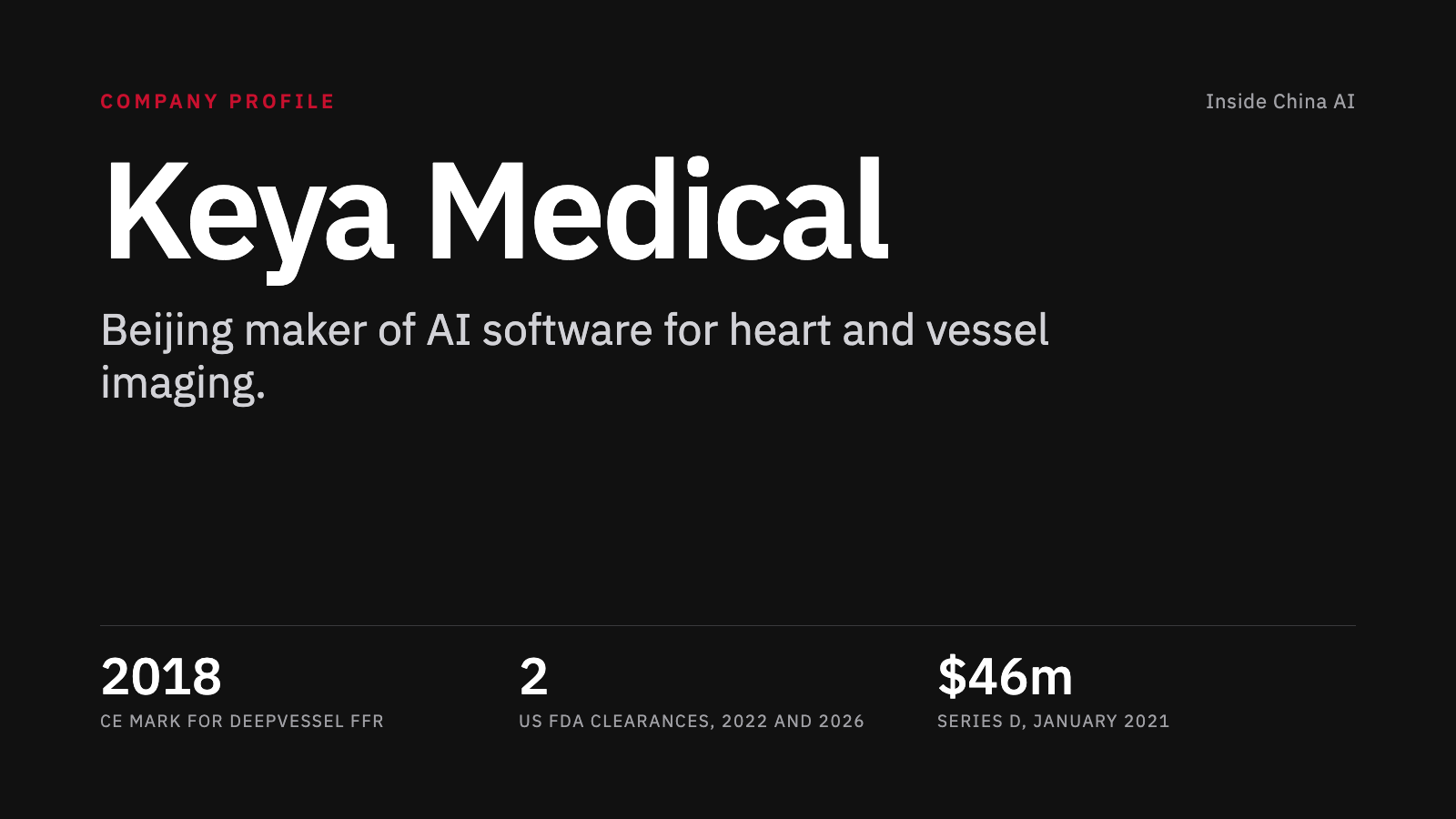
Keya Medical (科亚医疗) makes deep-learning software that reads coronary CT scans and estimates whether a narrowed artery actually restricts blood flow — a measurement that otherwise needs a pressure wire in the catheter lab. Its main product, DEEPVESSEL FFR, has carried a CE mark since 2018 and was tested at hospitals in Austria, France, Italy and Poland. As of November 2026, the European footprint we can verify consists of that certificate, an agreement with Bayer, announced in February 2024, to add the software to Bayer’s radiology-AI platform Calantic, trade-fair stands in Vienna and Munich, and research use at a Spanish hospital. We found no named European customer and no European subsidiary.
Origins and backing
Keya traces itself to CuraCloud, a medical-AI company that the English website says was founded in Seattle in 2016 and “rebranded as Keya Medical” in 2020 (Keya Medical). The Chinese parent, the joint-stock company 科亚医疗科技股份有限公司, says it was founded in January 2016 (keyamedical.cn). Its Chinese website gives one office address, in the Yizhuang economic development zone in Beijing, and lists a Shenzhen company, 深圳科亚医疗科技有限公司 (keyamedical.cn). The US Food and Drug Administration lists the applicant for Keya’s 2026 clearance, Keya Medical Technology Co., Ltd., in Beijing (FDA); the 2022 clearance went to a US entity, Keyamed Na, Inc., in Seattle (FDA). The English website, aimed at US clinicians, describes the company as “Headquartered in Seattle, Washington, and Shenzhen, China” (Keya Medical). In its North American business the company is led by Mary-Pierre Waiss, President, North America (Keya Medical). We could not establish from a primary source who leads the Chinese group.
Keya is privately held. Its own press releases list four rounds between February 2020 and January 2021: a strategic investment announced on 19 February 2020 from investors including Kunlun Internet Smart Fund, Growth FOF and Alwin Capital (Keya Medical); a Series B+ of “over $20 million” in August 2020 led by GGV Capital, Kunlun Worldwide, Guofang Investment and Yahui Precise Medical Care Fund (Keya Medical); a $30 million Series C on 12 November 2020 led by IDG Capital (Keya Medical, also reported by VCBeat); and a $46 million Series D on 14 January 2021 with investors including CICC Capital and the Shanghai Artificial Intelligence Investment Fund. With that round, the company said, its funding in 2020 came to “over $110 million” (Keya Medical). We found no later round, no valuation and no stock-exchange filing. The Chinese website has an investor-relations section with headings for a prospectus, results and announcements, all of them empty as of 27 November 2026 (keyamedical.cn).
What they build
Keya’s business is software for coronary CT angiography (CCTA). DEEPVESSEL FFR “processes coronary CTA images semi-automatically, generates a three-dimensional model of the coronary artery tree, and estimates CT FFR values”, the company says (Keya Medical). Fractional flow reserve (FFR) shows whether a narrowing limits blood flow enough to justify a stent; deriving it from an existing CT scan is meant to spare patients an invasive test. A second product, DEEPVESSEL Plaque, quantifies plaque and stenosis on the same scan, and a viewer called DVCloud brings the results together (Keya Medical). In China the company also lists assistance systems for lung and head-and-neck imaging and, in development, tools for planning coronary interventions (keyamedical.cn).
The regulatory record is the strongest part of the story. In China, DEEPVESSEL FFR received what the company describes as the country’s first Class III certificate for an AI medical device on 14 January 2020 (keyamedical.cn). The FDA cleared it in the United States on 1 April 2022 (510(k) K213657, FDA) and cleared DEEPVESSEL Plaque on 4 June 2026 (K260497, FDA). CuraCloud also obtained FDA clearance, on 13 April 2020, for CuraRad-ICH, software that flags brain haemorrhages on head CT (510(k) K192167, FDA). Keya says DEEPVESSEL FFR is now approved or admitted in six markets, including Singapore, Hong Kong and Taiwan (keyamedical.cn).
The main validation study, ADAPT, was sponsored by Keya and ran from August 2020 to December 2021 at ten sites, five in the United States and five in Europe (ClinicalTrials.gov). Against invasive FFR it reported a per-vessel sensitivity of 86.9 per cent and specificity of 86.7 per cent, the company says (Keya Medical).
Key numbers
- Ownership Private; last disclosed round a $46 million Series D (14 January 2021); funding in 2020 “over $110 million”, the company says
- Approvals CE mark 2018 (DEEPVESSEL FFR); China NMPA Class III, January 2020; FDA April 2022 (FFR) and June 2026 (Plaque)
- Research staff “100+”, the company says (undated)
- Overseas annual overseas revenue grew more than threefold in 2024, the company says, without a base figure
- Revenue and profit not published; the company gives no dated figure for the number of hospitals using its software
The research-team figure comes from Keya’s Chinese home page (keyamedical.cn) and the overseas statement from its timeline (keyamedical.cn).
The European angle
- Market access DEEPVESSEL FFR received its CE mark in 2018 after audits by the notified body DEKRA, under the European Medical Device Directives, the company announced on 21 September 2018 (Keya Medical).
- Partner On 21 February 2024 Bayer announced “new agreements with radiology AI technology providers”, Keya among them, to expand its medical imaging platform Calantic; Keya and a second provider “will build the new Cardiac Service Line on the platform” (Bayer). On 30 April 2024 Keya said it would “showcase its AI-based augmented CT-FFR analysis through Bayer’s Calantic Digital Solutions platform at ECR2024” (Keya Medical). Bayer’s Calantic product pages blocked automated access, so we could not confirm whether the software is still offered there as of 27 November 2026.
- Clinical research The ADAPT study included Medical University Innsbruck (Austria), the Institut Arnault Tzanck in Nice (France), the universities of Ferrara and Milan (Italy) and the National Institute of Cardiology in Warsaw (Poland) (ClinicalTrials.gov). In 2026 cardiologists at Hospital Álvaro Cunqueiro in Vigo, Spain, published a simulation with DEEPVESSEL FFR in 43 patients: the share of clinical scenarios in which further tests were recommended fell from 89.9 to 28 per cent, with savings of €213.84 per case, based on a “company-reported cost” of €400 per analysis. The authors declared no funding and no conflicts of interest and called the results “hypothesis-generating” (REC: Interventional Cardiology).
- Trade fairs Keya exhibited at ECR 2024 in Vienna, 28 February to 3 March 2024 (Keya Medical), and at the ESC Congress in Munich, 28–31 August 2026 (keyamedical.cn).
- Stated reach The English site says Keya “operates across Asia, Europe, and North America” (Keya Medical) and that it is “actively looking for clinical partners in the United States and EMEA” (Keya Medical). It names no European customer or distributor.
- Entities We found no European subsidiary or office. The company’s publicly named locations are in Beijing, Shenzhen and Seattle; a 2024 company text also lists a centre in Shanghai (Keya Medical).
- Lists A name check on 27 November 2026 found no match for Keya Medical, 科亚医疗 or CuraCloud on the EU consolidated financial sanctions list, the US Consolidated Screening List (including the Entity List) or the US Defense Department’s 1260H list.
- What a European hospital would actually encounter A certified, peer-reviewed CT-FFR tool from a Chinese company whose English website is aimed at US clinicians, whose documented route to European hospitals runs through a 2024 agreement with Bayer and trade fairs rather than a local organisation.
What we could not verify
- Who leads the Chinese group and who its current shareholders are.
- Funding after January 2021, any valuation, and whether a stock-market listing is being prepared.
- Whether the 2018 CE certificate, issued under the former Directives, has been renewed under the EU Medical Device Regulation, and whether DEEPVESSEL Plaque is CE-marked.
- Whether any European hospital pays for DEEPVESSEL FFR; the company names no European customer.
- Whether Bayer’s Calantic platform still offers the software as of November 2026.
- Revenue, profit and headcount.
The open question for Europe: will Keya turn eight years of CE marking into named European customers — and through whom?

Comments are closed