Graphic: Inside China AI
Kingsoft Cloud: AI Drives Growth at a Kingsoft-Controlled Cloud Provider With Close Ties to Xiaomi
Company profile · 28 November 2026.
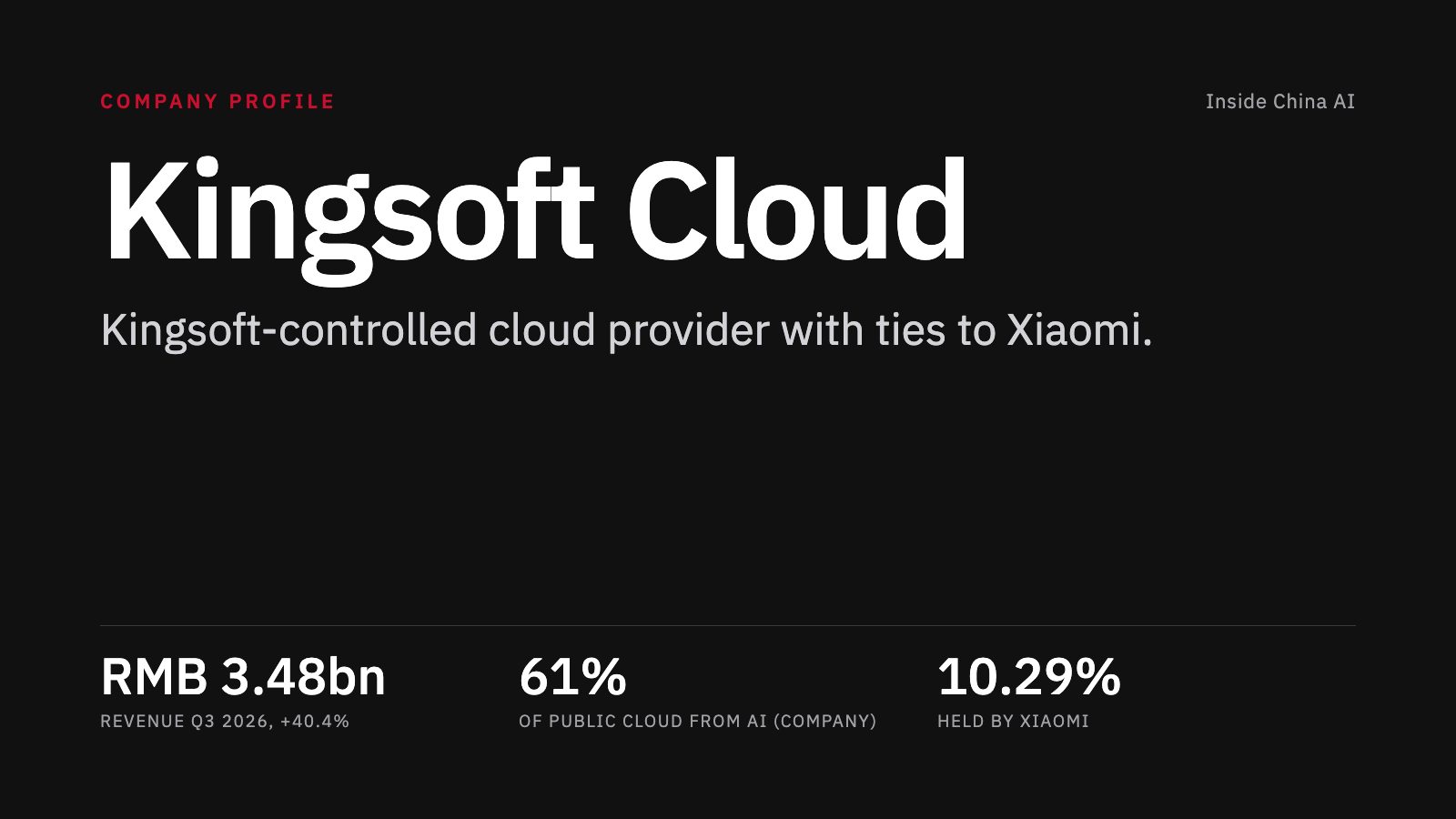
Kingsoft Cloud is a cloud provider controlled by Kingsoft Corporation and listed in New York and Hong Kong. AI now drives its growth: in the third quarter of 2026 revenue rose 40.4 per cent, and AI cloud gross billings equalled 61 per cent of public cloud revenue, the company says. Xiaomi is both a substantial shareholder and a fast-growing customer for model training and inference. For Europe, Kingsoft Cloud matters less as a supplier than as an indicator: its filings and region lists show no European entity, data centre or customer, and its only cloud region outside mainland China is Singapore.
Origins and backing
Kingsoft Cloud was founded in 2012 within the Kingsoft software group. It listed on Nasdaq in May 2020 (KC) and added a dual primary listing in Hong Kong by introduction in December 2022 (3896), according to its company website. The holding company is registered in the Cayman Islands and runs its business through subsidiaries and contractually controlled entities in mainland China, Hong Kong, Japan and the United States (2025 annual report). Its Beijing office is in the Xiaomi Science and Technology Park; the company describes Beijing and Wuhan as its “dual headquarters” (Kingsoft Cloud).
Kingsoft Corporation, listed in Hong Kong, holds 32.94 per cent and is the controlling shareholder. Xiaomi holds 10.29 per cent, directly and through a subsidiary (2026 interim report). Kingsoft Corporation also controls the office software maker Kingsoft Office, which we have profiled separately, as we have Xiaomi.
The leadership changed in March 2026. Lei Jun, Xiaomi’s controlling shareholder, had been a director since 2012 and chairman since 2015. He resigned on 25 March 2026 “due to his other business commitments”. Zou Tao, at the Kingsoft group since 1998 and acting chief executive since August 2022, became chairman. On the same day Qu Heng, a Xiaomi vice president, joined the board (HKEX announcement). Another non-executive director, Zhang Duo, heads Xiaomi’s artificial intelligence platform department. Zou Tao also chairs Kingsoft Office. The chief financial officer is Yi Li.
The company raised new equity in 2025. In April 2025 it sold shares in New York and Hong Kong. Kingsoft Corporation subscribed for 69,375,000 new shares at HK$5.83 each, issued in June 2025, and a placing of 338,000,000 shares at HK$8.29 followed in October 2025 (2025 annual report).
What they build
Kingsoft Cloud sells public cloud services (computing, storage, content delivery) and enterprise cloud projects, mainly for internet companies, public bodies, healthcare and financial services. It owned two data centres and around 102,900 servers “primarily throughout China” on 30 June 2026 and leases the rest of its data-centre capacity (2026 interim report).
Its AI offer is infrastructure and tooling rather than a model of its own. The StarFlow platform (星流) is, in the company’s words, “a turnkey AI training and inference platform built for the foundation AI models and embodied intelligence” (2025 annual report). Its model service offers “70+” models through one interface. On 27 November 2026 the Chinese website showed the DeepSeek-V4, GLM-5.3, MiMo-V2.6, MiniMax-3 and Qwen-3.8 families and announced the addition of Kimi K3 (ksyun.com). In the first half of 2026 the company added speech, image and video models and launched an Agent Engine and an agent platform, Star Origin AgentKit. Its private-cloud product Galaxy Stack now includes the AI tools, and the company says it is “optimizing domestic chips” for it (2026 interim report). It also sells an AI coding platform, Kingsoft Cloud Code (金山云码). We found no foundation model of its own; its “QZHOU” product is an enterprise question-answering assistant (Kingsoft Cloud).
Xiaomi is the most important single relationship. Kingsoft Cloud billed Xiaomi RMB 2,255.2 million for cloud services in 2025, 77.0 per cent more than in 2024. In April 2026 the board raised the annual caps for these services to RMB 4,000 million for 2026 and RMB 6,000 million for 2027, citing demand from Xiaomi’s “large model training and inference workloads, robotics, and smart electric vehicles”. Under a supplemental agreement Kingsoft Cloud will also procure Xiaomi’s MiMo model API services, which its customers can then call on its platform (HKEX announcement, 24 April 2026). Shareholders approved the new caps on 30 June 2026 (poll results). The Kingsoft group paid RMB 384.6 million for cloud services in 2025 (2025 annual report).
Key numbers
- Revenue RMB 3,478.1 million in Q3 2026 (+40.4%); public cloud RMB 2,756.7 million (+57.3%), enterprise cloud RMB 721.4 million (−0.6%) (Q3 2026 results)
- AI AI cloud gross billings RMB 1,683 million in Q3 2026 (+115%), 61% of public cloud revenue against 45% a year earlier, the company says
- Profit Operating profit RMB 47.9 million in Q3 2026; net loss RMB 118.1 million (Q3 2025: RMB 7.8 million), which the company attributes to higher interest costs and one-off subsidies in the prior-year quarter
- Investment Cash capital expenditure of RMB 6.2 billion in Q3 2026, “nearly 100% covered” by operating cash flow, according to the CFO; cash RMB 6,202.9 million on 30 September 2026
- Full year 2025 Revenue RMB 9,558.6 million (+22.8%), of which AI business RMB 2,961.7 million; net loss RMB 943.7 million (2024: RMB 1,979.0 million) (2025 annual report)
- Related parties Cloud services to Xiaomi RMB 2,255.2 million in 2025; to the Kingsoft group RMB 384.6 million
- Staff 14,394 employees on 30 June 2026, most of them in China
- Owners Kingsoft Corporation 32.94%; Xiaomi 10.29% (30 June 2026)
The European angle
- Presence None found. The annual report names operating entities in mainland China, Hong Kong, Japan and the United States. The English website lists offices in Singapore and the United States (Kingsoft Cloud), and the Chinese one adds Malaysia. Neither the 2025 annual report, the 2026 interim report nor the Q3 2026 results mention Europe.
- Where the data sits The current list of regions for Kingsoft Cloud’s virtual servers, updated on 9 January 2026, shows mainland Chinese regions and Singapore as the only region abroad (Kingsoft Cloud documentation).
- Lists Kingsoft Cloud, Kingsoft Corporation and Xiaomi are not on the EU’s consolidated financial sanctions list, the US Consolidated Screening List, which includes the Entity List, or the Pentagon’s 1260H list of Chinese military companies (checked 27 November 2026). We found no proceedings by a European regulator.
- What a European company would actually encounter Today, mostly nothing directly: Kingsoft Cloud sells in China and from Singapore. Where it matters is in the background, as infrastructure for Chinese companies such as Xiaomi; the filings do not say which of those workloads serve users outside China.
What we could not verify
- Whether Kingsoft Cloud runs any infrastructure in Europe through partners.
- How much of 2026 revenue comes from Xiaomi and Kingsoft; the Q3 release gives no figure.
- Which chips power the AI cloud, and in what proportion Chinese and foreign accelerators are used.
- Whether any European customer uses Kingsoft Cloud directly; we found none.
The open question for Europe: as Xiaomi and other Chinese customers take their AI services abroad, will Kingsoft Cloud follow them with infrastructure of its own, or stay a provider for China and Singapore?

Comments are closed