Graphic: Inside China AI
Laiye: A Beijing Automation Company Moves From RPA to AI Agents
Company profile · 28 November 2026.
Laiye (来也科技) sells software that lets companies hand routine office work to machines: first robotic process automation, now what it calls “agentic” automation and a desktop AI agent, Laiye Worker. In China it claims the top share of a new market for agent-driven process automation. In 2022 it bought the Paris chatbot company Mindsay and announced a US$50m push into Europe; today its website lists no European office, its UK company is in liquidation, and the European customers in its case studies date from the pandemic years or earlier. For European companies that run, or are asked to buy, its tools, the practical questions are which Laiye company they contract with and where their data goes.
Origins and backing
Laiye was formally established on 1 July 2015 and raised an angel round of RMB 25.46m, according to its Chinese company page. Its first product was a consumer assistant on WeChat. The same page lists Wang Guanchun (汪冠春), who holds a PhD from Princeton, as founder, chairman and chief executive, and Hu Yichuan (胡一川), who holds a PhD from the University of Pennsylvania, as chief technology officer; both previously founded a video recommendation service that Baidu acquired, the company says. Wang signed Laiye’s 14 April 2022 release as “Chairman and CEO”, and ITPro described Hu as “co-founder and CTO” on 3 November 2022.
In 2019 Laiye merged with Awesome Technology (奥森科技), the developer of the robotic process automation (RPA) platform UiBot, which took the company from chatbots into automation (Laiye). Its Chinese operating company is 来也科技(北京)有限公司, named in the footer of laiye.com. In 2021 it set up an Asia-Pacific headquarters in Singapore, the company says, and its international website is operated by LAIYE PTE. LTD., whose terms of use are governed by Singapore law.
Laiye is privately held. Its Chinese timeline lists a Series C of US$42m in 2020, a C+ of US$50m in 2021 and a C++ of US$70m in 2022. According to TechCrunch (18 April 2022), the Series C came in three tranches totalling US$160m, with the last one, of US$70m, led by Hopu Magnolia; Lightspeed China and Lightspeed Venture Partners were existing investors. The C+ round was led by Ping An Global Voyager Fund and a Shanghai AI industry fund, according to Laiye’s English company page, which also names Cathay Innovation, Sequoia Capital and ZhenFund among its backers. We found no funding round after 2022 and no stock-exchange filing. Revenue, headcount and valuation are not published.
What they build
Laiye describes itself as a platform to “build, deploy, and govern AI agents” across an enterprise (Laiye). Its products sit in layers:
- Laiye APA (Agentic Process Automation) is the successor to its RPA software. “In 2025, Laiye launched APA community version, completing its strategic repositioning from RPA to APA,” the company wrote on 30 July 2026; an Enterprise Edition followed on 14 August 2026 (Laiye).
- Laiye ADP (Agentic Document Processing) reads and checks invoices, contracts and other documents (Laiye).
- Laiye ACX (Agentic Customer Experience) is the customer-service and chatbot line (Laiye).
- Laiye Worker is a desktop agent for Windows and macOS that “plans the steps, operates enterprise systems, handles documents and data, and delivers the final result” (Laiye). On 26 October 2026 Laiye added an AI Accounts Payable Assistant for small and medium-sized companies, with connectors to Google, Xero, QuickBooks and AutoCount.
Laiye does not present a foundation model of its own. Laiye Worker is “model-agnostic” and routes tasks “to optimal LLMs based on latency, cost, and compliance needs”; before sending a request to a language model, it “swaps sensitive values with contextual placeholders”, the company says (Laiye). Its AI is therefore the orchestration, document processing and execution layer around models supplied by others.
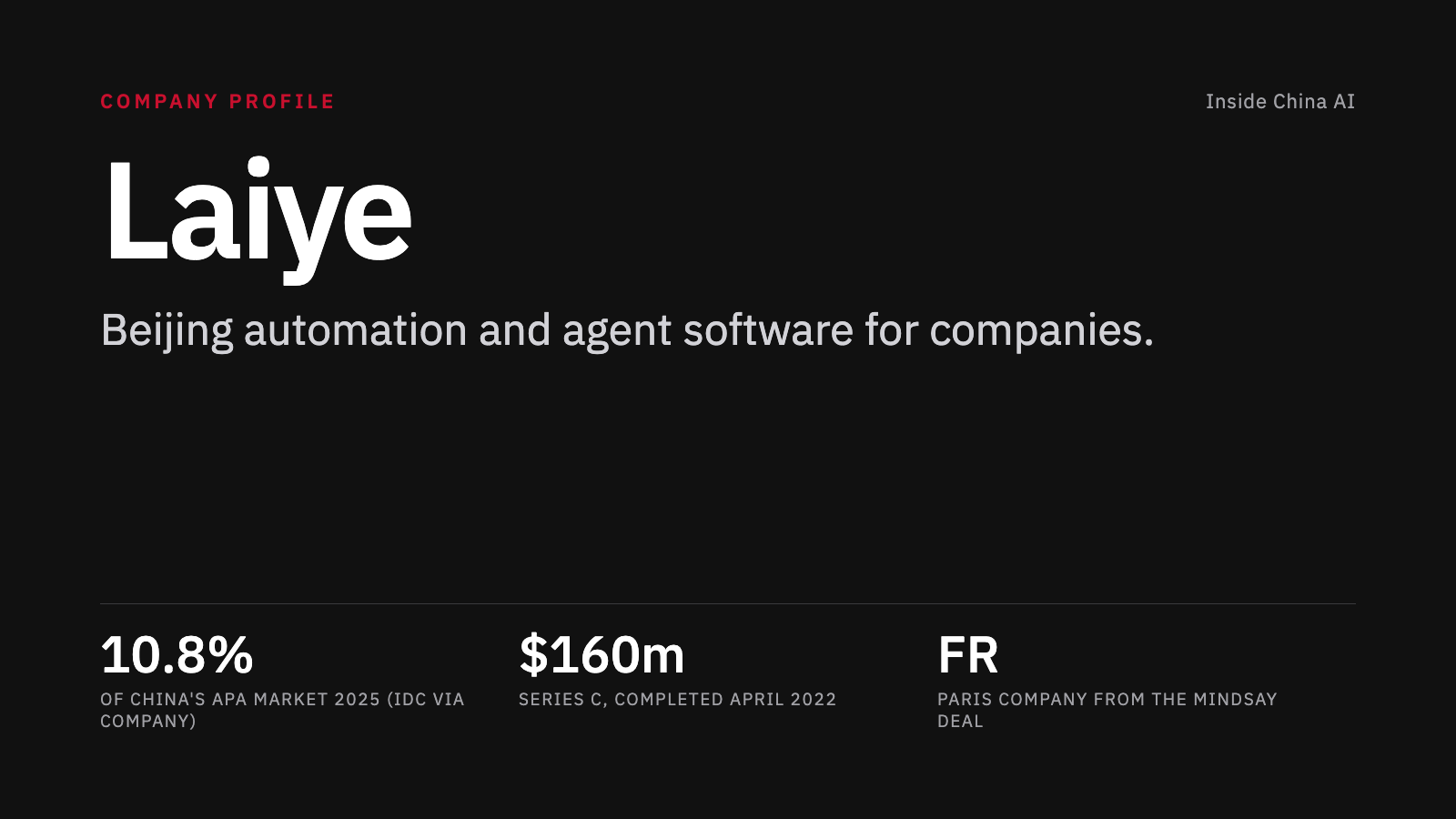
Laiye cites outside rankings for its position. According to its summary of an IDC report, China’s market for APA products and solutions reached about RMB 2.15bn in 2025, and Laiye held 10.8 per cent of the APA product market, the largest share. It says it was named a “Visionary” in Gartner’s 2026 Magic Quadrant for Intelligent Document Processing and has been included in Gartner’s RPA Magic Quadrant for six consecutive years (Laiye newsroom). We have not seen the underlying IDC and Gartner reports.
Key numbers
- Founded 1 July 2015, Beijing; Asia-Pacific headquarters in Singapore since 2021
- Ownership Private; investors named by the company include Lightspeed, Hopu, Ping An Global Voyager Fund, Cathay Innovation, Sequoia Capital, ZhenFund
- Funding Series C of US$160m in three tranches, completed April 2022 (TechCrunch); no later round found
- Market position 10.8% of China’s APA product market in 2025, rank 1, per IDC as cited by the company
- Scale More than 1 million registered developers, more than 300 Fortune 500 and China Top 500 companies as customers, more than 450 patents filed or pending, the company says (Laiye)
- Revenue, headcount, valuation Not disclosed
The European angle
- The 2022 push On 23 February 2022 Laiye announced a “$50 million commitment” to Europe, the Middle East and Africa, said it had launched UK operations and had recruited managers “to lead sales and consulting teams in the UK, Spain and Portugal and the German-speaking DACH region” (Laiye). On 14 April 2022 it announced the acquisition of Mindsay, “a leading European enterprise chatbot and voicebot platform”, and said it planned “a new R&D hub in Paris” (Laiye). Mindsay, based in Paris, had about 30 staff (TechCrunch); the price was not disclosed. In May 2022 the Paris R&D team had 16 people, and Laiye expected 80 to 100 staff in Paris including sales by the end of that year, according to JDN (3 May 2022).
- Presence today As of 27 November 2026, Laiye’s office list names Beijing, Shanghai, Shenzhen, Changsha, Hong Kong and Singapore, and no European location. The Mindsay acquisition still appears in its company timeline. France’s official company directory lists a Paris company named Laiye, also shown under the name Mindsay, as active, with Wang Guanchun as its president; it had no employees at the end of 2024 (annuaire-entreprises.data.gouv.fr, accessed 27 November 2026). In the UK, Laiye UK Limited, incorporated in October 2021 with Wang Guanchun as a director, has been in voluntary liquidation since July 2025, according to Companies House. We found no public statement on what became of the Paris team.
- Customers, the company says Laiye’s undated case studies name the French-Swiss rail operator TGV Lyria (a customer-service bot connected to Zendesk, “especially helpful during the COVID-19 crisis”), the French travel club Voyage Privé (a bot in seven languages, implemented “during the pandemic”) and the French-Belgian rail operator Thalys, which chose its chatbot provider in 2017, before Laiye acquired Mindsay in 2022. Thalys trains have run under the Eurostar name since 1 October 2023 (SNCB Europe). None of these studies shows a current customer relationship. A further study describes RPA robots in 14 scenarios at Bühler Leybold Optics, which it calls a German manufacturer, from early 2021, without saying where they run.
- Partners Laiye’s partner directory lists integrators in the UK (AIOps, AuraQ, RedK, which is also listed for Spain) and France (IAC, Keyrus). In February 2022 Laiye described IAC as its partner for intelligent automation in Europe (Laiye).
- Data Laiye’s website privacy policy, last updated January 2026, says personal data “will be retained within Singapore” (Laiye). For the User Center behind Laiye ADP, APA and Worker, the company says: “Your personal information will be stored in servers in Singapore. We also have global support, engineering, and other teams who support the Services, including from the People’s Republic of China, who may access your personal information” (Laiye). Its supplemental notice names Alibaba Cloud (Singapore) and Microsoft Singapore as hosting providers with servers in Singapore (Laiye).
- Lists We found no entry for Laiye or Mindsay on the EU’s consolidated financial sanctions list, the US Consolidated Screening List (which includes the Entity List) or the US Defense Department’s 1260H list (name check, 27 November 2026).
- What a European buyer would actually encounter Automation and agent software sold internationally from Singapore, through local integrators, with personal data held in Singapore and, according to the company, support teams that include staff in China who may access it.
What we could not verify
- Whether the French company Laiye has an office or staff today, and whether the Paris R&D hub planned in 2022 ever reached the announced size.
- Whether any European customer relationship is current. None of the case studies is dated; the European ones describe the years up to the pandemic.
- Revenue, headcount, valuation and current shareholdings, and whether Laiye has raised money since 2022.
- Which language models Laiye Worker uses by default, and where they are hosted for European customers.
The open question for Europe: is Laiye still building in Europe, or now selling to it from Singapore?

Comments are closed