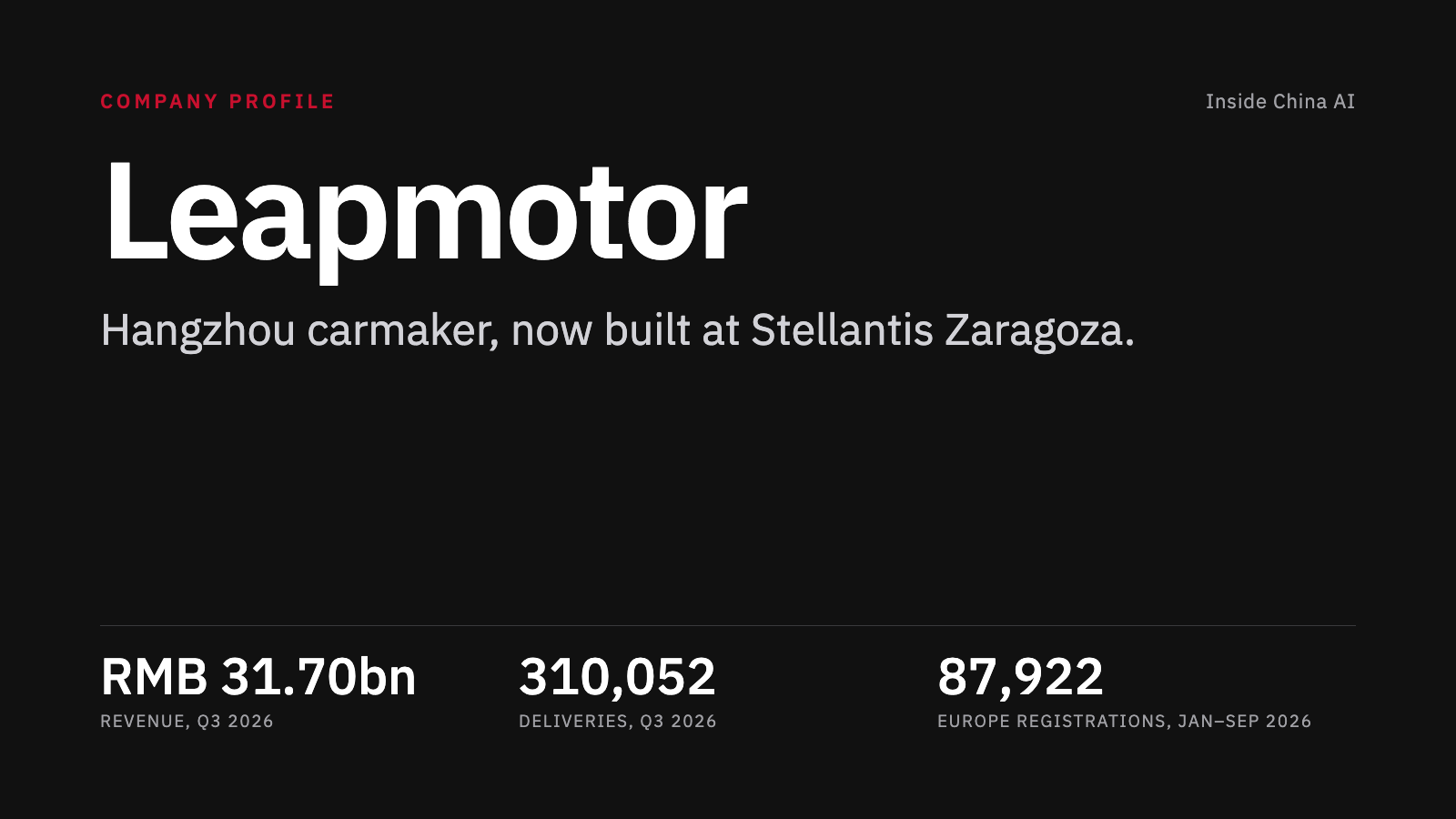
Graphic: Inside China AI
Leapmotor: The Chinese Carmaker Europe Has Started to Build — in Stellantis’ Factory
Part of The Model Layer — profiles of the Chinese AI companies Europe is about to meet. Company profile · 21 November 2026.
Of all the Chinese carmakers in this series, Leapmotor is the one most woven into Europe’s own industry. Stellantis owns about a fifth of the company and controls its international arm; Leapmotor cars are sold through more than 1,000 European outlets; and since October 2026 its B10 SUV has been built at Stellantis’ plant near Zaragoza in Spain. Europe accounted for nearly a quarter of Leapmotor’s revenue in the first half of 2026. What it imports from China is less the car than the technology inside it: the company says it develops its core systems itself — including the AI cockpit, which in China runs on DeepSeek and Alibaba’s Qwen models.
Origins and backing
Leapmotor — 零跑汽车, Zhejiang Leapmotor Technology, based in Hangzhou and listed in Hong Kong — was founded in 2015 by Zhu Jiangming, an electrical engineer, and released its first car in 2017 (2025 sustainability report, Leapmotor). It has grown into one of China’s fastest-growing electric-car makers: 106,127 deliveries in October 2026, the fourth month in a row above 100,000, and 772,666 in the first ten months against a target of one million (CnEVPost). In the first half of 2026 revenue rose to RMB 38.1 billion with a small profit, while the gross margin fell to 11.7 per cent (interim results). In the third quarter of 2026 deliveries reached 310,052 and revenue rose 63.0 per cent year on year to RMB 31.70 billion, but profit attributable to shareholders fell to RMB 40 million and the gross margin to 10.9 per cent, which the company attributes to rising raw-material costs and its product mix (third-quarter results).
Stellantis became a shareholder in 2023 and in May 2024 the two set up Leapmotor International, owned 51 per cent by Stellantis and 49 per cent by Leapmotor, to sell the cars outside China (ACEA; Q3 results). Since 1 September 2026 the joint venture has been led by Danilo Annese, who succeeded its founding chief executive Tianshu Xin (Megamodo, citing the company’s announcement). China’s FAW agreed in December 2025 to take about 5 per cent of Leapmotor, and a second investor, Jinyi High-tech, joined the same share placement in January 2026. According to Leapmotor’s filing, this would dilute Stellantis from 19.99 to about 18.3 per cent (HKEX filing). China’s securities regulator approved the placement on 10 September 2026; by the end of October 2026 the new shares had not yet been issued (HKEX, monthly return).
What they build
Leapmotor’s selling point is integration. The company says self-developed, high-value components make up 65 per cent of a vehicle’s cost and that it pursues “full in-house development of core technologies”. The main computing chips, however, come from Qualcomm, and Chinese chipmaker Axera says its driver-assistance chip is fitted to Leapmotor’s new global compact hatchback sold in Europe (Axera); an in-house chip Leapmotor presented in 2020 no longer appears in its filings. In China, its cockpit voice assistant uses DeepSeek and Alibaba’s Tongyi Qianwen models, according to its 2025 sustainability report. At its technology day on 17 September 2026 it showed a new vehicle architecture, LEAP 5.0, and a “world model” approach to assisted driving (CnEVPost). Its European cars currently offer standard driver assistance — adaptive cruise control, lane centring, traffic-jam assist — but no navigation-based assisted driving (Leapmotor Europe).
Key numbers
- Founded 2015 by Zhu Jiangming; based in Hangzhou; listed in Hong Kong (9863)
- Deliveries 106,127 in October 2026; 772,666 January–October (target: 1 million)
- H1 2026 Revenue RMB 38.1 billion, small net profit, gross margin 11.7%; exports 96,294 units
- Q3 2026 Revenue RMB 31.70 billion (+63.0%), profit attributable to shareholders RMB 40 million, gross margin 10.9%; deliveries 310,052, exports 63,278 (unaudited)
- Owners Stellantis 19.99% (January 2026); FAW about 5% (agreed December 2025, not yet completed in October 2026)
- Europe 87,922 registrations in the EU, EFTA and UK, January–September 2026 (ACEA); over 1,000 outlets (September 2026, Leapmotor)
- European production B10 at Stellantis Zaragoza, mass production since 16 October 2026; volume not disclosed
The European angle
- Physical presence Extensive. Leapmotor International B.V. is based in Hoofddorp near Amsterdam and controlled by Stellantis. Series production of the B10 began at Stellantis’ Zaragoza plant, together with an ancillary battery plant, on 16 October 2026 (Leapmotor), on one shift and without a fixed volume target; the partners have not published output figures, and first customer deliveries of Spanish-built cars are expected in December 2026 or January 2027, according to Leapmotor International’s chief executive (Automotive Manufacturing Solutions). The B05 is to follow in the first half of 2027, and Stellantis is considering building an Opel SUV on Leapmotor technology there from 2028. On 20 November 2026 Leapmotor agreed to provide engineering and development services for this new Opel C-SUV for EUR 100 million, with start of production expected in September 2028; the filing does not name the plant (HKEX filing). An earlier assembly line in Tychy, Poland, stopped on 30 March 2025.
- Sales European registrations of Leapmotor cars reached 87,922 in the first nine months of 2026, more than five times the year before, for a market share of 0.8 per cent (ACEA). In Germany, its own leasing examples run from the T03 city car to the C10 SUV.
- Tariffs Cars imported from China pay the EU’s countervailing duty — 20.7 per cent for co-operating companies including Leapmotor, according to a Reuters factbox of February 2026 — on top of the standard 10 per cent; cars built in Zaragoza do not.
- Data The European website’s privacy policy names Leapmotor International B.V. as controller and says data may be processed “within the European Union, United States of America, China”, with safeguards such as standard contractual clauses where EU law requires them (privacy policy). Leapmotor says it received a Europrivacy certification in October 2026 that also covered transfers to China (Leapmotor). The policy covers the website, not the connected car.
- AI in European cars Not yet the AI of the Chinese models. In March 2025 Leapmotor said it would bring smart-driving technology to Europe in 2026, trained on European road data (The Standard, citing Reuters); by November 2026 we found no EU approval for Leapmotor’s navigation-based assisted driving. Which AI models power the voice assistant in European cars, the company does not say.
- What a European buyer would actually encounter A Chinese-engineered car sold, serviced and increasingly built by Stellantis — with Chinese technology inside and a European company as counterparty.
What we could not verify
- How many cars Zaragoza has built so far; neither Stellantis nor Leapmotor has published a figure.
- The transfer of Stellantis’ Madrid plant to the joint venture, announced in May 2026 as an intention but not final.
- Where data from the cars, not the website, is processed.
The open question: when Leapmotor’s AI cockpit and assisted driving come to European cars, whose models will run in them — and where will the data go?

Comments are closed