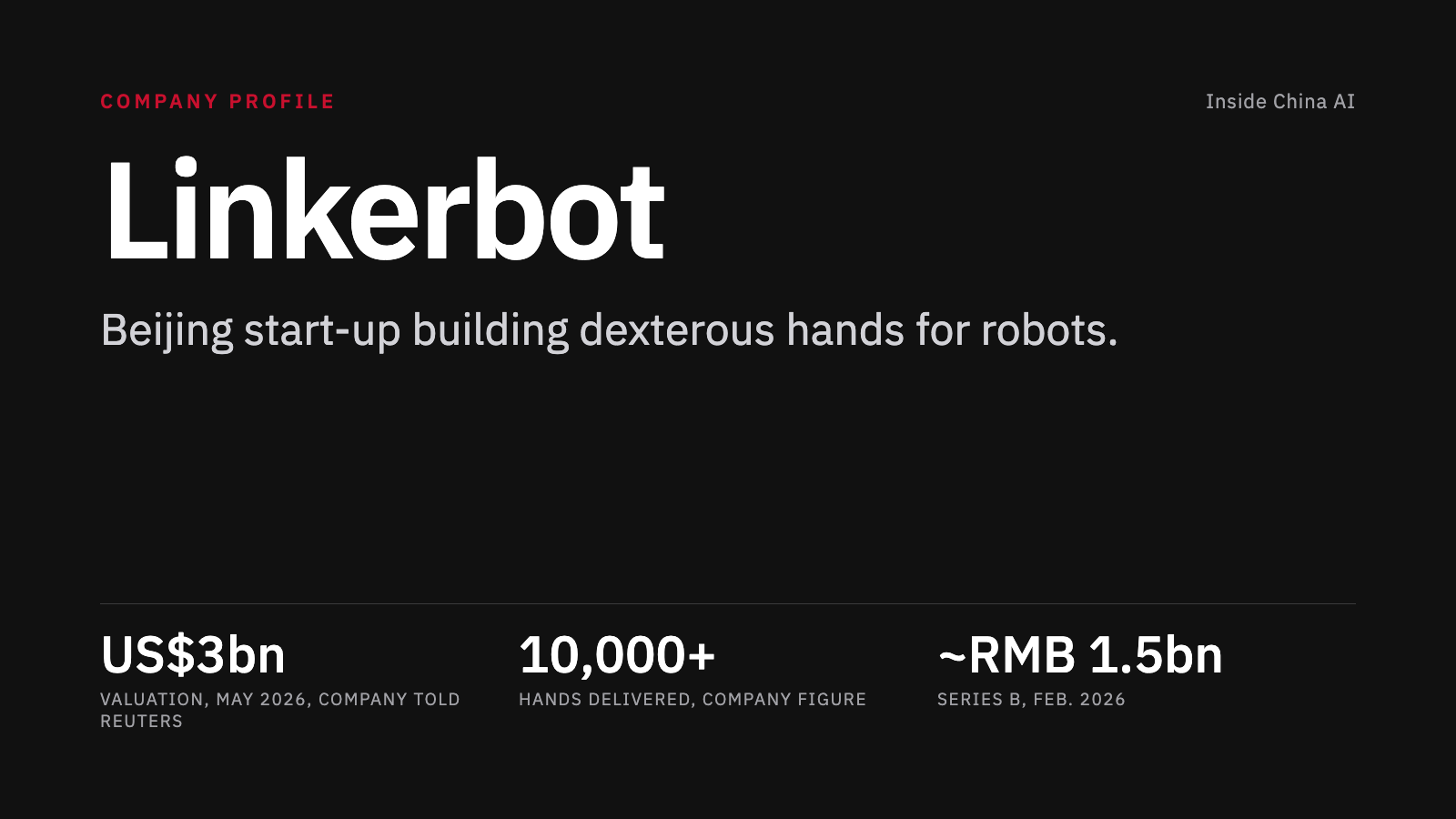
Graphic: Inside China AI
Linkerbot: A Beijing Start-up Building Dexterous Hands for Robots
Company profile · 28 November 2026.
Linkerbot (灵心巧手) is known less for whole robots than for the part most of them still lack: a hand that can grip, pinch and handle tools like a human one. On its website the Beijing company says it holds more than 80 per cent of the global market for high-degree-of-freedom robotic hands and has delivered more than 10,000 units; a funding round in April 2026 valued it at $3 billion, the company told Reuters. For Europe it matters as a component supplier: humanoid and robot-arm makers, labs and factories that want dexterous grippers are likely to meet its hands, inside Chinese robots or bought on their own. So far, however, its European footprint is thin — an exhibitor listing at a robotics conference in Vienna in June 2026, and no company, office or named customer here that we could find.
Origins and backing
The company’s legal name is 灵心巧手(北京)科技股份有限公司, a joint-stock company with its headquarters in Beijing’s Haidian district (company website). It says it also has branches or offices in Shanghai, Hangzhou, Shenzhen and the United States. Its founder is Zhou Yong (周永), who goes by Alex Zhou; he entered the gifted-youth class of Huazhong University of Science and Technology in 2000 and had founded two companies before, one in games and one in autonomous vehicles (TMTPost interview, 16 March 2026). His title differs between reports: TMTPost and Daily Economic News (30 April 2026) called him founder and chief technology officer; Reuters called him chief executive in May 2026. The company’s own pages name neither him nor a founding year, and reports differ on the date: Cailian Press wrote in February 2026 that Linkerbot was founded in 2023, and Daily Economic News that it had been registered less than three years earlier; TMTPost gives 2019 and says the company spent five years on research before raising money in 2025.
The money has come quickly. On 12 February 2026 Cailian Press reported a Series B of nearly RMB 1.5 billion led by Daode Investment and Shengshi Investment (Cailian Press). On 29 April it announced a Series B+ of undisclosed size; new investors included the Zhongguancun Science City Fund, BOC Asset Investment and Fosun Chuangfu, and existing shareholders followed on (China Securities Journal, 30 April 2026). The company told Reuters that the round valued it at $3 billion; earlier backers include Ant Group and HongShan, and Linkerbot said it would seek a $6 billion valuation in its next round, without saying when or whether through a private round or a listing (Reuters via The Standard, 4 May 2026). Linkerbot does not publish revenue.
What they build
The core product is the Linker Hand series. The company says it covers all three main ways of moving robot fingers — tendons, linkages and direct drive — and its website lists hands from the O6 and L6, with six active degrees of freedom, up to the O30 and the tendon-driven L30 Pro. The O6, which the company calls its entry model for wider adoption, has six active and five passive degrees of freedom, weighs 360 grams and carries up to 50 kilograms, the company says; the L20 has 16 active and five passive joints driven by nearly 20 motors developed in-house (company website). Around the hands it sells robot arms (Linker Arm), a humanoid platform, motion-capture gloves and a teleoperation system, Linker Open TeleDex, with which people’s hand movements are recorded and replayed on the robot.
That last part is where the AI comes in. Dexterous hands are hard to program by hand; most current approaches teach them from recorded human demonstrations. Linkerbot sells the equipment to collect such data, says it offers open datasets, and describes a skill library, LinkerSkillStore, and Linker Genesis (灵心造物大模型), which it calls “its embodied AI foundation model” (company website). We found no model card, paper, weights or benchmark for Linker Genesis, so it is not clear what kind of model it is or whether customers can use it. What is public is the developer software: a GitHub organisation that calls itself Linkerbot Ltd. and points to linkerbot.cn (not verified by GitHub) publishes SDKs for ROS 2, Python and C++, robot description files and simulation packages for MuJoCo and Isaac, mostly under Apache-2.0 or MIT licences (GitHub). In its FAQ the company says it has reproduced Stanford University’s ALOHA and HumanPlus imitation-learning projects on its hands.
Linkerbot names labs at Stanford, Cambridge, Tsinghua and Peking University, and the companies Midea and Foxconn, as users of its products, the company says. Reuters reported that it supplies leading Chinese humanoid makers and foreign industrial companies, which it did not name, citing confidentiality agreements.
Key numbers
- Legal form 灵心巧手(北京)科技股份有限公司, joint-stock company, Beijing (Haidian)
- Funding Series B of nearly RMB 1.5 billion (12 February 2026); Series B+ of undisclosed size (29 April 2026)
- Valuation $3 billion after the B+ round, the company told Reuters (4 May 2026); target of $6 billion for the next round
- Market share more than 80% of high-degree-of-freedom robotic hands worldwide, the company says on its website and told Reuters (4 May 2026); no independent figure
- Volumes more than 10,000 hands delivered, the company says on its website. Monthly output as reported: more than 4,000 in a single month (China Securities Journal, 30 April 2026); almost 5,000 a month, to rise “soon” to 10,000, the company told Reuters (4 May 2026)
- Staff more than 500 in research and development, more than 50 patents, the company says
- AI Linker Genesis “embodied AI foundation model” (no public documentation); teleoperation and data-collection hardware; open SDKs and simulation packages
- Revenue not disclosed
The European angle
- Physical presence None found. Linkerbot lists offices in China and the United States only; we found no European company, office or factory.
- Trade fairs The organisers of ICRA 2026, the IEEE’s international robotics conference, held in Vienna from 1 to 5 June 2026, listed Linkerbot as an exhibitor with booth 057 (ICRA 2026). We found no other European trade-fair listing.
- Customers and sales No named European customer or distributor. The company’s list of lab users includes “Cambridge” without saying whether it means the British university. Linker Hand models are listed by at least one online shop with pages in several European languages; we could not establish who runs it or whether it is an authorised distributor.
- Language The company’s only working website is in Chinese; the English text sits in the site code but we found no separate English website.
- Lists A name check on 28 November 2026 against the EU consolidated financial sanctions list, the US Consolidated Screening List (including the Entity List) and the US Defense Department’s 1260H list found no entry for Linkerbot or 灵心巧手. This is a name match, not a legal review.
- What a European buyer would actually encounter A component, not a brand: a Chinese robot hand inside a humanoid or on an arm, or a research hand bought for a lab, with open developer software but without a local company to deal with.
What we could not verify
- The founding year: reports give 2019 or 2023; the company does not say, and we did not consult the business register.
- Revenue and the market-share claim: no independent figure for the market for high-degree-of-freedom hands.
- Linker Genesis: architecture, size, training data and availability.
- European customers: whether any of the unnamed foreign industrial customers are in Europe, and whether the online shop listing Linker Hands in European languages is an authorised partner.
- A stock-market listing: we found no filing at a Chinese or Hong Kong exchange.
The open question for Europe: when European factories start testing humanoids, how many of the hands will come from Linkerbot — and will it then set up shop here?

Comments are closed