Graphic: Inside China AI
Loongson: The Beijing Chip Designer Building a Processor Architecture of Its Own
Company profile · 28 November 2026.
Loongson Technology (龙芯中科) designs CPUs on LoongArch, an instruction set it developed itself, and is now adding general-purpose GPUs with support for AI inference. The Shanghai-listed company sells almost entirely to China’s own state and industrial markets, it still makes losses, and it has been on the US Entity List since 2 March 2023. Europe will rarely meet a Loongson chip in a product. It matters for a different reason: Loongson shows how far China has got with computing hardware that does not depend on x86 or Arm licences.
Origins and backing
Loongson began as a research project. According to the company, the Institute of Computing Technology of the Chinese Academy of Sciences started developing Loongson processors in 2001. The operating company was registered in Beijing’s Haidian district on 5 March 2008, under the name Beijing Loongson Zhongke Technology Service Center (annual report 2022). According to the company, commercial operation started in 2010, “with funding led by Zhongke Suanyuan and the Beijing municipal government” (our translation; Loongson). On 24 June 2022 it listed on the Shanghai Stock Exchange’s STAR Market under the code 688047 (annual report 2022).
Hu Weiwu (胡伟武) has led the company since its early years. He worked at the institute from 1996 to January 2021, was vice-chairman and general manager of Loongson from August 2009 and has been chairman and general manager since November 2019 (annual report 2025). On 17 November 2026 the new board re-elected him chairman for three years and reappointed him general manager (announcement of 18 November 2026). The annual report names him as one of the company’s two actual controllers.
The shareholder register mixes a holding vehicle of the founders with the state. At 30 September 2026 the largest shareholder was Beijing Tiantong Xinyuan Technology with 21.56 per cent; the annual report calls it a “shareholding platform”. The state-owned Beijing Zhongke Suanyuan Asset Management held 19.32 per cent, and the state-owned Beijing Industrial Development Investment Management held 5.28 per cent (Q3 2026 report).
Loongson is raising new money. On 16 October 2026 its board cut a planned private placement of A shares from up to RMB2.3 billion to up to RMB1.62 billion. The money is for information-technology chips, CPU core technology and general-purpose GPU technology, all on a process the filing calls only “Xnm” (announcement of 20 October 2026). On 11 November 2026 the Shanghai exchange found that the application met the conditions for issuance. The deal still needs registration by the China Securities Regulatory Commission (announcement of 13 November 2026).
What they build
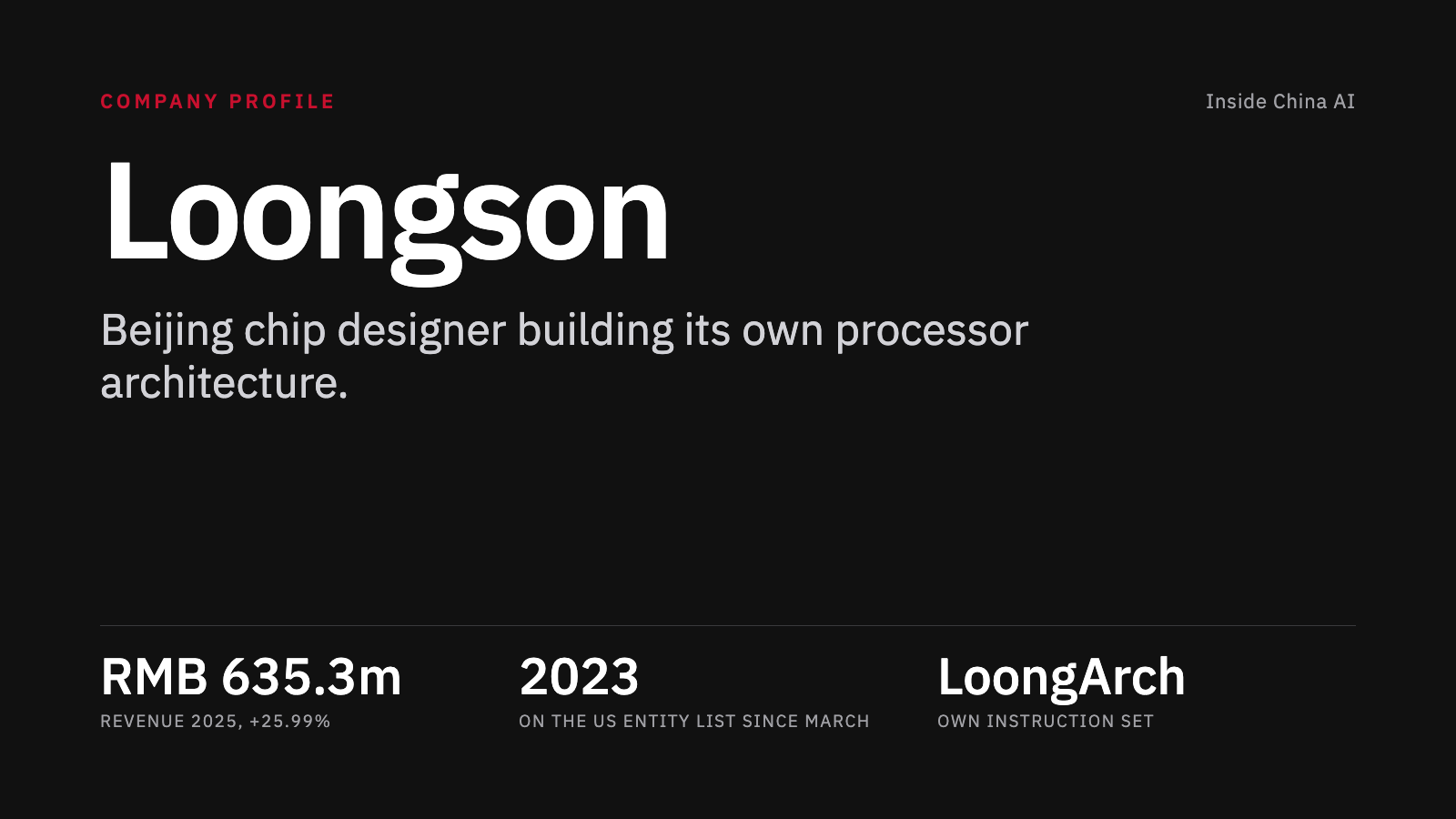
Loongson sells processors, companion chips and the basic software to run them. All of it rests on LoongArch, the instruction set Loongson designed itself. The company describes itself as one of very few Chinese CPU makers able to license both an instruction-set architecture and CPU cores to others, and it does license them; it names no licensees (interim report 2026). LoongArch is supported in the mainline Linux kernel, whose documentation describes it as “a new RISC ISA, which is a bit like MIPS or RISC-V” (kernel.org).
Its current processors include the 6000 series. The 3A6000 is a desktop processor, and the 3C6000 server chip integrates “16 LA664 cores on a single die” (Loongson). The 3B6000M, an eight-core chip for mobile devices, carries Loongson’s second-generation LG200 graphics core, which the company says supports “general calculation and AI acceleration” (Loongson). There are also embedded chips for industrial control, such as the 2K3000. Its own aim, in the company’s words: “self-developed, safe, and reliable processors to meet national strategic needs” (Loongson).
The AI connection is hardware, not models. Loongson has not released any AI models of its own. In a section on technology ethics, its 2025 annual report says the combination of its CPUs and GPUs “can provide high-compute, energy-efficient basic hardware support for AI applications”, and adds that “Loongson’s chip products do not in themselves constitute artificial intelligence” and do not directly raise ethical questions at the application level (our translation; annual report 2025). On 29 April 2025 it postponed two projects funded by its IPO, an advanced-process chip project and a GPU project, and changed their research plan to “strengthen the AI inference compute” of the projects (our translation). By mid-2026 its first general-purpose GPU, the 9A1000, was back from the fab, with function and performance that “basically meet expectations”, the company says. A later graphics core with INT4 support went to fab inside the next desktop CPU, the 3B6600. Loongson also says it has built a software stack for its GPU, optimised for “the main inference frameworks and common models” (our translation; interim report 2026).
The customers are mostly public. The company says its chips are used in e-government, energy, transport, finance, telecoms and education (Loongson). For 2025 to 2027 it has set itself a “three-year market transition”, away from the policy-driven market towards the open market (annual report 2025).
Two disputes with Shanghai CIP United, a company that says Loongson’s earlier MIPS licence contracts were transferred to it, have ended. In February 2021 CIP United and Prestige Century Investments brought an arbitration in Hong Kong over the MIPS licence. In a partial final award received on 23 June 2023 the tribunal dismissed six of their seven claims; on the remaining one it found that the claimants were entitled to royalties due from 7 February 2017 that Loongson had not paid, plus late-payment charges (announcement of 26 June 2023). In January 2024 the tribunal named Loongson the overall prevailing party and awarded it its arbitration costs (announcement of 13 January 2024). After these costs were set off against the royalties and late charges, an order made with the parties’ consent, effective 21 February 2024, required CIP United to pay Loongson a net RMB3.67 million by 31 March 2024 (announcement of 1 March 2024). Separately, in 2021 Loongson sued CIP United over statements CIP United had made about Loongson. In July 2025 the Beijing Internet Court ordered CIP United to publish an apology and to pay RMB450,000. On 28 November 2025 Loongson received the appeal judgment, which upheld that ruling and is final (announcement of 2 December 2025).
Key numbers
- Founded Research at the Chinese Academy of Sciences since 2001; company registered in Beijing on 5 March 2008; commercial operation since 2010, according to the company
- Listing Shanghai STAR Market, code 688047, since 24 June 2022; chairman and general manager Hu Weiwu
- Revenue 2025 RMB635.3 million (+25.99%); net loss attributable to shareholders RMB455.1 million, after RMB625.3 million in 2024 (annual report 2025)
- Revenue mix 2025 information-technology chips RMB308.9 million, solutions RMB168.5 million, industrial-control chips RMB157.9 million; the regional breakdown lists only regions of mainland China
- Nine months 2026 revenue RMB394.4 million (+12.46%); net loss attributable RMB412.5 million; R&D spending RMB364.0 million, 92.29% of revenue (Q3 2026 report)
- Third quarter 2026 revenue RMB122.5 million (+14.31%); net loss attributable RMB188.6 million. The company cites higher R&D and sales costs and an impairment on inventory
- Staff 977 at the end of 2025, 59.47% of them in R&D (annual report 2025)
- AI hardware LG200 graphics core in the 3B6000M; first general-purpose GPU 9A1000 back from the fab (mid-2026); no AI models of its own
The European angle
- Physical presence None found. In its 2025 annual report Loongson marks the section on overseas assets as not applicable and reports no significant overseas operating entity. All the subsidiaries it lists are in mainland China, and so are the branch offices on its website (annual report 2025; Loongson). The English website gives only a Beijing contact (Loongson).
- Customers and partners We found no European distributor, named customer, partner or trade-fair appearance. The revenue breakdown by region in the annual report contains only Chinese regions.
- Export controls The US Commerce Department added “Loongson Technology”, with the aliases Loongson Technology Corporation Limited, Loongson Zhongke Technology Co., Ltd, Loongson Zhongke and Godson Zhongke, to the Entity List with effect from 2 March 2023. Together with Inspur Group, 4Paradigm and others, it was listed “for acquiring and attempting to acquire U.S.-origin items in support of the China’s military modernization efforts”. The rule says: “This activity is contrary to U.S. national security and foreign policy interests” (Federal Register, 88 FR 13673, 6 March 2023). The entry requires a licence “for all items subject to the EAR”, which is reviewed under a “presumption of denial”, and carries footnote 4, under which this includes certain foreign-produced items. In the version of the electronic Code of Federal Regulations dated 25 November 2026 the entry is unchanged (eCFR). The Entity List is an export control, not a sanction.
- What the company says In its 2022 annual report Loongson wrote that the US Commerce Department’s website had announced on 2 March 2023, US local time, that the company had been added to the Entity List, and that suppliers of products and technology controlled under the US Export Administration Regulations “must obtain an export licence from the US Commerce Department in advance”. The report adds that US export controls aimed at Chinese high-tech semiconductor companies “could have an adverse effect on the company’s production and operations” (our translation; annual report 2022). Its 2025 annual report no longer names the list. It says that, as Western export controls tighten, an ecosystem that is core to the industry’s competitiveness must not be controlled by others.
- Other lists Loongson does not appear on the Pentagon’s Section 1260H list of Chinese military companies in the version published on 10 June 2026 (Federal Register). In our name check of 28 November 2026 it did not appear on the EU’s consolidated financial sanctions list, and on the US Consolidated Screening List only in the Entity List entry above. We found no EU proceedings.
- What a European buyer would actually encounter Most likely no Loongson hardware at all, but LoongArch support in open-source software such as the Linux kernel. Any company that wanted to supply Loongson with US-origin technology would need a US export licence.
What we could not verify
- Who licenses LoongArch or Loongson CPU cores. The company reports licensing income but names no licensees.
- Whether the 2026 share placement will be registered by the China Securities Regulatory Commission, and on which manufacturing process the “Xnm” chips will be made.
- Any European customer or partner. We found none, but that does not prove there are none.
The open question for Europe: will LoongArch stay a Chinese domestic platform, or will Loongson look for licensees and customers abroad as it moves towards the open market?

Comments are closed